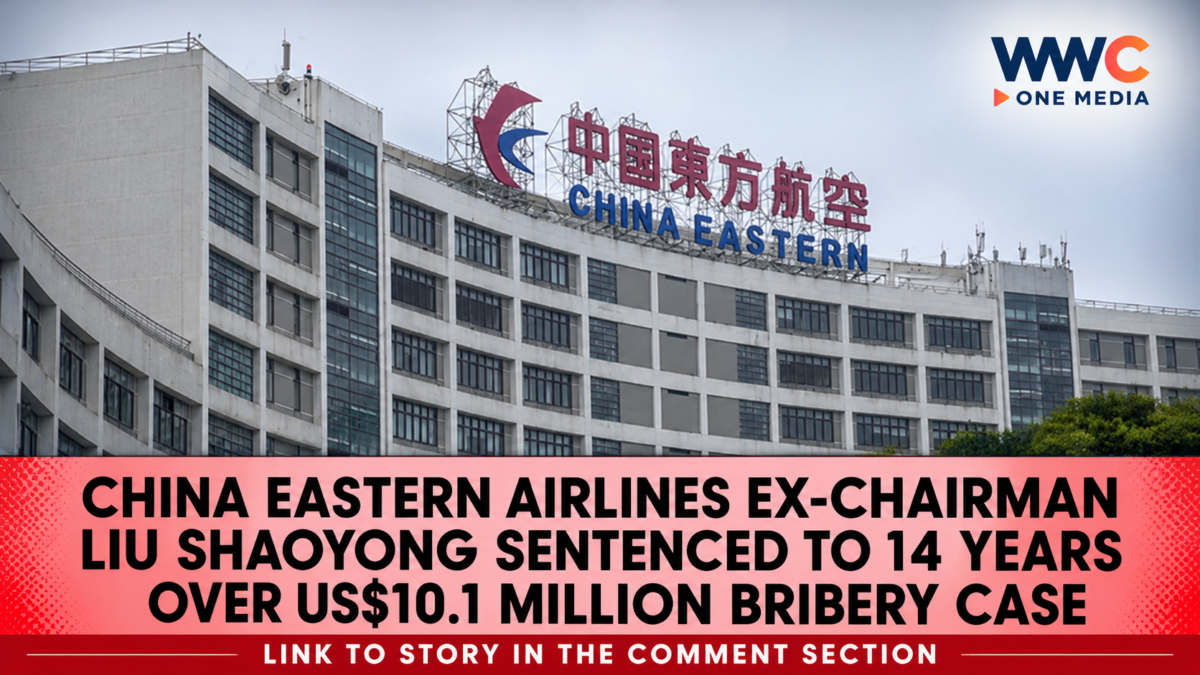
A former chairman of China Eastern Airlines has been sentenced to 14 years in prison after a Chinese court found that he accepted more than 67.5 million yuan (approximately US$10.12 million) in bribes over a 21-year period.
Liu Shaoyong, who previously held top management positions at both China Eastern Airlines and China Southern Airlines, was convicted of using his positions and influence to help businesses and individuals secure commercial opportunities, project contracts and airline route-related benefits.
The Shenyang Intermediate People’s Court in Liaoning province announced the first-instance judgment on November 3, 2026. Alongside the prison sentence, Liu was fined 4 million yuan. His illegal gains and related proceeds were also ordered confiscated and transferred to China’s national treasury.
The case is significant not only because of the amount involved, but also because Liu once occupied some of the most influential leadership positions in China’s aviation industry.
His conviction comes amid Beijing’s continuing anti-corruption campaign, which has increasingly focused on senior executives and officials connected to powerful state-owned enterprises.
Court Finds Liu Accepted More Than 67.5 Million Yuan in Bribes
The court established that Liu accepted illegal payments and valuables worth more than 67.5 million yuan between 2002 and 2023.
During that period, he held several senior positions, including general manager of China Eastern Airlines, general manager of China Southern Airlines Group, chairman of China Southern Airlines, and later senior leadership positions at China Eastern Airlines Group.
According to the judgment, Liu used the authority and influence associated with these positions to provide assistance to companies and individuals seeking advantages in business-related matters.
The court identified three principal areas in which he provided assistance:
- Business operations: Using his position and influence to help companies and individuals with commercial matters.
- Project contracting: Providing assistance in securing project-related business opportunities.
- Airline route management: Using his influence in matters involving airline routes and related management decisions.
In return, he illegally received money and valuables with a combined value exceeding 67.5 million yuan.
The amount is equivalent to approximately US$10.12 million, based on the exchange rate cited in Reuters’ report.
The court found that Liu’s conduct constituted the crime of accepting bribes under Chinese law.
Why Liu Received 14 Years Instead of a Harsher Sentence
Although the court described the amount involved as exceptionally large, it also identified circumstances that justified a lighter punishment.
According to the judgment, Liu’s bribery offences included attempted conduct. After being taken into custody, he truthfully confessed to his crimes and voluntarily disclosed most of the bribery-related facts that investigators had not previously uncovered.
The court also considered that he admitted guilt, expressed remorse and actively returned illegal proceeds.
Authorities had recovered all the money and property involved in the case, including related proceeds.
These circumstances were considered when determining his punishment.
The final first-instance sentence was:
- Prison term: 14 years
- Financial penalty: 4 million yuan
- Confiscation: Illegal gains and related proceeds
- Destination of recovered assets: China’s national treasury
The ruling is an important distinction between the amount involved and the final punishment. The court did not say that the amount was small; rather, it considered the mitigating circumstances when imposing the sentence.
The November 3 announcement was a first-instance judgment. The available reports do not establish whether Liu has appealed or whether the judgment has become final.
From Airline Leadership to a Major Corruption Investigation
Liu’s career in aviation spanned several decades.
He first held senior management positions at China Southern Airlines before moving into leadership at China Eastern Airlines.
He became general manager of China Eastern Airlines Group in 2008 and later took on the role of chairman in December 2016. He remained chairman until August 2022, when he resigned from the position.
During his time in leadership, China Eastern strengthened its position in the domestic and international aviation markets. The company integrated Shanghai Airlines into its operations and joined the SkyTeam global airline alliance.
The airline’s development during that period helped establish its position among China’s three largest state-owned carriers.
Liu’s influence extended beyond one company because he had also served as general manager of China Southern Airlines Group and chairman of China Southern Airlines.
For more background on the financial challenges facing the country’s major carriers, read WWC One Media’s report: China’s Big Three Airlines Bet on International Travel as Losses Deepen.
The report examines how Air China, China Eastern and China Southern have been dealing with rising operating costs, weaker domestic fares and pressure to improve their financial performance.
Investigation Began in 2025 Before His Criminal Conviction
Liu’s downfall became public in June 2025, when China’s anti-corruption authorities announced that he was under investigation for suspected serious violations of discipline and law.
The investigation was conducted by China’s Central Commission for Discipline Inspection and National Supervisory Commission.
On January 4, 2026, authorities announced that Liu had been expelled from the Communist Party following disciplinary investigations.
The announcement accused him of abusing his positions to benefit others in areas including project contracting, flight management and aircraft leasing, among other alleged misconduct.
It also referred to other disciplinary violations. These were part of the authorities’ broader disciplinary findings and should be distinguished from the specific conduct established in the subsequent criminal court judgment.
In May 2026, China’s top procuratorate announced that Liu had been indicted on bribery charges.
The indictment marked the formal progression of the case into criminal prosecution. It was not itself a conviction.
The Shenyang Intermediate People’s Court publicly heard the case on July 24, 2026. Prosecutors presented evidence, while Liu and his defence lawyers were given the opportunity to examine the evidence and make their arguments.
During his final statement, Liu admitted guilt and expressed remorse, according to the official court account.
The November 3 judgment then formally established his criminal liability and imposed the 14-year prison sentence.
China’s Anti-Corruption Campaign Is Reaching Powerful State-Owned Enterprises
Liu’s conviction is another high-profile development in China’s long-running anti-corruption campaign, launched under President Xi Jinping in 2012.
The campaign has targeted government officials, financial regulators, executives and other individuals connected to state-owned institutions.
In recent years, the investigations have increasingly reached sectors considered strategically important to China’s economy, including banking, securities, infrastructure and aviation.
Another example covered by WWC One Media was China’s sentencing of former securities regulator Wang Jianjun to life imprisonment over a US$14 million bribery case.
Wang was convicted of accepting more than 93.4 million yuan in illegal payments while holding senior positions in China’s securities regulatory system.
Although the two cases involve different institutions and separate criminal proceedings, they illustrate how China’s anti-corruption investigations have reached senior figures in organizations that influence major economic decisions.
Reuters has also reported that Beijing’s campaign has increasingly focused on misconduct involving state-owned enterprise assets, public funds, infrastructure spending and financial resources.
The campaign has sent a clear warning that seniority and institutional influence do not automatically shield executives from prosecution.
However, questions remain about how effectively enforcement can translate into lasting institutional safeguards and stronger independent oversight.
China’s Airlines Face Financial Pressure at the Same Time
Liu’s conviction comes at a difficult moment for China’s aviation industry.
In a separate Reuters report published on November 2, the three largest Chinese airlines were described as heading toward full-year losses after weaker third-quarter results.
China Eastern’s third-quarter net profit fell 98.2 per cent year on year to 64 million yuan. Air China’s quarterly profit dropped 92.6 per cent, while China Southern reported a net loss of 609 million yuan.
All three airlines also recorded losses for the first nine months of 2026.
The carriers cited rising jet fuel costs, weak domestic fares, competition from high-speed rail and disruptions caused by typhoons among the pressures affecting their performance.
These financial challenges are separate from Liu’s criminal case. There is no evidence in the court judgment that his bribery offences caused the airlines’ current financial difficulties.
Nevertheless, the two developments highlight the pressures surrounding China’s major aviation companies: they must maintain commercial competitiveness while facing growing scrutiny over management, governance and financial performance.
For further context on the competitive environment, WWC One Media previously examined the dispute over Air China’s proposed additional US flights and the Russian-airspace advantage behind the disagreement.
That report explains how geopolitical tensions and differences in access to Russian airspace have become significant factors in competition between Chinese and American airlines.
What Does the Conviction Mean for China Eastern Airlines?
Liu’s sentence concerns his personal criminal liability for accepting bribes while holding senior positions.
The court’s announcement does not state that China Eastern Airlines itself has been convicted, fined or ordered to pay compensation in this case.
It also does not establish that the airline’s current management participated in Liu’s conduct or that its present flight operations will be directly affected by the judgment.
However, the case raises important questions about corporate governance at large state-owned companies.
Major airlines make decisions involving aircraft purchases, leasing arrangements, project contracts, route planning, airport partnerships and other commercial matters. Senior executives can exercise considerable influence over these activities.
Effective internal controls, transparent procurement procedures and independent oversight are therefore important in preventing personal interests from interfering with corporate decisions.
The aviation industry also faces safety and regulatory responsibilities that extend beyond profitability. WWC One Media previously reported on China’s decision to tighten Beijing airspace rules following an aircraft crash into a major tower, another example of the regulatory challenges facing the country’s aviation sector.
While that incident is unrelated to Liu’s bribery conviction, it provides additional context on the importance of oversight and accountability in aviation.
The Bottom Line
Former China Eastern Airlines chairman Liu Shaoyong has been sentenced to 14 years in prison after a Chinese court found that he accepted more than 67.5 million yuan, or approximately US$10.12 million, in bribes between 2002 and 2023.
The Shenyang Intermediate People’s Court also imposed a 4-million-yuan fine and ordered the confiscation of his illegal gains and related proceeds.
The case is particularly significant because Liu previously held top leadership positions at both China Eastern Airlines and China Southern Airlines, giving him influence across two of China’s most important state-owned aviation groups.
His investigation began in 2025, followed by his expulsion from the Communist Party in January 2026, an indictment in May, a public court hearing in July and the first-instance judgment on November 3.
The court cited his confession, disclosure of previously unknown bribery facts, remorse and return of illegal proceeds as mitigating circumstances.
Although the conviction does not establish wrongdoing by China Eastern’s current management, it highlights the risks associated with unchecked executive influence in major state-owned enterprises.
As China’s aviation giants face mounting financial and competitive pressures, the case adds another major governance issue to an industry already under close public and regulatory scrutiny.
With a former leader of two major Chinese airlines now sentenced to 14 years over millions of dollars in illegal payments, will Beijing’s anti-corruption campaign bring lasting accountability to China’s powerful state-owned companies?