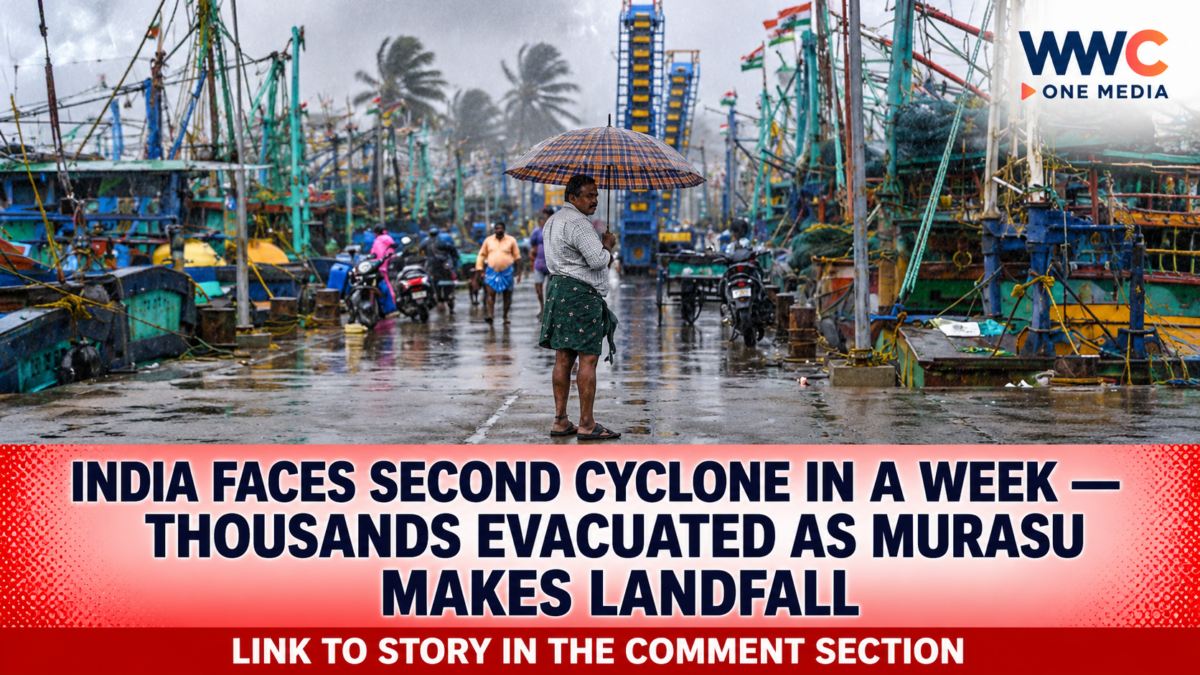
ANDHRA PRADESH, INDIA — India’s southeastern coast has been hit by a second cyclone within a week, prompting large-scale evacuations and emergency preparations as communities continue recovering from the destruction caused by an earlier storm.
Cyclone Murasu made landfall along the coast of Andhra Pradesh early Tuesday, November 3, according to the India Meteorological Department (IMD).
The storm crossed the coastline between approximately 3:30 a.m. and 5:30 a.m. local time, bringing sustained winds of 100 to 110 kilometres per hour and gusts reaching 120 kilometres per hour.
Authorities said thousands of residents had been moved to safer locations ahead of the storm. Around 2,000 people had already been evacuated by Monday, while officials planned to relocate approximately 30,000 people in Andhra Pradesh.
Initial reports following landfall indicated that no deaths or injuries had been recorded, although trees and electricity poles were uprooted.
The arrival of Murasu has placed additional pressure on emergency services in a region still dealing with the aftermath of Cyclone Arnab, which killed at least six people and damaged homes, crops and infrastructure the previous week.
Cyclone Murasu Makes Landfall Along Andhra Pradesh Coast
The IMD confirmed that Cyclone Murasu crossed the southeastern coastline of Andhra Pradesh early Tuesday.
The severe cyclonic storm brought sustained winds of 100–110 km/h, with stronger gusts reaching approximately 120 km/h.
Andhra Pradesh was expected to experience the most significant impact, while neighbouring Tamil Nadu was also placed under weather warnings.
The cyclone developed over the Bay of Bengal, an area known for producing tropical storms that frequently affect India’s eastern coastline.
Although Murasu was forecast to be less intense than Cyclone Arnab, authorities continued preparing for heavy rainfall, strong winds and possible disruptions to electricity and transportation.
Thousands Evacuated Before the Storm Arrived
The Andhra Pradesh State Disaster Management Authority began evacuation operations on Monday as Murasu approached the coast.
Prakhar Jain, managing director of the state disaster management authority, told Reuters that approximately 2,000 people had been evacuated by Monday.
Officials were planning to move around 30,000 people to safer locations.
The evacuation programme focused on communities considered vulnerable to the approaching storm, particularly residents in low-lying coastal areas.
Authorities also deployed disaster-response personnel ahead of landfall.
Six teams from India’s National Disaster Response Force and seven teams from the State Disaster Response Force were reported to have been assigned to preparedness operations.
Some National Disaster Response Force personnel were sent from neighbouring Tamil Nadu to support the response.
The preparations were intended to help authorities respond quickly to emergencies and assist communities affected by flooding, damaged infrastructure and power interruptions.
Officials Warn of Possible Power Disruptions
Andhra Pradesh Chief Minister N. Chandrababu Naidu directed government departments to prepare for the storm’s potential impact.
Before landfall, estimates indicated that between 6,000 and 8,000 electricity poles could be damaged, creating a significant risk of power interruptions.
The warning came as the state was still restoring infrastructure damaged by Cyclone Arnab.
Officials were also concerned about possible damage to roads, communication networks and agricultural areas.
Fishermen in affected coastal districts were advised not to venture into the sea while the storm approached.
Authorities also instructed local officials to remain available in vulnerable areas to coordinate emergency assistance.
Tamil Nadu and Odisha Also Prepare for Heavy Rain
Although Andhra Pradesh was expected to experience the strongest impact, neighbouring states were also preparing for adverse weather.
Tamil Nadu faced forecasts of heavy rainfall, including in parts of Chennai.
Schools were closed in Andhra Pradesh, Tamil Nadu and Odisha as precautionary measures.
Weather forecasts also indicated that rainfall could continue across parts of Andhra Pradesh, Telangana, Odisha and Chhattisgarh even as Murasu weakened after moving inland.
In Tamil Nadu, emergency personnel and power-restoration teams were also prepared to assist neighbouring Andhra Pradesh.
The wider response highlighted the regional impact of cyclones forming over the Bay of Bengal, where weather systems can affect several states beyond their immediate landfall locations.
Cyclone Arnab Left Six People Dead and Widespread Damage
Murasu arrived less than a week after Cyclone Arnab struck Andhra Pradesh on October 28.
Arnab was classified by the India Meteorological Department as a very severe cyclonic storm, bringing heavy rain and strong winds to the eastern coastline.
At least six people were officially reported killed, according to an Andhra Pradesh government official cited by Reuters.
Some media reports cited a higher figure of nine deaths, but the official death toll reported by Reuters was six.
The earlier cyclone also caused extensive infrastructure damage.
At least 15,000 electricity poles were reported damaged, while numerous homes and trees were affected.
More than 180,000 people were evacuated across Andhra Pradesh and Odisha before Arnab made landfall.
Schools were closed, while some train and flight services were cancelled as authorities prepared for the storm.
The damage left several communities facing electricity interruptions and the difficult task of repairing homes and restoring essential services.
Repeated Cyclones Put Pressure on Recovery Efforts
The arrival of a second cyclone within such a short period creates additional challenges for communities that have only recently experienced severe weather.
Residents may still be dealing with damaged homes, interrupted electricity and agricultural losses when another storm arrives.
Emergency teams must also balance immediate evacuation and rescue responsibilities with ongoing recovery operations.
For farmers, repeated heavy rainfall and strong winds can threaten crops and delay the restoration of agricultural activities.
For coastal communities, the storms can disrupt fishing operations and affect household incomes.
The latest cyclone therefore raises concerns not only about immediate weather damage but also about the longer recovery process for affected families and businesses.
Can India’s Early-Warning Systems Reduce the Impact?
India has strengthened its cyclone-monitoring and disaster-preparedness capabilities over the years.
Weather forecasting, early-warning notifications, evacuation planning and the deployment of emergency-response teams have become important parts of the country’s approach to tropical storms.
The evacuation of residents before both Arnab and Murasu demonstrated the role of advance preparations in protecting communities.
However, the damage caused by repeated storms shows that preparedness does not eliminate the risks associated with severe weather.
Authorities must still manage infrastructure damage, restore essential services and ensure that affected residents receive assistance.
The effectiveness of the response will depend on continued coordination between national agencies, state governments and local emergency teams.
A Second Storm Raises New Questions About Recovery
Cyclone Murasu’s landfall marks another difficult period for India’s eastern coastline.
Although early reports indicated no deaths or injuries following the storm’s arrival, the situation remained subject to further assessment as authorities inspected affected areas.
The immediate priority is to monitor weather conditions, restore damaged infrastructure and assist residents who were relocated ahead of the cyclone.
The experience of Cyclone Arnab also demonstrates how quickly severe weather can affect communities, even when evacuation and emergency preparations are already underway.
For thousands of residents along India’s southeastern coast, the challenge now extends beyond surviving another storm.
It is also about rebuilding homes, restoring livelihoods and recovering from two major cyclones within a single week.