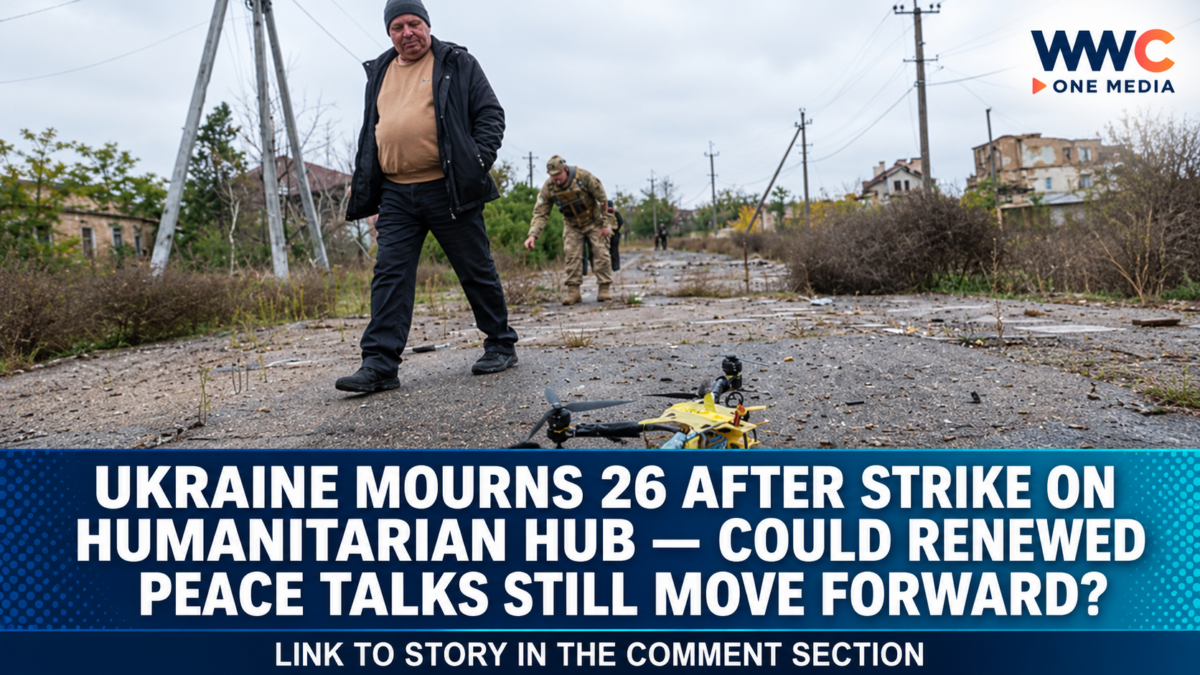
KOMYSHUVAKHA, UKRAINE — At least 26 people were killed after Russian forces struck a school building used as a humanitarian aid distribution centre and a nearby shelter in southeastern Ukraine, according to Ukrainian authorities, raising fresh concerns about civilian safety as diplomatic efforts to end the war continue.
The attacks occurred on Monday, November 2, in Komyshuvakha, a frontline village in the Zaporizhzhia region. Ukrainian President Volodymyr Zelenskyy said the school was being used to distribute humanitarian assistance to residents who remained in the area.
The building was not operating as a regular school because of its proximity to the frontline. Instead, residents gathered there to receive humanitarian packages, with the site also serving as a shelter.
The reported death toll rose to 26 as emergency services continued assessing the damage. Five people were receiving hospital treatment, including two rescue workers, while local officials reported that dozens of people were still unaccounted for.
The incident has intensified criticism from Kyiv and renewed questions about the prospects for de-escalation, particularly as a separate humanitarian ceasefire in Ukraine’s Kherson region had just expired.
Humanitarian Aid Centre and Nearby Shelter Hit
According to Zelenskyy, the first strikes hit the school building while residents were arriving to collect humanitarian assistance. A subsequent attack hit a nearby shelter.
Ukrainian emergency services said 26 people were killed. Reuters reported that two members of a rescue crew and four police officers were among those who died.
The emergency response was complicated by continuing security threats in the area. A Ukrainian military official said additional Russian drone activity hindered rescue operations.
Local officials also reported that people remained missing, with estimates varying between approximately 20 and 27 in different reports.
The final number of casualties could therefore change as emergency teams continue their work and authorities verify information.
Zelenskyy Condemns the Attack
Zelenskyy accused Russia of deliberately striking a location where civilians gathered to receive essential assistance.
He said the attack demonstrated that Moscow was not showing an intention to reduce hostilities, particularly after the recent humanitarian arrangements in southern Ukraine.
The Ukrainian president argued that the location’s regular use for aid distribution should have been known to Russian forces.
His statements represent the Ukrainian government’s assessment of the incident. Russia had not publicly provided a response to the specific attack in the reports available at publication time.
The incident also highlights the risks faced by humanitarian workers, emergency responders and residents who remain in communities close to active fighting.
Rescue Operations Continue as Casualty Figures Are Assessed
Emergency services and police continued working in Komyshuvakha after the strikes.
The presence of additional aerial threats made the response more difficult, according to Ukrainian regional officials.
The reported deaths of emergency personnel and police officers added to concerns about the dangers facing those trying to assist civilians during attacks.
Authorities were still assessing the full extent of the destruction and attempting to establish the whereabouts of people reported missing.
Because the situation was still developing, the reported casualty figures should be treated as provisional rather than final.
Attack Comes as a Separate Humanitarian Ceasefire Expires
The bombing occurred on the same day that a limited ceasefire in Ukraine’s Kherson region expired.
The temporary arrangement, which began on October 27, was intended to support humanitarian assistance and evacuation efforts in Oleshky, a Russian-occupied city in the southern Kherson region.
The arrangement was separate from the attack in Komyshuvakha, which is located in the Zaporizhzhia region.
The local truce allowed humanitarian operations to proceed in an area where residents had faced difficult living conditions and limited access to essential supplies.
Ukraine’s ombudsman and lead civilian negotiator, Dmytro Lubinets, said he hoped the arrangement could serve as a model for additional humanitarian operations.
However, the ceasefire was limited in geographical scope and duration. It did not represent a nationwide suspension of fighting.
Ukraine’s General Staff said Russian forces used the pause to strengthen their drone defences and replenish ammunition supplies in the area. That assessment was made by Ukrainian military authorities.
The expiration of the arrangement, followed by the deadly attack in another southern region, underlined how fragile local humanitarian agreements remain.
Other Ukrainian Regions Also Report New Attacks
The November 2 developments were not limited to Zaporizhzhia.
Ukrainian authorities reported additional drone attacks in the Kharkiv region, where at least 12 people were injured. Damage was reported to residential buildings, greenhouses and a refrigeration facility.
In the Black Sea port city of Odesa, five people were reported injured after another attack damaged homes and a warehouse.
Russia’s Defence Ministry, meanwhile, said its forces had intercepted or destroyed 212 Ukrainian drones overnight.
That figure was a statement from the Russian government and could not be independently verified from the available reporting.
The developments illustrate how attacks and counterattacks continue across different parts of the two countries even as diplomatic discussions are being prepared.
False Emergency Alerts Add to Public Concerns
Separately, authorities in Ukraine and Russia reported that government-operated mobile applications had been compromised, resulting in the distribution of false emergency notifications.
In Ukraine, some users received misleading alerts referring to radiation levels, chemical threats and alleged public disturbances.
The country’s authorities temporarily suspended the affected application while addressing the incident. Ukraine’s air force said the cyberattack had not affected its security and defence operations.
Russia also reported false notifications through its emergency-alert application across 33 of the country’s 89 regions.
Its Emergency Situations Ministry said the wider public warning system remained operational through other channels, including text messages, media broadcasts and local sirens.
It was not immediately clear whether the incidents in the two countries were connected.
A Russian Telegram channel claimed that a hacking group had taken responsibility for the Ukrainian breach, but the Associated Press said it could not independently verify the claim or establish the group’s identity and affiliations.
The incidents demonstrate how digital disruptions can complicate public communication during an ongoing conflict, particularly when residents rely on emergency notifications for safety information.
US-Mediated Russia-Ukraine Talks Expected in Abu Dhabi
Despite continued attacks, diplomatic efforts are expected to resume.
US special envoy Steve Witkoff said discussions involving Russian and Ukrainian representatives, with American mediation, were scheduled for November 10 and 11 in Abu Dhabi.
The proposed discussions are expected to address postwar security arrangements, de-escalation and humanitarian concerns.
American officials also planned meetings with European and NATO representatives in Brussels to discuss security guarantees for Ukraine and broader regional stability.
The negotiations would represent another attempt to move discussions forward after earlier diplomatic efforts failed to produce a comprehensive agreement.
However, the latest attack illustrates the difficulty of building confidence while fighting continues.
The parties still face major disagreements over security arrangements, territory and the conditions required for a lasting settlement.
Can Humanitarian Agreements Lead to a Wider Breakthrough?
The attack in Komyshuvakha has renewed attention on the vulnerability of civilians living near the frontline.
Humanitarian distribution centres and shelters are particularly important in communities where residents have limited access to food, medicine and other essential supplies.
The deaths reported in Zaporizhzhia also highlight the risks faced by emergency workers and police officers who respond when communities are struck.
The separate ceasefire in Kherson demonstrated that limited humanitarian arrangements can be negotiated, but its expiration showed how difficult it remains to sustain even temporary cooperation.
The upcoming Abu Dhabi discussions could provide another opportunity for the United States, Ukraine and Russia to address humanitarian issues and explore ways to reduce hostilities.
Whether those discussions can produce measurable progress remains uncertain.
For now, the latest attack leaves Ukraine facing another major civilian tragedy while the wider conflict continues.
The central question is whether renewed diplomacy can produce meaningful protections for civilians—or whether further attacks will continue undermining efforts to establish even limited periods of peace.