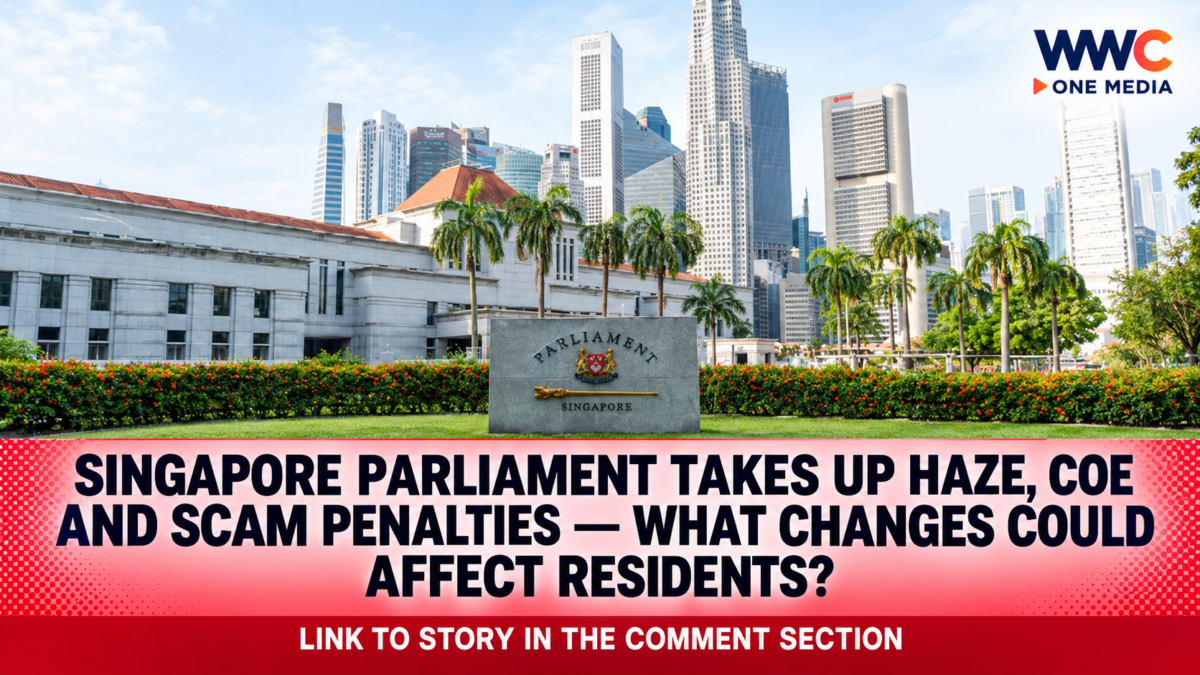
SINGAPORE — Singapore’s Parliament is set to examine several major public concerns on November 3, with transboundary haze pollution, proposed changes to the Certificate of Entitlement (COE) system and tougher sentencing for scam-related offences among the key issues on the agenda.
The sitting comes as the Government faces growing pressure to strengthen accountability for businesses potentially linked to forest fires in Indonesia, address concerns about car affordability and reinforce its approach to tackling scams involving both adults and young people.
More than 50 parliamentary questions have been filed on the haze, while the Ministry of Home Affairs (MHA) is introducing the Sentencing (Scams) Bill for its first reading.
Other questions will cover the impact of haze on outdoor workers and vulnerable groups, the proposed COE reforms, a disruption affecting public healthcare services and safeguards against child abuse.
1. Haze Pollution Puts Corporate Accountability Under the Spotlight
Transboundary haze is expected to dominate much of the parliamentary discussion as Singapore seeks stronger ways to address pollution linked to forest and land fires in Indonesia.
More than 50 questions submitted by Members of Parliament concern the Government’s response, including the effectiveness of existing legislation, investigations into companies potentially connected to the fires and the protection of people affected by deteriorating air quality.
One major issue involves the Transboundary Haze Pollution Act (THPA), introduced in 2014 to allow Singapore to take action against entities responsible for causing or contributing to haze pollution affecting the country.
Workers’ Party MP Sylvia Lim has requested an update on investigations involving four companies that remain under scrutiny over possible violations connected to the 2015 haze episode.
The cases have attracted renewed attention because investigations have remained unresolved for years, highlighting the practical difficulties of collecting evidence and establishing responsibility when relevant businesses and operations are located across national borders.
Other MPs have asked how authorities can identify companies that may be connected to fires through complicated corporate ownership structures, business relationships and financial arrangements.
Yio Chu Kang MP Yip Hon Weng also raised questions about possible connections between haze-causing activities, illicit land clearing and transnational organised or financial crime.
He asked whether businesses with a connection to suspected haze-causing activities should face enhanced due diligence and scrutiny measures.
Singapore moves to strengthen its haze enforcement framework
The Government has already taken several steps to increase pressure on companies potentially connected to the fires.
The National Environment Agency (NEA) issued notices to Singapore-based companies seeking information about their corporate relationships, Indonesian land concessions and fire-prevention measures.
Authorities have also established a specialist panel of legal, investigative and financial experts to assess companies’ operations, corporate structures and supply chains.
The panel is intended to help address the difficulties of investigating businesses whose operations extend across different jurisdictions.
The Government has also announced plans to amend the THPA to strengthen enforcement and require identified companies to provide investigators with access to relevant corporate documents, business information and premises.
Under the proposed framework, failure to comply with certain investigation requirements could become an offence.
However, receiving an information request or preventive notice does not automatically establish that a company caused the haze or committed an offence. Investigations and legal assessments must determine whether responsibility can be established.
2. Outdoor Workers and Vulnerable Residents Seek Better Protection
The haze discussion will also focus on the people who face greater exposure to unhealthy air.
MPs have asked how the Government intends to protect outdoor workers, students, children and people with existing health vulnerabilities when particulate pollution reaches elevated levels.
Labour MP Melvin Yong raised the importance of allowing workers to report inadequate protection or unsafe working conditions confidentially, without fear of retaliation.
This issue is significant for workers whose jobs require them to remain outdoors even when air quality deteriorates.
Questions have also been raised about the readiness of preschools and other facilities to protect children during haze episodes.
The wider concern is whether existing workplace protections, indoor air filtration and public-health measures are sufficient when pollution affects different parts of Singapore.
The parliamentary discussion could help clarify what additional safeguards may be considered and whether agencies need stronger coordination during severe haze conditions.
3. Proposed COE Changes Raise Questions About Car Affordability
Another major issue is the proposed reform of Singapore’s Certificate of Entitlement system.
The Land Transport Authority (LTA) previously proposed merging COE Categories A and B for cars into a single category, accompanied by a system of surcharges and rebates linked to a vehicle’s Open Market Value (OMV).
The proposed approach is intended to address differences between mass-market cars and higher-value models under the existing COE framework.
However, MPs want clarification on how the changes could affect vehicle prices and whether the new arrangement would make car ownership more affordable for ordinary households.
Yio Chu Kang MP Yip Hon Weng asked what market distortion the proposed changes are intended to correct and how the Government would determine whether the revised system maintains meaningful distinctions between mass-market and higher-value vehicles.
East Coast MP Jessica Tan raised concerns about affordability for families and small and medium-sized enterprises that depend on cars or commercial vehicles.
She also asked whether additional measures could be considered for people who are increasingly priced out of car ownership.
Meanwhile, MP Edward Chia questioned whether the proposed rebates and surcharges should be calculated as percentages of COE prices rather than fixed amounts.
He also raised the issue of whether safeguards would ensure that rebates actually benefit vehicle buyers instead of being absorbed into dealers’ selling prices.
Will the new system make cars more affordable?
The proposed COE changes could alter how different categories of vehicles compete for certificates, but their actual impact on buyers will depend on the final rules and market response.
A rebate mechanism does not automatically guarantee lower vehicle prices.
If dealers adjust their pricing or market demand changes, the financial benefit reaching consumers could differ from the intended outcome.
For households and businesses, the central question is whether the revised framework will improve affordability without creating new distortions in the COE market.
The parliamentary questions may help clarify how the Government intends to evaluate the proposed system before any final implementation.
4. Sentencing (Scams) Bill Targets Deterrence for Young and Adult Offenders
The Ministry of Home Affairs is introducing the Sentencing (Scams) Bill for its first reading on November 3.
The proposed legislation follows concerns raised by Senior Minister K. Shanmugam in Parliament on October 6 about young people becoming involved in scam-related offences.
The Government wants to reinforce the principle that scammers and people who facilitate scams should face deterrent sentences, regardless of their age.
The issue gained attention after a High Court decision in September 2026 involving several young offenders who had participated in scam-related activities as money mules.
The court allowed appeals in four of seven cases, replacing the original outcomes with probation or community-based sentences in those cases.
The ruling placed greater emphasis on rehabilitation for the young offenders involved.
Shanmugam subsequently said the Government intended to clarify its policy through legislation, arguing that deterrence and prevention should carry greater weight in sentencing people involved in scams.
He also said the authorities were concerned that scam syndicates could exploit young people by offering quick financial rewards in exchange for access to bank accounts or other forms of assistance.
Why the Government wants tougher sentencing
The concern is not limited to people who directly contact victims.
Money mules and other individuals who provide accounts or financial services can help scam networks receive, transfer or conceal money obtained through fraudulent activities.
According to MHA, more than 1,000 young people were investigated in connection with scam reports in 2025.
The ministry also highlighted that more than 5,000 elderly people were victims of scams that year, with losses from those cases amounting to approximately S$200 million.
The figures have strengthened the Government’s argument that scam-related offences can have serious consequences for victims, including people who depend on their savings for retirement.
The proposed Bill is intended to make the Government’s sentencing policy clearer and reinforce deterrence for people who participate in scam operations.
However, its introduction for first reading does not mean the legislation has already completed Parliament’s approval process or taken effect.
5. Previous Anti-Scam Laws Form Part of a Wider Enforcement Strategy
The Sentencing (Scams) Bill comes after Singapore introduced other legal measures aimed at disrupting scam networks.
In September 2026, Parliament passed the Scams (Countermeasures) and Other Matters Bill, which strengthened the authorities’ ability to disrupt suspected scam-related accounts and work with service providers.
These measures form part of a broader strategy that targets the infrastructure used by scam syndicates, including accounts and services that may facilitate fraudulent transactions.
Related WWC ONE MEDIA coverage:
Singapore Passes New Anti-Scam Law Allowing Restrictions on Suspected Mule Accounts
The earlier legislation expanded the authorities’ powers to disrupt suspected scam accounts, providing context for the Government’s latest effort to strengthen sentencing rules.
The two legislative developments address different parts of the problem: one focuses on disrupting scam infrastructure, while the new Bill concerns sentencing policy.
6. Healthcare Disruption and Child Protection Also Feature in Parliamentary Questions
Beyond the three main issues, MPs have also submitted questions about the resilience of Singapore’s public healthcare systems and the protection of young children.
Several MPs are seeking answers about a nine-hour disruption on October 13 that affected services across all three public healthcare clusters.
The disruption was attributed to a technical problem involving network connectivity.
National health technology agency Synapxe said there was no indication that the incident was caused by a cyberattack.
MPs want to know how many patients were affected, whether independent backup systems were available and what measures are being considered to prevent similar disruptions.
Questions have also been raised about child-protection safeguards following the death of an eight-month-old baby in a case involving abuse by the child’s parents.
The MPs are seeking clarification on how suspected abuse involving very young children can be identified, particularly when families are not already known to social services.
They have also asked whether information from healthcare encounters should be incorporated into the Government’s cross-agency child-protection assessment framework, known as Sensemaking Alerts for Frontline Engagement and Response (SAFER).
The discussion highlights the importance of identifying warning signs early and ensuring that relevant agencies can coordinate their responses.
7. Why This Parliamentary Sitting Matters
The November 3 parliamentary agenda brings together several issues with direct implications for Singapore residents.
The haze debate concerns public health, environmental accountability and the Government’s ability to pursue companies operating across borders.
The COE discussion could influence the future cost structure of car ownership, particularly for families and businesses that depend on vehicles.
The Sentencing (Scams) Bill, meanwhile, signals a continued effort to deter scam-related offences and discourage young people from becoming involved in criminal networks.
Healthcare resilience and child protection add further pressure on public agencies to strengthen safeguards and improve coordination.
The key developments to watch are whether the Government can close longstanding enforcement gaps in the haze investigation, how it responds to concerns about the proposed COE framework and what legal changes will emerge from the new scam-sentencing legislation.
For Singapore residents, the outcome could shape more than parliamentary policy. It may influence the country’s environmental protections, transport costs, public safety and the way authorities respond to emerging social risks.
The bigger question is whether the measures being considered will translate into stronger enforcement and practical improvements that people can actually feel in their daily lives.