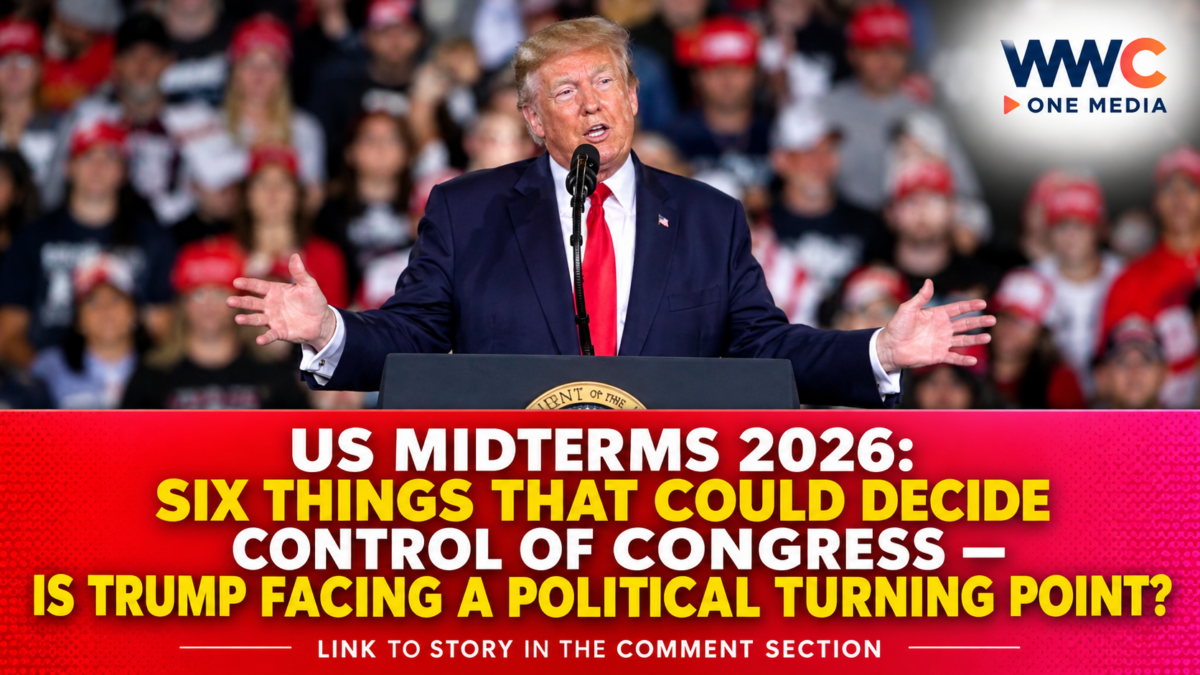
WASHINGTON, United States — Millions of Americans head to the polls on November 3, 2026, in midterm elections that could reshape the balance of power in Washington and determine how much influence President Donald Trump retains over the final two years of his presidency.
Republicans currently control both chambers of Congress, but Democrats are seeking to take back the House of Representatives and challenge the Republican majority in the Senate.
The election is widely viewed as the first nationwide electoral verdict on Trump’s second administration. Its outcome could influence legislation, government spending, congressional investigations, federal appointments and the political strategies of both parties ahead of the 2028 presidential election.
Beyond the battle for congressional seats, voters are weighing concerns about living costs, immigration, the administration’s policies and the US-led war with Iran.
Here are six major developments to watch as Americans vote.
1. The battle for control of the House and Senate
The most immediate question is whether Republicans can preserve their narrow congressional majorities or whether Democrats will take control of one or both chambers.
All 435 voting seats in the House of Representatives are being contested. The Senate has 35 elections, including regularly scheduled and special contests.
Republicans entered the election with a narrow 218-214 House advantage, alongside a 53-47 Senate majority when two independents who caucus with Democrats are counted on the Democratic side.
Democrats need a net gain of four seats to take control of the Senate. The House threshold is also tight, although calculations can vary with vacancies and the chamber’s current membership.
The House is widely considered more favorable territory for Democrats, while the Senate contest remains highly competitive.
Several Senate races are attracting particular attention, including contests in Ohio, Iowa, Alaska, Texas, Maine and Michigan.
A Democratic victory in either chamber would significantly change the political environment for Trump.
A Democratic-controlled House could intensify congressional oversight and investigations involving the administration. A change in Senate control could make confirmations of federal judges and senior government officials more difficult.
If Republicans retain both chambers, Trump would have a more favorable environment for advancing his legislative priorities.
2. Election-day problems and disputes over vote counting
Another important issue is whether election officials can administer the vote smoothly and resolve disputes without undermining public confidence.
Close contests can lead to challenges involving voter eligibility, ballot processing, counting procedures and certification.
Long queues, voting-machine problems and legal challenges could also delay the release of results in closely contested states.
The US Justice Department plans to deploy approximately 1,000 election monitors nationwide, according to reporting cited by Reuters. Some local officials have raised concerns about the potential for voter intimidation, while the department has rejected those concerns.
Alaska has also become a focal point for election-related legal questions. The Justice Department filed a lawsuit seeking to prevent the state from certifying its Senate results under a particular narrow-margin scenario involving two Republican candidates with similar names.
The dispute illustrates how legal and administrative questions could become significant if the final vote is extremely close.
Not every state is expected to produce complete results on election night. Mail ballots, provisional ballots and different state counting procedures can affect when official outcomes become clear.
Media projections should therefore not be confused with certified election results.
3. How will Trump respond if Republicans lose?
Trump’s reaction to the results could become one of the most closely watched developments after polling stations close.
A Republican victory would strengthen his position within the party and give his administration a better opportunity to pursue its remaining legislative priorities.
A major Republican defeat, however, could increase pressure on the president to reconsider unpopular policies and respond to criticism from within his own party.
The possibility of election-result disputes is also receiving attention because Trump repeatedly made false claims that the 2020 presidential election was stolen after losing to Joe Biden.
Reuters reported that Trump has continued questioning election integrity ahead of the 2026 midterms, making his response to a possible Republican defeat an important political issue.
Election officials and the public will be watching whether candidates accept verified results and allow established state procedures to determine the outcome.
The key distinction is that a close result or delayed count does not, by itself, indicate fraud or misconduct.
4. Voter turnout could determine the outcome
The number and composition of voters participating in the midterms could make a significant difference in competitive districts and states.
Pre-election polling cited by Reuters suggested Democrats entered Election Day with greater enthusiasm about voting than Republicans.
However, enthusiasm does not automatically translate into victory.
Young, Black and Hispanic voters are particularly important constituencies for Democrats, but participation among these groups has historically been lower in midterm elections than in presidential election years.
If these voters participate at lower-than-expected levels, Democratic candidates could struggle to convert favorable polling into actual victories.
Republicans, meanwhile, have argued that many of their supporters prefer voting on Election Day rather than participating in early voting.
Early-voting figures must also be interpreted carefully. Party registration does not necessarily reveal how an individual voted, and voting early does not always mean more people ultimately participate.
A strong Election Day turnout could change the balance in races that appeared close before November 3.
5. The results could influence the 2028 presidential race
Although the presidential election is still two years away, the midterms could influence which political messages and candidates gain momentum.
Democrats remain divided over the best strategy for rebuilding their national appeal after their 2024 presidential election defeat.
One group favors a more populist economic approach that emphasizes household costs, inequality and economic opportunity.
Others favor a centrist strategy intended to attract independent voters and Republicans dissatisfied with their party.
The performance of candidates representing these different approaches could strengthen one faction over the other.
A strong showing by progressive candidates may encourage Democrats to emphasize more ambitious economic policies, while victories by moderate candidates could reinforce calls for a broader appeal to swing voters.
Republicans will also be assessing the results.
A strong performance could reinforce Trump’s influence over the party and shape the selection of candidates and policy priorities for 2028.
A significant defeat could encourage Republican lawmakers to distance themselves from certain administration policies or seek a different political direction.
The midterms will not determine the 2028 presidential nominees, but they could influence the political environment in which that contest develops.
6. Can Republican campaign spending overcome voter concerns?
Campaign financing is another major factor in the election.
Republicans entered the final campaign stretch with a substantial spending advantage, using advertising and political organizations to promote their candidates and criticize Democratic opponents.
Reuters reported that Trump spent more than US$277 million, primarily through his MAGA super PAC, on a late television and direct-mail campaign supporting Republican candidates.
Tesla chief executive Elon Musk also spent approximately US$366 million during the midterm cycle to support Republican candidates, according to campaign-finance data cited in the report.
The scale of spending raises questions about how effectively financial resources can influence voters in competitive races.
Democrats have emphasized economic concerns, particularly the cost of living, while criticizing the administration’s policies.
Republicans have sought to defend their record and convince voters that their candidates are better positioned to advance the country’s interests.
However, campaign spending does not guarantee electoral success.
Voters may place greater importance on personal financial circumstances, inflation, fuel costs, immigration and foreign policy than on the volume of political advertising they encounter.
The results will offer an important indication of whether Republican financial advantages can overcome broader dissatisfaction with the administration.
Why the midterms matter beyond November 3
The midterm elections are important because Congress has substantial authority over federal legislation, spending and government oversight.
The House plays a central role in initiating revenue-related legislation, approving spending measures and conducting investigations.
The Senate considers legislation and has important responsibilities involving presidential appointments, federal judges and treaties.
If Democrats take control of one or both chambers, Trump’s administration could face a more difficult legislative environment.
A divided Congress could also lead to political confrontations over budgets, immigration, taxes, foreign policy and other national priorities.
However, control of Congress does not give either party unlimited power. Legislative procedures, Senate voting rules, presidential authority and the need for bipartisan support can all influence what lawmakers are able to accomplish.
The newly elected members are scheduled to begin their congressional terms on January 3, 2027.
The Bottom Line
The November 3, 2026, US midterms are more than a contest for congressional seats. They are a major test of President Donald Trump’s political influence and the ability of Republicans to maintain control of Washington.
The six issues to watch are the House and Senate races, election administration, Trump’s response, voter turnout, the emerging 2028 political landscape and the impact of campaign spending.
Democrats are seeking to use voter dissatisfaction and their anticipated House gains to challenge the administration, while Republicans are relying on their campaign organization, financial resources and Election Day mobilization to defend their majorities.
The final outcome could reshape the political direction of the United States during the remaining two years of Trump’s term.
The biggest question is whether voters will give Trump and Republicans another two years of congressional support—or hand Democrats the power to challenge his administration from Capitol Hill.