NEW YORK — October 31, 2026
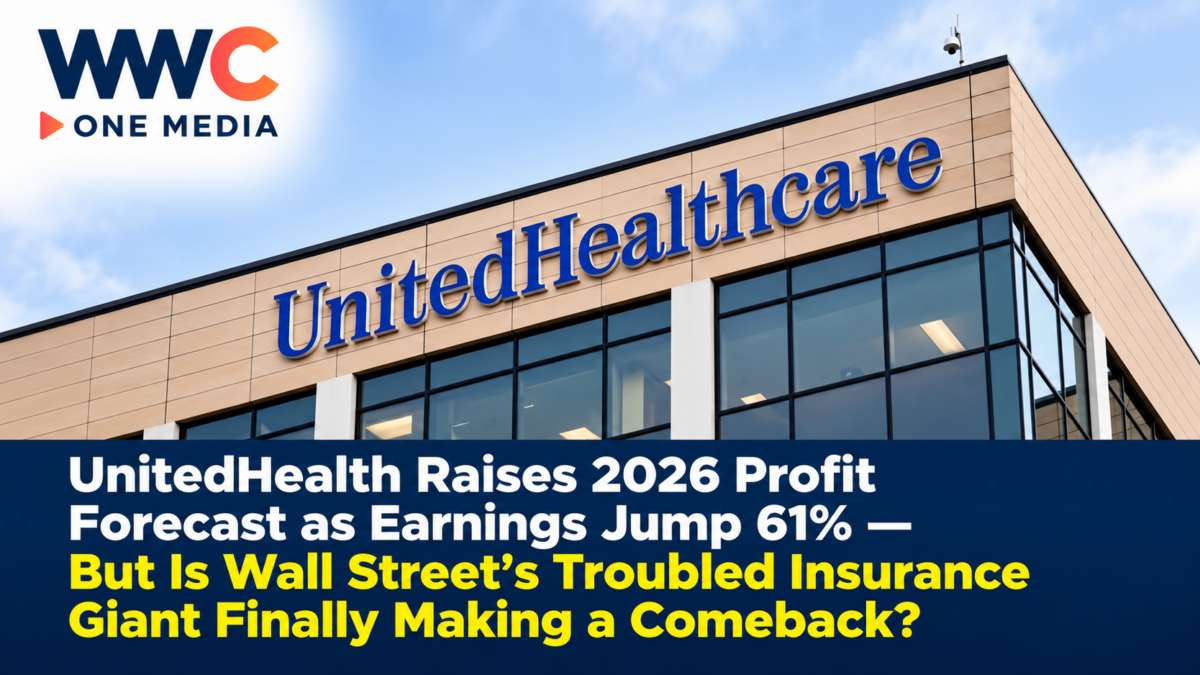
UnitedHealth Group, one of America’s largest health insurance and healthcare services companies, is showing fresh signs of a financial recovery after reporting stronger-than-expected third-quarter earnings, raising its annual profit forecast and delivering improvements in medical-cost management.
The developments are attracting renewed attention from Wall Street investors who have watched the company struggle with rising healthcare expenses, operational challenges and a prolonged crisis of confidence.
In an October 30 CNBC investment commentary, the company’s improving financial performance became the basis for a bullish argument that UnitedHealth’s turnaround may finally be gaining momentum.
But the numbers tell a more complicated story.
UnitedHealth reported third-quarter revenue of $112.7 billion and adjusted earnings of $4.69 per share, a substantial improvement from $2.92 per share a year earlier.
The adjusted earnings increase of approximately 61% exceeded Wall Street expectations.
The company also raised its full-year 2026 adjusted earnings forecast to at least $20.50 per share, up from its previous range of $19.50 to $20.00.
However, revenue declined slightly from the corresponding quarter in 2025, while health insurance membership fell as the company withdrew from less profitable business.
The recovery therefore appears to be driven more by improving profitability and operational discipline than rapid customer or revenue growth.
The central question is whether UnitedHealth can sustain stronger earnings while healthcare costs remain elevated — or whether the apparent turnaround could lose momentum before investors see its full benefits.
UnitedHealth Beats Earnings Expectations and Raises Its 2026 Outlook
UnitedHealth released its third-quarter financial results on October 13, providing evidence that its restructuring efforts were producing measurable results.
The company reported:
- Quarterly revenue of approximately $112.7 billion.
- Adjusted earnings of $4.69 per share.
- Reported earnings of $4.56 per share.
- Operating earnings of $6.6 billion.
- Operating cash flow of $5.1 billion.
- A medical care ratio of 88.4%.
Adjusted earnings increased from $2.92 per share in the same quarter last year.
According to Reuters, Wall Street analysts had expected adjusted earnings of approximately $4.14 per share.
The actual result therefore exceeded expectations by around 55 cents.
UnitedHealth also increased its adjusted full-year profit forecast to at least $20.50 per share.
That was a significant improvement from the previous range of $19.50 to $20.00.
The stronger outlook reflects management’s confidence that pricing changes, cost controls and operational improvements are beginning to stabilize the business.
But these developments do not establish that the turnaround has been completed.
The company must still demonstrate that higher profitability can be maintained beyond a single strong quarter.
The Medical Care Ratio Is the Number Investors Are Watching
One of the most important indicators of UnitedHealth’s recovery is its medical care ratio.
This measure represents the proportion of insurance premium revenue used to pay medical claims and related healthcare expenses.
A higher ratio generally means the insurer is spending more of its premium revenue on medical care, leaving less available for administrative expenses and operating profit.
UnitedHealth reported an 88.4% medical care ratio for the third quarter.
That compares with 89.9% one year earlier.
The improvement of 1.5 percentage points is significant for a company operating at UnitedHealth’s scale.
It suggests that increases in premiums, changes to insurance benefits and tighter medical-cost management have improved the relationship between revenue and claims expenses.
However, one qualification matters.
UnitedHealth disclosed approximately $610 million in favorable prior-period medical reserve development related to 2026 service dates.
This reduced the reported medical care ratio.
Consequently, investors should avoid assuming that the entire improvement came solely from ongoing operational efficiencies.
The reserve benefit was a real component of reported financial performance, but its exact scale may not recur in future quarters.
Optum’s Recovery Is Becoming a Major Part of the Investment Story
UnitedHealth operates through two major businesses: UnitedHealthcare and Optum.
UnitedHealthcare provides health insurance coverage.
Optum provides healthcare services, technology, pharmacy-related businesses and other solutions.
During the third quarter, Optum generated approximately $66.9 billion in revenue and $3.7 billion in operating earnings.
The segment’s improved performance helped support the company’s consolidated results.
Optum Health, which manages physician groups and other care-delivery operations, had previously faced substantial pressure from rising patient costs and underperforming contracts.
The company has been restructuring those operations, exiting some unprofitable arrangements and working to improve financial discipline.
According to Reuters and The Wall Street Journal, those efforts contributed to a significant recovery in Optum Health earnings.
But the turnaround has required difficult decisions.
UnitedHealth has reduced exposure to certain healthcare arrangements, scaled back some operations and focused more heavily on profitability.
Those actions can support earnings.
They can also result in lower revenue or fewer patients being served.
The financial challenge is determining whether a leaner Optum can maintain sustainable growth without sacrificing the service quality and scale that made the business strategically valuable.
UnitedHealth Is Prioritizing Profitability Over Membership Growth
The company’s insurance business is also undergoing significant changes.
UnitedHealthcare served approximately 48.3 million people during the third quarter.
That was lower than the roughly 50.1 million recorded a year earlier.
Membership reductions reflected changes across employer-sponsored coverage, Medicaid and Medicare Advantage.
Some of these changes were linked to deliberate decisions to withdraw from markets or products that management considered insufficiently profitable.
This strategy can improve margins.
But it creates a tradeoff.
UnitedHealth may report stronger earnings even while serving fewer insured customers.
For shareholders, the strategy could be attractive if the remaining business produces more sustainable cash flow.
For patients and policymakers, however, reduced participation in insurance markets raises questions about coverage availability, provider networks and competition.
The company’s recovery must therefore be evaluated from two perspectives: its financial performance and the impact of its business decisions on healthcare access.
Medicare Advantage Remains a Critical Risk
Medicare Advantage is one of the most important areas of UnitedHealth’s insurance business.
The program allows eligible Medicare beneficiaries to receive coverage through private insurers that contract with the federal government.
It can provide additional benefits and coordinated-care arrangements.
But the financial model depends on government payment rates, patient medical expenses, quality ratings and regulatory requirements.
UnitedHealth has been adjusting its Medicare Advantage offerings in response to rising medical costs.
According to Barron’s, the company had approximately 935,000 fewer Medicare Advantage members compared with the end of 2025.
Its effort to improve profitability has included withdrawing from some less attractive markets and modifying benefit structures.
Those actions could support margins.
However, they may also reduce the company’s scale and affect customer relationships.
A further complication involves quality ratings.
Medicare Advantage star ratings can influence bonus payments and the competitive position of insurance plans.
UnitedHealth will therefore need to demonstrate that its more selective growth strategy can improve earnings without weakening the long-term quality and attractiveness of its offerings.
America’s Healthcare Inflation Problem Has Not Disappeared
UnitedHealth’s improving medical-cost ratio comes against a broader backdrop of rising healthcare spending.
The United States has one of the world’s largest and most expensive healthcare systems.
Medical providers, insurance companies, employers and households are all facing pressure from higher treatment costs, expensive medicines and increased demand for care.
WWC ONE MEDIA examined the broader problem in America’s Healthcare Economy Is Booming — But Patients Are Paying the Price.
The report described how healthcare spending can grow rapidly while patients still face higher premiums, deductibles and out-of-pocket expenses.
This environment matters directly to UnitedHealth.
Higher medical expenses can reduce the profitability of insurance contracts if premiums do not adequately reflect the cost of care.
On the other hand, more restrictive benefits or narrower provider networks can create dissatisfaction among members.
UnitedHealth must manage both challenges.
Improved profitability may help rebuild investor confidence, but it does not automatically mean healthcare has become more affordable for patients.
Optum’s Pharmacy Business Faces a Rapidly Changing Drug Market
UnitedHealth’s pharmacy services operations also face major changes as spending on specialty medicines expands.
Expensive treatments for obesity, diabetes, cancer and other chronic conditions are changing how insurers and pharmacy benefit managers manage costs.
The financial stakes are enormous.
WWC ONE MEDIA recently examined the growth of this market in Eli Lilly Revenue Surges 39% to $24.4 Billion as Mounjaro and Zepbound Smash Records — But Why Did Its Earnings Forecast Fall?.
The article detailed the sharp increase in demand for Eli Lilly’s diabetes and obesity medicines.
For insurers, such treatments can provide meaningful health benefits but may also create substantial near-term expenses.
Coverage arrangements, pharmacy negotiations and reimbursement rules therefore have an important influence on financial performance.
Optum’s diversified operations give UnitedHealth exposure to this changing market.
But they also bring regulatory, pricing and operational risks.
The growth of the specialty drug industry is not an automatic profit opportunity for every business involved in financing or managing those treatments.
UnitedHealth’s Turnaround Follows Years of Difficulties
UnitedHealth’s recovery efforts follow a period of substantial operational and reputational pressure.
The company was affected by a major cyberattack involving Change Healthcare in 2024.
The disruption affected healthcare payment and claims-processing systems and created extensive operational and financial consequences.
The company later confronted unexpectedly high medical expenses, missed financial targets and changes in leadership.
Stephen Hemsley returned as chief executive officer as the company sought to rebuild confidence in its operations and financial outlook.
The current restructuring involves reviewing underperforming businesses, adjusting insurance pricing, improving administrative efficiency and investing in technology.
These measures are intended to establish a more sustainable operating model.
However, investors should distinguish improvements following a difficult period from proof that the business has returned to its previous long-term growth trajectory.
A turnaround can produce impressive percentage gains partly because the comparison period was unusually weak.
Management Is Looking Toward Renewed Growth in 2027
UnitedHealth executives have suggested that the company could return to stronger earnings growth in 2027.
Chief Financial Officer Wayne DeVeydt told analysts that the lower end of the company’s long-term earnings growth target of 13% to 16% represented a reasonable starting point for thinking about the following year.
That does not constitute a finalized 2027 earnings forecast.
It indicates management’s expectations for the business if improvements continue.
Investors will be watching whether the company can generate growth from its strengthened 2026 earnings base.
The distinction matters because a 13% increase on an adjusted earnings base of $20.50 per share would imply more than $23 per share.
But such a calculation is only an illustration of potential earnings growth.
It is not a confirmed future financial result.
Actual 2027 performance will depend on claims trends, enrollment, government payments, regulatory developments and the success of restructuring efforts.
Why Some Investors Are Becoming Bullish on UnitedHealth Stock
The case for a UnitedHealth recovery rests on several developments.
First, adjusted earnings have improved substantially.
Second, the company has raised its annual profit forecast.
Third, its medical care ratio has moved in a favorable direction.
Fourth, Optum’s operating performance has strengthened.
Finally, management is signaling that longer-term earnings growth could resume.
For investors who believe the operational improvements will continue, these developments may support a more optimistic valuation.
That is the broader premise behind CNBC’s October 30 investment commentary.
But buying shares because a company appears to be recovering involves risk.
Stock prices can already reflect expectations of future earnings improvement.
Even if a company performs better operationally, its shares may decline if results fall short of investor forecasts.
A successful investment therefore depends not only on whether the business recovers, but also on the price paid for its stock.
The Risks That Could Derail UnitedHealth’s Recovery
Several important challenges remain.
Medical inflation could accelerate again, raising the cost of paying insurance claims.
Medicare Advantage reimbursement policies may affect profitability.
Medicaid funding pressures could continue creating difficulties for insurers.
Enrollment reductions could undermine long-term revenue growth if the company struggles to attract profitable customers.
Optum’s restructuring may also take longer than anticipated.
Meanwhile, healthcare insurers and pharmacy benefit managers remain exposed to regulatory scrutiny and changing government policies.
UnitedHealth’s scale provides significant resources, but it also means its operations are closely connected to some of America’s most politically sensitive healthcare programs.
A favorable earnings report cannot eliminate those risks.
The Patient Affordability Problem Creates a Complicated Recovery
One of the most important questions is how UnitedHealth’s pursuit of higher margins affects consumers.
Health insurers generally seek to align premiums with the expected cost of providing medical benefits.
When medical costs rise unexpectedly, profitability can deteriorate.
To restore margins, companies may adjust prices, benefits or geographic participation.
But those adjustments can affect consumers’ choices and out-of-pocket expenses.
WWC ONE MEDIA previously reported on broader Affordable Care Act affordability concerns in $500 Obamacare Refund Checks Start Going Out to Nearly 1 Million Americans — But They Won’t Reach Every ACA Enrollee.
The article examined premium increases and the challenges facing households purchasing health insurance.
Those issues are not identical to UnitedHealth’s Medicare Advantage and Optum operations.
Nevertheless, they illustrate the economic environment in which large health insurers must operate.
For investors, improved margins may be encouraging.
For patients, the more important questions may concern premium affordability, provider access and the quality of care.
A sustainable healthcare turnaround should ultimately be evaluated on more than financial metrics alone.
What Could Happen to UnitedHealth Shares Next?
The outlook for UnitedHealth shares will depend on whether management delivers on its improved earnings expectations.
Investors are likely to focus on future medical care ratios, Optum margins, Medicare Advantage enrollment and the company’s ability to generate cash.
The market will also assess whether the company’s valuation appropriately reflects the expected pace of recovery.
If claims trends stabilize and earnings continue improving, investors could become more confident in management’s strategy.
If medical costs rise unexpectedly or membership reductions create greater pressure on revenue, that confidence could weaken.
The company’s third-quarter report provides measurable evidence of progress.
It does not guarantee a sustained stock-market rally.
What This Means for Investors in the Philippines
UnitedHealth is listed on the New York Stock Exchange under the ticker symbol UNH.
Its performance may be relevant to Philippine investors who hold US equities, international mutual funds or exchange-traded funds with exposure to American healthcare companies.
However, the company’s financial results do not directly determine the outlook for Philippine insurers or healthcare providers.
Healthcare regulation, reimbursement arrangements and consumer markets differ substantially between the United States and the Philippines.
Investors considering a foreign healthcare stock should evaluate the company’s financial statements, regulatory risks, valuation and the effect of currency movements.
The broader lesson is that a corporate turnaround can create investment opportunities, but strong recent earnings alone are not enough to establish whether a stock is attractively priced.
The Bigger Question: Can UnitedHealth Turn Financial Recovery Into Sustainable Growth?
UnitedHealth’s latest results provide evidence that management is making progress.
The company has improved profitability, raised earnings guidance and demonstrated better cost management.
Optum’s operating performance has also strengthened.
But the recovery comes with important qualifications.
Revenue remains under pressure.
Membership has declined.
Medical costs remain elevated.
And part of the latest medical care ratio improvement benefited from favorable reserve development.
These factors make it essential to distinguish a genuine improvement in financial performance from a completed turnaround.
The next challenge is whether UnitedHealth can maintain stronger margins while rebuilding sustainable growth.
The Bottom Line
UnitedHealth Group’s third-quarter 2026 results have strengthened the argument that its financial recovery is progressing.
The company reported $112.7 billion in quarterly revenue, adjusted earnings of $4.69 per share and an improved medical care ratio of 88.4%.
Management raised its full-year adjusted earnings outlook to at least $20.50 per share and indicated that stronger growth could resume in 2027.
These are encouraging developments for a business that has faced substantial operational and financial challenges.
But the recovery remains exposed to rising healthcare costs, enrollment declines, reimbursement policies and regulatory uncertainty.
As Wall Street begins reconsidering UnitedHealth’s prospects, one question will determine whether the company’s latest earnings represent the beginning of a lasting comeback: Can America’s insurance giant restore strong profits and sustainable growth without allowing medical costs and shrinking membership to undermine the recovery?