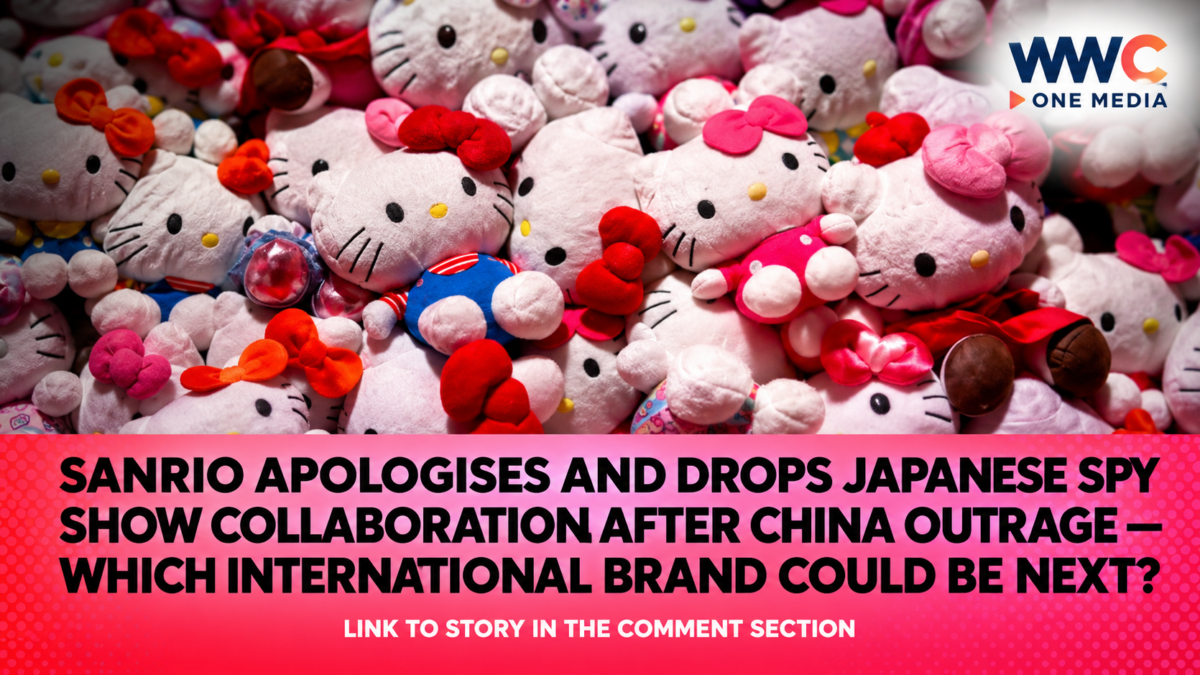
TOKYO — The company behind Hello Kitty has cancelled a collaboration with a Japanese television spy drama after the partnership triggered strong criticism in China, highlighting the growing risks international brands face when entertainment and geopolitics collide.
Sanrio announced on Wednesday, October 28, that its Chinese subsidiary would terminate its collaboration with VIVANT, a Japanese espionage drama produced by broadcaster Tokyo Broadcasting System (TBS).
The decision followed days of criticism on Chinese social media, which intensified after state media joined the controversy over merchandise featuring Sanrio characters dressed as spies from the show.
In its statement, Sanrio’s Chinese subsidiary apologised for the concern caused by the partnership and said the collaboration contained expressions inconsistent with the group’s corporate philosophy.
The company confirmed that it was ending the existing collaboration, along with all subsequent projects and promotional activities.
The move puts one of Japan’s best-known character brands at the centre of a wider dispute involving historical sensitivities, national identity and increasingly strained relations between Beijing and Tokyo. Reuters+2
Why did Hello Kitty become part of the controversy?
The dispute centres on VIVANT, a Japanese television drama involving intelligence operations, spies and a terrorist organisation called Tent.
The series is fictional, but its latest season includes a storyline in which a fictional Chinese intelligence agency captures and tortures Japanese operatives.
That portrayal became a source of criticism in China.
Chinese viewers objected to the way the fictional Chinese agency was depicted, while Chinese state broadcaster CCTV accused the programme of distorting history and deliberately smearing Beijing, according to the South China Morning Post.
The controversy then extended beyond the television series itself.
Sanrio had partnered with the production to create soft toys featuring characters such as Hello Kitty dressed in spy-themed outfits associated with the drama.
Although the merchandise was part of a commercial entertainment collaboration, critics connected the products to the show’s disputed portrayal of Chinese intelligence agents.
As the criticism gained momentum, Sanrio’s Chinese subsidiary announced the cancellation. South China Morning Post+1
Sanrio says the collaboration conflicts with its corporate philosophy
Sanrio’s response was notable because the company did not simply announce that the promotional campaign would be paused.
Instead, it apologised publicly and said the partnership contained expressions inconsistent with the Sanrio Group’s corporate philosophy.
It also confirmed that all future projects and promotional activities connected with the collaboration would be terminated.
TBS, meanwhile, defended the drama’s fictional nature.
TBS president Masamine Ryuho said at a regular press conference on Wednesday that the series was entirely fictional and was not intended to disparage any specific country, according to Japanese media reports.
The broadcaster had not immediately commented on Sanrio’s cancellation when Reuters published its report.
The differing responses illustrate the difficult position of entertainment companies when fictional storytelling becomes entangled with political sensitivities in important overseas markets. Reuters+1
China remains too important a market for Sanrio to ignore
The commercial stakes are significant.
Sanrio remains heavily exposed to the Chinese consumer market, where its character merchandise has attracted a substantial following.
The company recorded sales of 9.8 billion yen in China during its first quarter, equivalent to approximately US$62 million, with sales rising almost 25% compared with the same period a year earlier, according to Reuters.
That growth helps explain why the company has a strong commercial interest in maintaining its relationship with Chinese consumers.
But the controversy illustrates the challenge facing foreign brands: a marketing partnership that appears harmless in one market can become a reputational problem in another when local political sensitivities are involved.
The pressure is particularly complicated for Japanese businesses, which must balance commercial opportunities in China against deteriorating diplomatic relations between the two countries.
WWC ONE MEDIA previously examined this corporate dilemma in Japanese Companies Retreat From China at Record Pace as Takaichi-Taiwan Tensions Deepen. The report explored how political tensions, economic conditions and supply-chain concerns are influencing Japanese companies’ decisions about their Chinese operations. Reuters+1
China-Japan relations add another layer to the dispute
The Sanrio controversy comes amid a deterioration in relations between Beijing and Tokyo.
Tensions escalated after Japanese Prime Minister Sanae Takaichi made remarks in late 2025 suggesting that a hypothetical Chinese attack on Taiwan could trigger a military response from Japan under certain circumstances.
Beijing strongly objected to the comments.
China has since urged its citizens not to travel to Japan and restricted exports of rare earths to the country. These materials are important for manufacturing products ranging from automobiles and electronics to defence equipment.
The diplomatic dispute has created additional uncertainty for Japanese companies that depend on Chinese customers, suppliers or manufacturing operations.
For businesses, the challenge is not limited to trade restrictions or supply-chain disruptions. Cultural products, advertising campaigns and entertainment partnerships can also become targets of public criticism.
WWC ONE MEDIA has also covered the wider diplomatic dispute in China Hits Back at Japan With Sevenfold Visa Fee Hike, examining another example of how political tensions are affecting relations between the neighbouring countries. Reuters+1
Sanrio is not the first international brand to face backlash in China
Foreign companies have repeatedly discovered how quickly consumer criticism in China can escalate into a major commercial and reputational problem.
In 2018, Italian luxury fashion house Dolce & Gabbana cancelled a Shanghai fashion show after promotional videos showing a Chinese woman struggling to eat Italian food with chopsticks triggered widespread criticism.
In 2021, international fashion and sportswear brands including H&M, Nike and Adidas faced criticism in China over comments concerning labour conditions in Xinjiang.
These cases involved different issues, but they demonstrate a recurring challenge for multinational companies: decisions or messages that generate controversy in China can have consequences for partnerships, promotions and consumer relationships.
The Sanrio case is particularly interesting because the company was not directly producing a political statement. Its involvement came through a character-merchandise collaboration linked to a fictional television programme.
That did not prevent the partnership from becoming part of a wider public dispute. Reuters+1
Kylian Mbappe controversy shows how quickly brand partnerships can be affected
The Sanrio announcement also followed another controversy involving a major international name.
French football star Kylian Mbappe apologised after remarks about former Chinese leader Mao Zedong triggered criticism in China.
Several Chinese sponsors reportedly cut ties with the footballer following the backlash.
The timing of the two incidents has drawn attention to the pressure faced by foreign celebrities and companies operating in China.
For brands, sponsorships and collaborations are not simply marketing arrangements. They can also become part of a larger discussion about cultural respect, national identity and political sensitivities.
WWC ONE MEDIA previously examined another example of how public controversy can spread across a company’s wider brand portfolio in Indonesian Brand Kahf Faces Malaysia Boycott Over Viral Football Meme. Reuters+1
Could more Japanese brands face similar pressure?
Sanrio’s decision raises an important question for Japanese companies that rely on China for growth.
How should businesses respond when a commercial partnership becomes politically sensitive?
Cancelling a collaboration may help contain immediate criticism, but it can also create uncertainty for international partners and entertainment producers.
Continuing a partnership despite strong local opposition carries its own reputational risks.
For Sanrio, the commercial relationship with China remains significant, particularly given the reported growth in its Chinese sales.
The company therefore faces a delicate balancing act: protecting its international character brands, maintaining consumer trust and managing its business interests in a major overseas market.
The cancellation does not establish that Sanrio is withdrawing from China. It concerns the VIVANT collaboration and its associated future projects and promotions.
But the episode sends a wider message to international businesses: in an increasingly sensitive geopolitical environment, even fictional characters and entertainment merchandise can become caught in real-world diplomatic tensions.
For Hello Kitty’s maker, a television collaboration has become a corporate headache. For other global brands, the bigger question is whether the next unexpected controversy could come from a partnership they never considered political in the first place.