
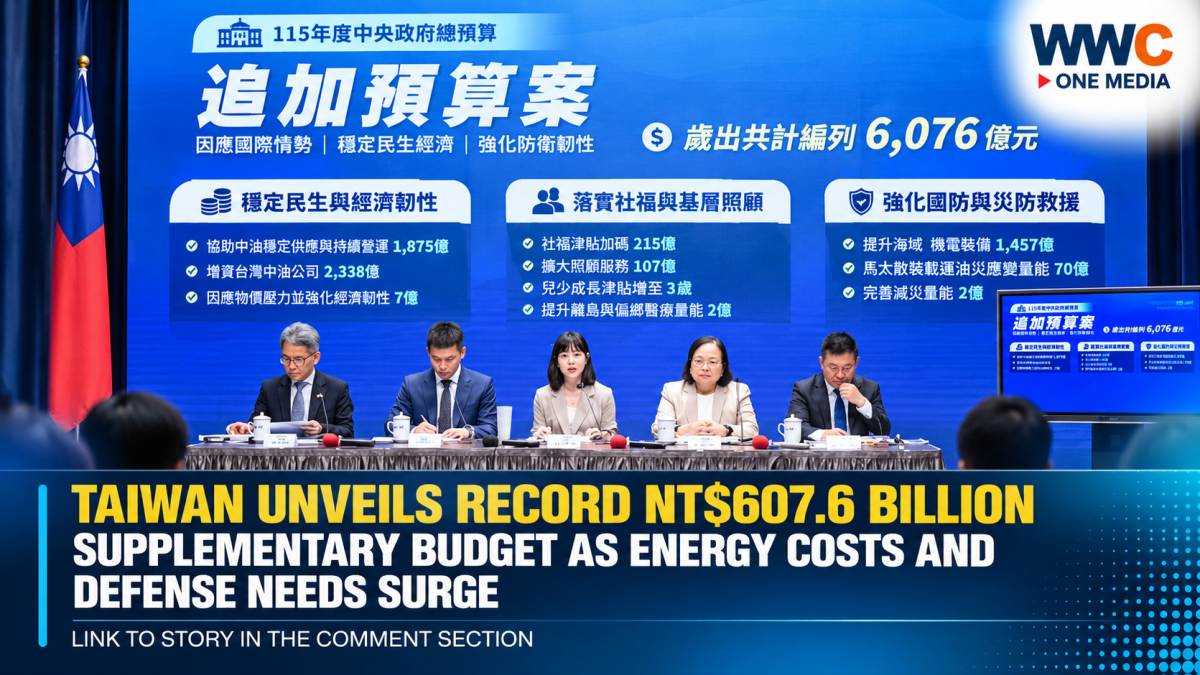
TAIPEI — September 4, 2026 — Taiwan’s government has approved a record NT$607.63 billion (about US$19.13 billion) supplementary budget, putting energy security, inflation relief and defense modernization at the center of a massive new spending proposal.
The Executive Yuan approved the package on Thursday, with NT$421.3 billion earmarked for economic stabilization and NT$145.69 billion for defense-related spending. The proposal still needs approval from Taiwan’s opposition-controlled Legislative Yuan before the money can be released.
The size of the package—and the political fight already surrounding it—could make the proposal one of Taiwan’s most consequential budget battles of the year.
Why is Taiwan proposing such a huge package?
The government says the supplementary spending is designed to respond to several pressures at once, particularly higher energy costs linked to conflicts in the Middle East, economic stabilization and urgent national-defense requirements.
One of the biggest allocations is a proposed NT$233.8 billion capital injection for CPC Corp., Taiwan, the state-run oil and gas company.
Government officials say CPC has accumulated losses partly because it has invested heavily in liquefied natural gas infrastructure and supply chains while keeping domestic fuel prices below what they otherwise might have reached. The government also considers CPC’s LNG infrastructure strategically important to Taiwan’s energy resilience.
The package also includes NT$187.5 billion aimed at offsetting inflationary pressures associated with the continuing Middle East conflicts.
That money would help cover measures involving fuel and household gas prices, electricity, domestic air travel, taxi fuel, fertilizer, fishing-fleet fuel and harbor-related costs.
The fuel-price pressure is significant
Taiwanese officials said international energy prices have surged amid the conflict involving the United States and Iran.
Vice Minister of Economic Affairs Lai Chien-hsin said crude oil had reached US$144 per barrel during the period of extreme price pressure.
According to the government, CPC’s price-stabilization measures have helped prevent an even sharper increase at Taiwanese fuel pumps. Without those controls, gasoline could have reached approximately NT$45 per liter, officials said, potentially adding NT$1,000 to NT$2,000 a month to the fuel expenses of an average commuter.
The government has also proposed keeping household natural-gas prices unchanged for the rest of the year, but officials said that would depend on the supplementary budget being approved.
Defense spending is the other major flashpoint
While energy and economic stabilization account for the largest share of the package, the NT$145.7 billion defense allocation is arguably the most geopolitically significant.
Reuters reported that the proposed funding would support systems including Strong Bow anti-ballistic missiles, more than 600 coastal surveillance and reconnaissance drones, more than 40,000 coastal attack drones and more than 100 small unmanned surface vessels.
Taiwan’s Defense Ministry has described the additional funding as urgent, arguing that previous legislative cuts left gaps in planned military capabilities.
The supplementary defense allocation includes:
- NT$55.9 billion for three types of uncrewed systems
- NT$13 billion for seven defense programs, including the domestically developed Chiang Kung, or Strong Bow, missile system
- NT$7.3 billion to replenish urgent ammunition stocks
- NT$900 million for the Taiwan Tactical Network
- NT$64.5 billion for two classified programs.
The government says the military wants procurement of coastal reconnaissance and attack drones to begin this year, while deliveries of small one-way unmanned surface vessels are expected from 2027.
Taiwan’s defense spending could cross NT$1 trillion
The additional allocation could push Taiwan’s total defense-related spending above NT$1 trillion this year, according to the South China Morning Post’s analysis of the Cabinet proposal.
The additional spending would raise defense expenditure from roughly 3.32% to about 3.83% of GDP, although the supplementary budget itself remains subject to legislative approval.
The development comes as President Lai Ching-te’s administration continues to push for greater military preparedness and domestic defense production amid escalating pressure from Beijing.
Reuters reported that Taiwan’s government has made defense modernization a central policy priority as China’s military pressure on the island increases.
But Taiwan’s opposition is already pushing back
The budget is unlikely to pass without a political fight.
Taiwan’s opposition-controlled Legislature has promised to scrutinize the proposal, with the Kuomintang (KMT) and Taiwan People’s Party (TPP) questioning both the defense allocations and the large proposed capital injection for CPC.
Opposition lawmakers have argued that the CPC funding may not satisfy the legal conditions for a supplementary budget and have questioned why such a large amount is being directed toward the state-run energy company.
The KMT has also said the defense spending must comply with the opposition-backed legislation designed to strengthen Taiwan’s domestic drone industry.
The TPP, meanwhile, has questioned the government’s use of a supplementary budget to address CPC’s losses, arguing that the company’s financial problems have accumulated over several years rather than being caused by a single extraordinary event.
Those are opposition allegations and legal arguments—not a court ruling that the budget is unlawful.
A second battle is brewing over Taiwan’s drone strategy
The dispute over drones is particularly complicated.
Last month, Taiwan’s Legislature approved a six-year NT$240 billion plan for drone development and procurement, while rejecting a competing government proposal for NT$210 billion.
The newly proposed supplementary budget now seeks additional funding for drone-related capabilities.
The government argues that the funding is needed to maintain the military’s planned force-development schedule after lawmakers previously cut NT$470 billion from the Cabinet’s proposed NT$1.25 trillion special defense package.
Taiwan’s military has also set an ambitious goal of acquiring 40,000 coastal attack drones by next year, alongside hundreds of reconnaissance drones and unmanned surface vessels.
That makes the budget more than simply an accounting exercise—it is also part of Taiwan’s broader effort to build a more domestically supported defense industry.
The government says the budget will not add to national debt
Despite its unprecedented size, Cabinet officials say the supplementary budget has been structured so that it will not affect fiscal planning or increase national debt, according to Taipei Times.
The administration is now asking lawmakers to approve the proposal.
But that claim will face scrutiny in the Legislature, particularly because the opposition parties control the chamber and have already raised legal and policy objections.
For ordinary Taiwanese households, the most immediate issue may be energy prices rather than military procurement.
For Taiwan’s national-security planners, however, the defense component could be just as important.
Why this matters beyond Taiwan
The proposal arrives at a particularly sensitive moment for the island.
Taiwan is trying to balance energy security, inflation control, economic stability and military preparedness while facing increasing strategic pressure from China.
The proposed package therefore represents two very different priorities at once:
At home: keeping fuel, gas and electricity costs under control.
On the security front: rapidly expanding drones, missile defenses, ammunition reserves and other military capabilities.
And with the Legislative Yuan now holding the power to scrutinize and potentially alter the proposal, the next battle is no longer whether Taiwan needs more spending—it is where that money should go, and under what legal framework.
Bottom line
Taiwan’s Cabinet has approved a record NT$607.63 billion supplementary budget, but it is not yet approved spending.
The proposal must clear the Legislature, where opposition lawmakers have already signaled intense scrutiny.
If approved substantially as proposed, the package would simultaneously provide major support for energy-price stabilization and economic relief while giving Taiwan’s military a significant new injection for drones, missile defense, ammunition and other capabilities.
The biggest question now is whether Taiwan’s divided Legislature will allow the Cabinet’s record-breaking package to move forward—or rewrite the priorities before a single dollar is released.
WWC ONE MEDIA J.M.D




Leave a Reply