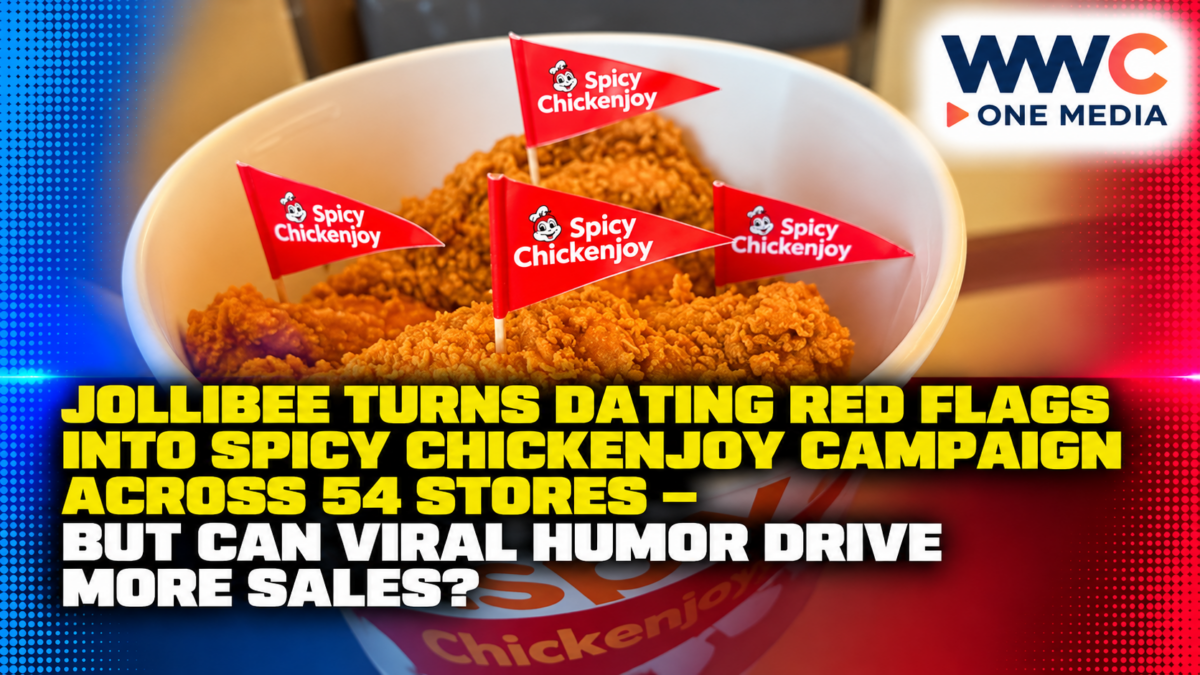
MANILA, PHILIPPINES — Filipinos are usually told to avoid red flags in relationships, but Jollibee Philippines is encouraging customers to embrace a different kind of warning sign: one that comes with its signature Spicy Chickenjoy.
The country’s popular fast-food brand has launched a playful marketing campaign called “The Only Red Flag You Want,” transforming the viral language of dating and relationship warnings into humorous miniature red flags that customers can enjoy alongside their meals.
The promotion runs from October 15 to November 15, 2026, at 54 participating Jollibee stores nationwide, or until supplies last.
Through the hashtag #TheOnlyRedFlagIWant, diners are encouraged to choose their favorite red-flag message, take photographs or videos and share their experiences on social media.
The campaign has already attracted online attention, with the phrase “JOLLY RED FLAG” reportedly trending on X, formerly Twitter.
But behind the witty slogans is a larger business strategy: turning a familiar fast-food purchase into something customers want to talk about, photograph and recommend.
Can Jollibee transform internet humor into stronger consumer loyalty and more Chickenjoy sales—or will the excitement fade as quickly as the next social media trend arrives?
JOLLIBEE GIVES RELATIONSHIP RED FLAGS A SPICY TWIST
The campaign takes inspiration from the internet’s fascination with relationship red flags.
In dating conversations, a red flag commonly refers to behavior that signals a potential problem.
On social media, the expression has evolved into a source of jokes, memes and humorous observations about romance.
Jollibee has adapted that language to promote Spicy Chickenjoy.
Instead of warning customers about troublesome relationships, its miniature red flaglets feature positive and funny messages associated with the product.
The idea is simple: create a memorable joke that customers can enjoy while eating.
The campaign demonstrates how a familiar internet expression can be incorporated into an everyday dining experience.
WHAT IS ‘THE ONLY RED FLAG YOU WANT’?
“The Only Red Flag You Want” is a limited-time promotional activation for Jollibee Spicy Chickenjoy.
Its central feature is a collection of miniature red flaglets containing humorous messages.
Customers at participating branches can select a flaglet, incorporate it into their Chickenjoy photographs and share the result with friends.
The approach creates opportunities for user-generated content.
Rather than simply viewing a traditional advertisement, consumers become participants in the campaign.
Their photographs, comments and videos may introduce the promotion to people beyond the participating stores.
However, the availability of the flaglets is limited, and the promotion does not apply to every Jollibee branch.
THE FUNNY RED FLAG MESSAGES
Jollibee’s campaign uses short, relationship-inspired messages that play on familiar dating expectations.
Among the published messages are:
- “Red flag na laging available for you”
- “Red flag na pwede ipakilala sa friends mo”
- “Red flag worth saying ‘yes’ to”
The first jokes about someone who is always available.
The second plays on the idea of introducing a partner to friends.
The third turns an apparent warning sign into something worth accepting.
The humor works because it contrasts the usual negative meaning of a red flag with an enjoyable food experience.
These simple messages provide material for photographs, captions and conversations.
Their short format also makes them easy to understand on mobile social media feeds.
PROMOTION RUNS UNTIL NOVEMBER 15
The campaign began on October 15 and is scheduled to continue until November 15, 2026.
However, availability is subject to remaining supplies.
Participating branches may run out of flaglets before the scheduled end date.
Customers should not assume that the promotional items will remain available at every location throughout the campaign.
The announcement also does not establish that flaglets are being distributed at all Jollibee restaurants nationwide.
The rollout is limited to 54 participating stores.
ONLY 54 PARTICIPATING JOLLIBEE STORES
The company confirmed that the special flaglets are available at 54 participating stores across the Philippines.
This is an important limitation.
Jollibee operates a much larger restaurant network, but only selected branches were included in the campaign announcement.
The reviewed reports do not provide a complete verified list of all 54 participating locations.
They also do not disclose the number of promotional flaglets allocated to each branch.
Consumers interested in participating should check Jollibee’s official channels or contact a branch to confirm availability.
It would be misleading to claim that every Jollibee branch offers the promotion.
HOW CUSTOMERS CAN PARTICIPATE
The promotional activity encourages customers to visit a participating Jollibee branch and enjoy Spicy Chickenjoy with one of the special flaglets.
Customers can select a preferred message, photograph their meal and share the experience online using #TheOnlyRedFlagIWant.
The campaign is designed for both casual diners and social media users who enjoy creating short videos and photographs.
However, the announcement does not establish a contest, guaranteed prize or financial reward for posting content.
There is also no verified indication that using the hashtag automatically qualifies participants for vouchers, cash prizes or other giveaways.
The promotion should be understood primarily as an interactive brand experience.
‘JOLLY RED FLAG’ GAINS ATTENTION ON X
One of the campaign’s early achievements is the online conversation surrounding its humorous concept.
Jollibee and several marketing publications reported that “JOLLY RED FLAG” trended on X.
The attention suggests that the idea connected with users familiar with relationship jokes and meme culture.
However, trending status is not the same as a verified sales increase.
The company has not disclosed the number of posts generated, total campaign impressions or engagement rates.
It has also not published a measured increase in Spicy Chickenjoy sales directly attributable to the campaign.
The online response provides evidence of promotional visibility, but not yet of commercial success.
JOLLIBEE MARKETING EXECUTIVE EXPLAINS THE STRATEGY
Jollibee Philippines vice president for marketing Dorothy Ching said the campaign reflects customers’ enjoyment of social media trends and creating content while dining.
The company wanted to bring the playful aspects of online culture into its restaurants.
The miniature flags give diners a physical item that can become part of photographs and videos.
This combination of real-world dining and online sharing is central to the campaign’s design.
Customers encounter the promotional item in a restaurant, but the resulting content can circulate beyond the location.
The strategy aims to make the Spicy Chickenjoy experience more memorable without requiring the company to introduce an entirely new menu product.
WHY INTERNET HUMOR MATTERS TO FAST-FOOD BRANDS
Digital marketing increasingly depends on understanding how consumers communicate online.
Memes and viral expressions can spread quickly because they are familiar, easy to repeat and adaptable to different situations.
For brands, these trends offer opportunities to participate in conversations already taking place.
A humorous campaign may be more likely to inspire sharing than a conventional product announcement.
However, trends can also become outdated quickly.
A campaign that feels timely today may become less interesting when online attention shifts elsewhere.
Successful trend-based marketing therefore requires both cultural relevance and a connection to the product being promoted.
Jollibee’s red-flag campaign attempts to achieve this by linking dating jokes directly to Spicy Chickenjoy’s identity.
SPICY CHICKENJOY WAS ALREADY AN EXISTING PRODUCT
An important reporting distinction is that Jollibee did not introduce Spicy Chickenjoy for the first time through the October red-flag campaign.
The spicy version of its signature fried chicken was already part of the brand’s offerings.
Earlier in August, Jollibee launched another promotional effort emphasizing the product’s flavor and enjoyable heat.
The previous campaign featured actress and singer Alexa Ilacad.
The October initiative builds on that broader marketing effort rather than announcing an entirely new fried chicken product.
The new development is the use of miniature promotional flags and viral dating humor.
ALEXA ILACAD HELPS PROMOTE SPICY CHICKENJOY
Alexa Ilacad has been featured in Jollibee’s wider Spicy Chickenjoy marketing.
In August 2026, the brand positioned her as a personality associated with the product’s energetic and playful image.
BusinessMirror documented the campaign, emphasizing the company’s effort to present spicy flavors as enjoyable rather than merely difficult to tolerate.
The later red-flag promotion follows a similar playful approach.
However, the October reports do not establish that Ilacad personally attended events at all 54 participating branches.
They also do not announce a celebrity meet-and-greet as part of the flaglet promotion.
Any such appearance would require a separate official announcement.
JOLLIBEE BETS ON FILIPINOS’ APPETITE FOR SPICY FOOD
The company’s earlier Spicy Chickenjoy campaign cited research indicating that approximately 13% of surveyed Filipino adults identified spicy flavors as a taste preference.
This suggests a market segment interested in food with more heat.
However, the finding should not be interpreted as proof that 13% of all Filipinos regularly purchase Spicy Chickenjoy.
The research concerns taste preference among surveyed adults, not product sales.
It also does not establish that every consumer who enjoys spicy food will choose Jollibee over competing restaurants.
The company’s marketing approach attempts to make the product appealing through both flavor positioning and entertaining promotional content.
USER-GENERATED CONTENT EXTENDS THE DINING EXPERIENCE
The campaign gives customers an easy way to create social media content.
A miniature flag placed beside a meal can become the focus of a photograph.
The message may then inspire a humorous caption or a short video.
Friends who see the post may recognize the joke and respond with their own experiences.
This creates an opportunity for the campaign to spread beyond paid advertising.
However, user-generated content also means that companies do not control every public reaction.
Some consumers may find the campaign entertaining, while others may be indifferent.
A viral idea must still offer a satisfying product and dining experience to support repeat purchases.
LIMITED-TIME PROMOTIONS CREATE A REASON TO PARTICIPATE
By limiting the flaglets to 54 branches and setting a November 15 end date, Jollibee creates a defined period for participation.
Limited-time promotional items may encourage customers to visit while supplies are available.
The format also gives consumers something different from an ordinary meal presentation.
However, there is no evidence that the promotional flags are being sold as collectible products.
The announcement does not provide a resale value or indicate that customers can purchase complete sets independently.
It also does not establish that the promotion includes discounted Chickenjoy prices.
The campaign’s principal attraction is its humor and social media appeal.
CAN A VIRAL CAMPAIGN INCREASE RESTAURANT SALES?
From a business perspective, the key question is whether promotional attention translates into actual customer transactions.
A successful marketing campaign may generate awareness, encourage first-time purchases or increase repeat visits.
It may also strengthen consumers’ emotional connection with a brand.
But social media visibility and financial results are different measures.
The company would need to disclose relevant sales information to demonstrate a measurable increase caused by the red-flag campaign.
At present, the public announcement does not include transaction figures, incremental revenue or return on marketing spending.
Any assertion that the campaign has already increased Spicy Chickenjoy sales by a specific percentage would be unsupported.
JOLLIBEE GROUP REPORTED STRONGER SECOND-QUARTER EARNINGS
The promotional campaign comes against a wider business backdrop.
Jollibee Foods Corporation reported approximately ₱3.4 billion in net income attributable to parent shareholders for the second quarter of 2026.
That represented a 5.7% increase compared with the same period in 2025.
The company also reported consolidated second-quarter revenue growth of 10.7%.
Philippine system-wide sales increased 5.7%, with the Jollibee brand contributing 6.6% growth.
These results reflect broader restaurant operations during April through June.
They cannot be attributed to the October red-flag campaign, which began several months later.
FIRST-HALF PROFITS SHOW A MORE COMPLEX PICTURE
Although Jollibee Group reported record second-quarter parent-attributable earnings, its complete first-half results were less favorable.
According to its Philippine Stock Exchange financial filing, first-half net income attributable to parent shareholders declined approximately 13.3% to ₱4.87 billion.
First-half gross revenue increased approximately 9.9% to ₱163.62 billion.
The distinction illustrates why financial reporting should examine comparable periods carefully.
Strong performance in one quarter does not necessarily mean profits increased over the entire first half.
Likewise, a successful promotional concept does not automatically solve broader cost pressures affecting the restaurant industry.
RISING COSTS REMAIN A CHALLENGE FOR RESTAURANT OPERATORS
Fast-food companies must manage expenses involving ingredients, labor, transportation, utilities and restaurant operations.
Price adjustments may help offset some costs, but they can also affect consumer purchasing decisions.
Jollibee Group’s August financial announcement discussed pricing and productivity measures intended to support profit margins.
Marketing campaigns such as the red-flag promotion operate within that wider commercial environment.
A humorous promotion may attract attention, but long-term profitability still depends on food quality, customer service, pricing and operational efficiency.
Jollibee must balance those factors while competing for Filipino consumers’ spending.
THE CAMPAIGN REFLECTS A SHIFT TOWARD PARTICIPATORY ADVERTISING
Traditional restaurant advertising often emphasizes taste, price, ingredients or convenience.
The #TheOnlyRedFlagIWant campaign takes a different approach.
It provides a small physical prop that becomes part of a customer’s experience.
The customer then decides whether to share that experience online.
This approach encourages participation rather than relying solely on one-way promotional messaging.
It may also help a brand appear more connected to contemporary online humor.
However, this does not mean traditional advertising has become ineffective.
Brands typically combine several approaches, including mass advertising, product promotions, digital content and in-store experiences.
The red-flag activation is one component of Jollibee’s broader marketing strategy.
WHAT OTHER NEWS OUTLETS CONFIRM
InsiderPH reported the campaign on October 28, emphasizing the humorous flaglets and online attention.
MARKETECH APAC independently published coverage confirming the campaign’s name, rollout dates and 54 participating branches.
Interaksyon, part of the Philstar Media Group, discussed the initiative in its October 23 food news roundup.
Orange Magazine and Manila Republic also documented the promotional messages and customer participation mechanics.
BusinessMirror’s earlier reporting provides background on Jollibee’s August Spicy Chickenjoy campaign with Alexa Ilacad.
Jollibee Group’s official August financial announcement and Philippine Stock Exchange filing establish the wider corporate performance context.
Together, these sources support the existence, timing and structure of the campaign.
However, much of the campaign coverage uses the same company-provided publicity material.
The reporting does not independently verify a specific number of promotional red flags distributed or establish that the campaign has generated additional profits.
WHAT CUSTOMERS SHOULD KNOW BEFORE VISITING
Consumers who want to participate should first confirm that their preferred Jollibee branch is among the participating locations.
The campaign covers 54 selected stores.
Promotional flaglets are scheduled to be available through November 15, 2026, while supplies last.
Customers can participate by choosing a flaglet, photographing their Spicy Chickenjoy and sharing the experience using #TheOnlyRedFlagIWant.
However, the public announcement does not establish that every meal includes a flaglet or that supplies are unlimited.
It also does not specify a nationwide fixed price, automatic discount or guaranteed reward for social media posts.
The safest approach is to verify current participation conditions through official Jollibee channels.
THE BIGGER QUESTION: CAN JOLLIBEE TURN INTERNET HUMOR INTO LASTING BRAND LOYALTY?
Jollibee’s “The Only Red Flag You Want” campaign demonstrates how a familiar online joke can become a memorable fast-food promotion.
By combining Spicy Chickenjoy with playful red flags, the company has created an experience that encourages photography, conversation and social media sharing.
The concept has already attracted publicity and reportedly gained trending attention on X.
Its limited rollout across 54 branches adds a sense of exclusivity.
But the long-term business impact remains unknown.
A trending phrase can generate conversation without necessarily increasing sales.
A fun promotional item can attract attention without guaranteeing repeat visits.
For Jollibee, the challenge is turning short-lived digital excitement into meaningful customer relationships.
The true measure of the campaign will be whether it strengthens Spicy Chickenjoy’s appeal and encourages customers to return after the limited-time flaglets disappear.
And as Filipino diners continue sharing their favorite relationship red flags online, one important question remains:
Will Jollibee’s spicy take on dating humor become a marketing success that drives lasting customer demand—or will its viral appeal fade once the next internet trend takes over?