
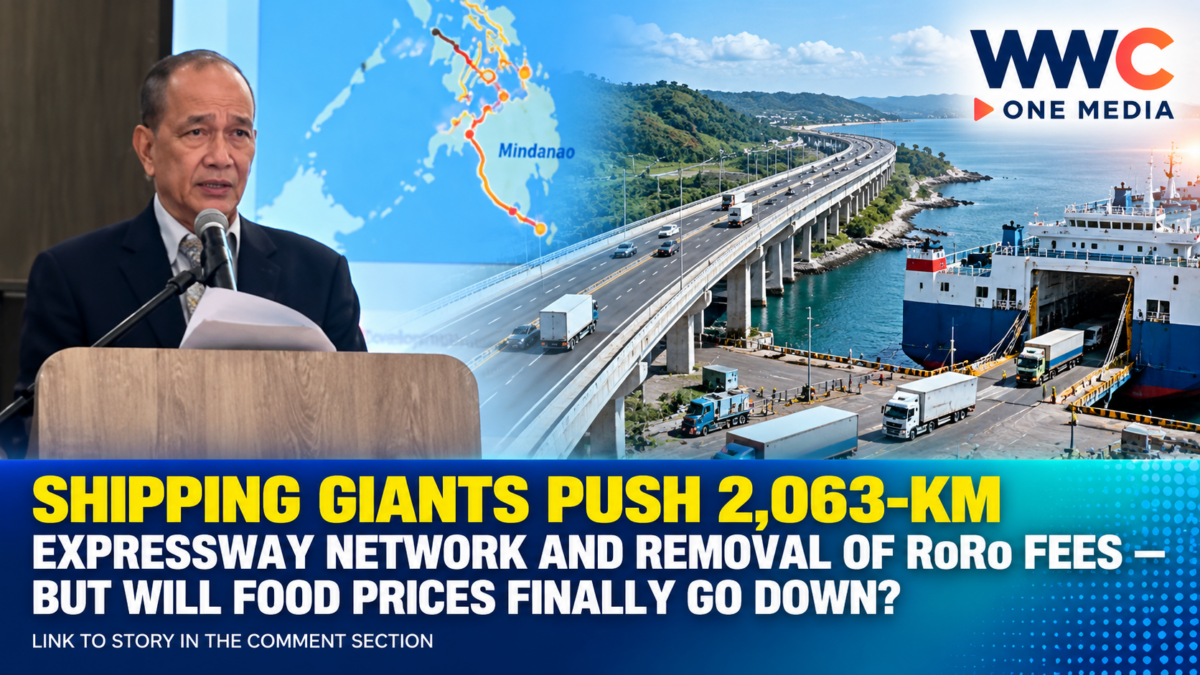
CEBU CITY, PHILIPPINES — A powerful group of domestic shipping operators is calling for a major transformation of the Philippines’ transportation network, proposing eight strategic expressway corridors and the removal of roll-on/roll-off (RoRo) terminal fees to reduce logistics costs and ease pressure on consumer prices.
The Philippine Coastwise Shipping Association (PCSA), representing more than 50 shipping companies operating over 800 vessels, believes the country must rethink how highways, ports and ferries connect its major islands.
The proposal comes at a time when businesses and consumers are confronting high transportation costs, elevated fuel prices and the challenges of transporting goods between Luzon, the Visayas and Mindanao.
At its October 23 general membership meeting at NUSTAR Resort and Casino in Cebu City, PCSA chairman Lucio Lim Jr. urged the Marcos administration to commission feasibility studies for an integrated network of expressways.
He also called for RoRo vessels and their terminals to be recognized as extensions of the country’s highway system.
The association argues that reducing transport costs could make agricultural products, construction materials and other essential goods more affordable.
But the proposals raise a major question: Could rebuilding the country’s inter-island logistics system finally ease the cost pressures faced by Filipino households?
SHIPPING GROUP CALLS FOR A MAJOR TRANSPORTATION OVERHAUL
According to InsiderPH’s October 26 report, PCSA is pushing for greater government attention to infrastructure development outside Luzon.
Its chairman, Lucio Lim Jr., who also operates Lite Shipping Corporation, said inefficient roads and expensive inter-island transportation continue to affect regional businesses.
For many Philippine companies, moving products requires a combination of trucks, ports and ferries.
Agricultural goods may travel from farms to distribution centers, then through highways and RoRo vessels before reaching urban markets.
Each stage introduces expenses involving fuel, labor, tolls, port charges, equipment and waiting time.
When delivery expenses rise, businesses may face pressure to adjust their selling prices.
For consumers, those increases can become particularly noticeable in products that need frequent transportation, such as fresh food.
PCSA believes improving transport efficiency should be treated as a national economic priority rather than merely an issue affecting shipping operators.
EIGHT PROPOSED EXPRESSWAYS COULD CHANGE REGIONAL CONNECTIVITY
The association has identified eight road corridors that it believes deserve comprehensive feasibility studies.
Together, the proposals cover approximately 2,063 kilometers.
The proposed routes are:
- Cebu: Bogo City to Santander — 230 kilometers. Intended to improve north-to-south road connections and access to major ferry routes.
- Panay: Caticlan, Aklan, to Iloilo City — 214 kilometers. A potential transport corridor linking northern tourism and commercial gateways with Iloilo.
- Negros: Bacolod City to Dumaguete City — 216 kilometers. A proposed connection between major economic centers on the island.
- Oriental Mindoro: Calapan City to Roxas — 121 kilometers. A corridor linking important RoRo gateways.
- Masbate: Aroroy to Esperanza — 156 kilometers. Intended to support movement across the island.
- Samar and Leyte: Allen, Samar, to Liloan, Southern Leyte — 406 kilometers. A long-distance corridor involving major transport routes across the Eastern Visayas.
- Western Mindanao: Dapitan City to Zamboanga City — 329 kilometers. Proposed to strengthen connectivity between major western Mindanao destinations.
- Eastern and Southern Mindanao: Surigao City to Davao City — 391 kilometers. A potential transport link between important Mindanao gateways and commercial areas.
These corridors were identified by the shipping association, not announced as eight fully approved national expressway projects.
The exact alignments, costs, environmental requirements and financing models would still require government and engineering assessment.
PANAY COULD BENEFIT FROM THE CATIClAN–ILOILO CORRIDOR
One proposal particularly relevant to Western Visayas is the 214-kilometer corridor linking Caticlan in Aklan with Iloilo City.
Caticlan is an important gateway for visitors traveling to Boracay and an access point for inter-island transportation.
Iloilo City serves as a major commercial, educational and logistics center.
A higher-capacity road network could potentially improve cargo movement between transport gateways and regional markets.
That could matter for agriculture, retail distribution, tourism supplies and businesses operating across Panay.
However, the corridor is still only a proposal for study.
There is no verified government commitment in the reporting reviewed to construct the entire 214-kilometer route as an expressway.
Any eventual project would need to address land acquisition, environmental impacts, financing and coordination with communities along its alignment.
CEBU, NEGROS AND MINDANAO COULD ALSO SEE MAJOR BENEFITS
PCSA’s proposed Cebu corridor would connect Bogo City in the north with Santander in the south.
The association believes stronger road connectivity could reduce congestion and make truck movements more efficient.
In Negros, the proposed Bacolod-to-Dumaguete corridor could help connect commercial centers and improve the movement of agricultural and manufactured products.
For Mindanao, the proposed Surigao-to-Davao and Dapitan-to-Zamboanga routes could support longer-distance travel between ports, production areas and major cities.
These improvements may be particularly useful for goods that require timely delivery.
However, infrastructure benefits depend on actual design, traffic volumes and the connectivity of surrounding roads.
An expressway cannot solve port congestion, inadequate shipping capacity or supply-chain problems on its own.
The road network must function as part of an integrated system.
RORO TERMINAL FEES COULD ACCOUNT FOR UP TO 15% OF SOME FREIGHT COSTS
Alongside the expressway proposals, PCSA is calling for the elimination of RoRo terminal charges.
According to Lim, those charges typically represent approximately 5% to 10% of the total freight cost of a 10-wheeler truck.
On certain short-haul routes, the association estimates that the share can reach 15%.
The figures refer to the industry’s estimated share of freight costs, not a verified percentage of the final retail price of food.
For shipping companies and truck operators, removing such fees could reduce the amount paid when transporting rolling cargo through ports.
Those savings may eventually benefit merchants and consumers.
However, a lower transport expense does not guarantee an equivalent decline in product prices.
The final effect depends on competition, the number of intermediaries, demand and whether businesses pass savings along the supply chain.
PPA ALREADY CUT SOME AGRICULTURAL RORO FEES TO JUST ₱1
The shipping group’s proposal comes after a significant policy change by the Philippine Ports Authority (PPA).
In March 2026, the agency announced a temporary reduction of RoRo terminal fees to just ₱1 for eligible vehicles carrying raw and unprocessed agricultural products.
The measure was implemented under PPA Administrative Order No. 003-2026.
Eligible cargo includes specified agricultural products such as rice, corn, fruits, vegetables, fishery products and live livestock or poultry.
The reduced fee applies to qualifying vehicles and shipments, not automatically to every RoRo passenger or cargo operation.
Before the reduction, the PPA identified applicable fees of approximately ₱258 for certain light delivery vehicles and ₱516 for heavy delivery trucks under the referenced categories.
The policy illustrates that targeted fee reductions have already been introduced to support agricultural transport.
However, PCSA’s latest proposal is broader.
The association wants a more fundamental restructuring of RoRo terminal charges and their role in the national transport system.
The difference matters because it would be inaccurate to suggest that no fee relief has been implemented.
SHIPPING GROUP WANTS RORO PORTS TREATED LIKE BRIDGES
One of PCSA’s most ambitious proposals involves changing the way the government classifies RoRo infrastructure.
Lim argues that RoRo vessels effectively connect highways separated by water.
Under that interpretation, ferry terminals can function as extensions of the road network, just as bridges connect roads across rivers and other obstacles.
The association has suggested transferring the management and maintenance of some RoRo ports outside the main ports administered by the PPA and Cebu Port Authority to the Department of Public Works and Highways (DPWH).
The objective would be to treat these facilities more directly as national transportation infrastructure.
Lim cited examples from Japan and Norway, where ferry services can be integrated into broader transportation systems.
However, applying a similar framework in the Philippines would require careful review.
Port administration involves specialized safety, navigation, maintenance, security and operational responsibilities.
Changes in jurisdiction could require new laws, regulations or agreements between government agencies.
WHO WILL PAY FOR PORT OPERATIONS IF FEES DISAPPEAR?
The proposal raises a significant financial question.
RoRo ports require ongoing funding for maintenance, personnel, safety facilities, lighting, security and equipment.
Terminal fees provide revenue that can help support those services.
If charges are eliminated, the government would need to determine how the costs will be funded.
One possibility would be greater reliance on national budget appropriations.
Another could involve restructuring port revenue arrangements or introducing alternative financing systems.
However, transferring a cost from port users to taxpayers does not eliminate the underlying expense.
It changes who pays for it.
For this reason, any proposal to abolish terminal fees should include an assessment of replacement funding, operational efficiency and the fiscal impact on government agencies.
SunStar Cebu also noted that the shipping group had not presented a complete funding mechanism for replacing lost terminal revenue.
That remains a critical issue for policymakers.
CAN FASTER TRANSPORT HELP LOWER FOOD PRICES?
The association believes transport improvements could help ease inflationary pressure.
Its reasoning is based on the relationship between logistics costs and product prices.
Farm products often pass through multiple stages before reaching consumers.
Transportation, handling, storage and distribution all contribute to the total cost.
When these expenses rise, businesses may adjust their prices to maintain operating margins.
Faster highways and more efficient ferry systems could potentially reduce fuel consumption, waiting times and other expenses.
For perishable products, shorter delays may also help prevent spoilage.
However, food prices depend on more than transportation.
Agricultural production, weather conditions, imports, international commodity prices, electricity, labor and retail competition also matter.
Consequently, reducing RoRo terminal fees would not automatically solve inflation or guarantee cheaper food nationwide.
The benefits would need to be measured in actual supply chains.
SLEX TR5 CITED AS A MODEL FOR REGIONAL EXPRESSWAYS
Lim pointed to San Miguel Corporation’s proposed South Luzon Expressway Toll Road 5 project as an example of the infrastructure model PCSA envisions.
The proposed four-lane expressway would stretch approximately 420 kilometers from Lucena City in Quezon to Matnog, Sorsogon.
According to the shipping group’s presentation, the project is expected to shorten travel time along the corridor from around 15 hours to five hours upon completion.
That reduction remains a project estimate, not a demonstrated travel time on a completed expressway.
PCSA believes similar investments in the Visayas and Mindanao could improve truck efficiency and encourage regional economic development.
But each proposed expressway would require its own feasibility study.
Potential benefits must be weighed against construction costs, toll affordability, environmental effects and projected traffic demand.
PUBLIC-PRIVATE PARTNERSHIPS COULD HELP FINANCE THE NETWORK
The shipping association has suggested public-private partnerships as one financing option.
Under a PPP arrangement, private companies may help finance, build, operate or maintain infrastructure under contracts with the government.
This approach can mobilize capital and specialized expertise.
However, private investment generally requires a commercially viable revenue model.
For toll roads, profitability can depend on traffic volumes, toll rates and operating costs.
In areas with lower traffic demand, a conventional toll-road model may be less financially attractive.
The association also suggested multiyear congressional appropriations as another potential funding mechanism.
Such an approach would require the government to balance the proposals against other infrastructure priorities and fiscal constraints.
No verified construction budget or national rollout schedule for all eight corridors has been established.
GOVERNMENT OFFICIALS HEAR THE SHIPPING INDUSTRY’S PROPOSALS
The PCSA presented its recommendations during its general membership meeting in Cebu City on October 23.
Undersecretary Bret Monsanto attended on behalf of Cabinet Secretary Benhur Abalos.
Abalos, who was unable to join the meeting in person, delivered a video message expressing willingness to listen to concerns from the shipping industry.
Monsanto said he would relay the association’s recommendations to the Office of the Cabinet Secretary.
The participation of government representatives demonstrated that the proposals were being raised through official channels.
However, attendance and expressions of support should not be interpreted as formal project approval.
The government has not been independently verified to have adopted all eight corridors or approved the wholesale elimination of RoRo terminal fees.
WHAT INDEPENDENT REPORTING REVEALS
SunStar Cebu reported the shipping group’s proposals on October 23, highlighting the eight corridors, terminal fee concerns and the unresolved question of replacement port funding.
The Philippine Daily Inquirer also covered the call to remove RoRo terminal fees on October 24.
Regional reporting emphasized the effect of transport expenses on inter-island commerce and household prices.
Meanwhile, the PPA’s own 2026 announcements confirm that a limited ₱1 terminal-fee policy already applies to qualifying agricultural shipments.
Together, these sources establish a clearer picture.
The shipping group’s broader reform proposals are genuine, but they are not yet implemented government policy.
The proposed expressways remain subject to feasibility, financing and regulatory evaluation.
And while some port charges have been temporarily reduced for agricultural cargo, a wider abolition of terminal fees would require further action.
THE BIGGER QUESTION: CAN THE PHILIPPINES BUILD A CONNECTED ISLAND ECONOMY?
The debate over expressways and RoRo terminal charges reflects a fundamental challenge in Philippine development.
The country’s geography requires goods and passengers to move across both land and sea.
Road congestion, inefficient port procedures and multiple transport expenses can make that movement costly.
For businesses outside the traditional economic centers of Metro Manila and CALABARZON, these challenges can limit competitiveness.
For consumers, transportation expenses may contribute to higher prices.
PCSA’s proposals aim to address the problem by treating the nation’s roads, ports and RoRo services as parts of one connected system.
But achieving that vision would require substantial investment, effective project selection and coordination across government agencies.
The reforms would also need to preserve safe and financially sustainable port operations.
A network of faster roads and more efficient ferry terminals could strengthen domestic trade, but the real measure of success will be whether businesses and households experience meaningful savings.
And as the shipping industry urges the Marcos administration to act, one question remains:
Will the proposed 2,063-kilometer expressway network and removal of RoRo terminal fees finally make food and essential goods more affordable — or will the cost of building and maintaining the system become the next obstacle to solving the Philippines’ logistics problem?










