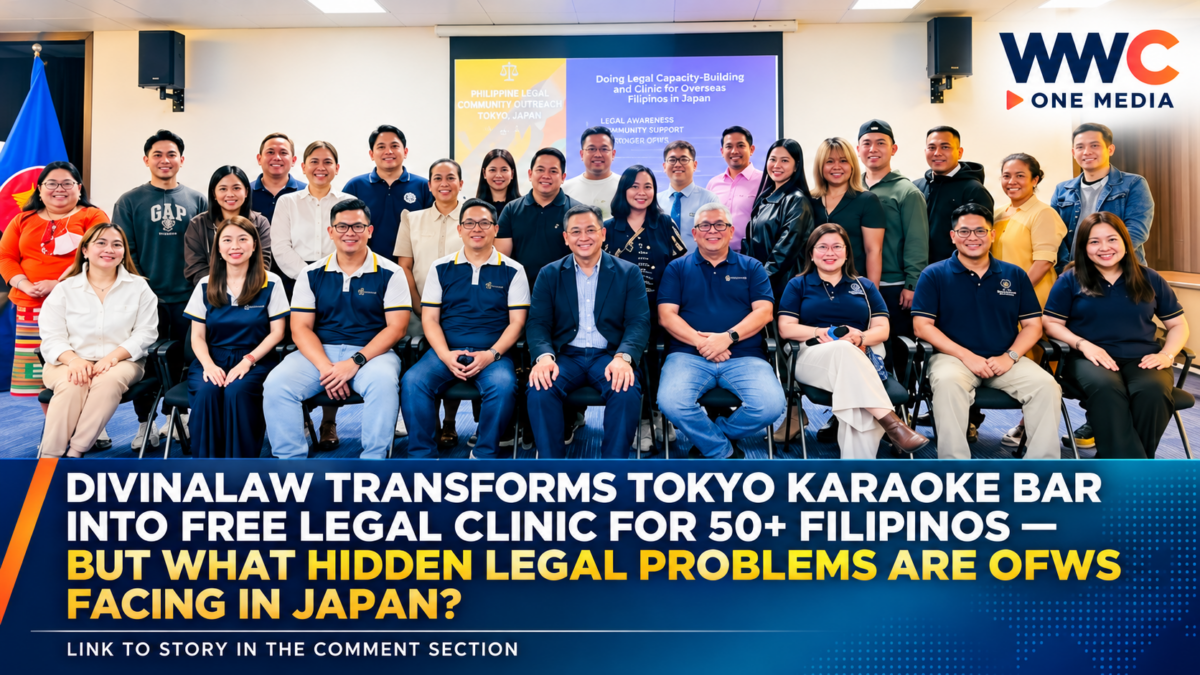
TOKYO, Japan — October 25, 2026 — A popular karaoke venue in Tokyo’s bustling Roppongi district became an unlikely center for legal assistance after Philippine law firm DivinaLaw transformed part of the entertainment establishment into a free consultation clinic for overseas Filipino workers (OFWs).
Instead of performing their favorite songs, more than 50 Filipino participants gathered on Saturday, October 24, to discuss serious legal concerns involving employment, immigration, family disputes, property investments, citizenship and divorce.
The unusual legal outreach, organized under DivinaLaw’s Dulog Legal program, was part of the firm’s 20th anniversary celebrations and highlighted the legal challenges that can follow Filipinos long after they leave their home country.
For many OFWs, the gathering offered something more valuable than entertainment: an opportunity to speak directly with Philippine lawyers without paying consultation fees.
From Karaoke Microphones to Legal Consultations
The event took place at Karaoke Kan Roppongi Honten in Tokyo’s Minato City, a venue associated with Filipina entrepreneur Abby Agwas Watabe and her Japanese husband.
The establishment’s familiar neon lights, karaoke screens and microphones remained, but the room was rearranged to accommodate face-to-face meetings between lawyers and Filipino residents.
Despite rainy weather, attendees arrived to seek guidance on legal issues that could affect their livelihoods, family relationships and financial security.
DivinaLaw founder and managing partner Atty. Nilo Divina traveled to Japan with senior partners and other lawyers to lead the outreach.
Divina, who also serves as dean of the University of Santo Tomas Faculty of Civil Law, emphasized that Filipinos should remain aware of their legal rights regardless of where they work.
“Your dignity does not end when you leave the airport. Your dignity goes with you wherever you go,” Divina told participants, according to InsiderPH.
His message underscored a concern for migrant workers: living overseas does not eliminate legal obligations or problems connected to the Philippines.
Jobs, Immigration, Property and Divorce: What OFWs Wanted to Know
The Tokyo legal mission addressed a wide range of concerns, including employment rights, immigration documents, marriage, family registration and property ownership.
Among the practical problems raised were unpaid wages, potential scams and questionable property transactions in the Philippines.
For Filipinos investing their earnings in land or houses back home, lawyers stressed the importance of checking ownership documents, confirming sellers’ identities and verifying property titles before releasing money.
Other concerns involved children born in Japan whose births had not been properly reported to Philippine authorities.
These registration issues can create complications when families later need Philippine civil registry records or other official documents.
Foreign divorce was another important subject.
A marriage legally dissolved in Japan does not necessarily cease to have legal effect in the Philippines without the appropriate recognition process.
The issue has become especially relevant for Filipino nationals who marry foreign citizens and later seek to clarify their civil status under Philippine law.
Philippine Supreme Court Moves to Ease Foreign Divorce Recognition
The legal discussion in Tokyo came amid an important development in Philippine family law.
On October 8, 2026, the Philippine Supreme Court announced amendments to the Rules of Court intended to simplify how Filipino spouses establish a foreign divorce when seeking judicial recognition in the Philippines.
Under the announced amendments, qualified petitioners would no longer be required to prove the applicable foreign law when filing their petition.
However, the changes do not eliminate the need for judicial recognition or alter the substantive requirements under Article 26(2) of the Family Code.
The Supreme Court has also previously clarified that certain divorces obtained through administrative procedures or mutual agreement abroad may qualify for recognition, provided the applicable legal requirements are met.
For affected Filipino families in Japan, these developments may reduce procedural difficulties, although individual cases still require careful legal assessment.
Filipina Entrepreneur Helps Bring Legal Assistance Closer to OFWs
One of the most compelling stories behind the event involved Abby Agwas Watabe, a Filipina entrepreneur who helped make the Tokyo legal mission possible.
Watabe, who began her career as an entertainer in Japan in the early 2000s, supported the initiative by providing the venue for the consultations.
She said overseas Filipinos need trustworthy legal professionals who can explain their rights and help them avoid costly mistakes.
Her participation turned a commercial entertainment space into a community venue where Filipinos could seek legal guidance without the usual consultation expenses.
Daily Tribune also reported that Philippine Embassy Acting Consul General Robert D. Quintin, representing Ambassador Mylene Garcia-Albano, expressed appreciation for the initiative and the support extended to the Filipino community.
DivinaLaw’s Free Legal Program Expands Beyond the Philippines
The Tokyo mission was not the firm’s first legal outreach.
Dulog Legal began in 2022 with a community-based initiative in Caloocan City before expanding to several Philippine provinces and overseas destinations.
Its international activities have included Chongqing, China, and Hong Kong, where Filipino communities received legal guidance on employment, property, family law and civil registry concerns.
During its 20th anniversary year, the law firm has also conducted outreach activities in Davao, Pampanga, Batangas and Cebu, with additional Philippine destinations being planned.
DivinaLaw has likewise strengthened its professional connections with Japan. In April 2026, it announced an affiliation agreement with Tokyo-based SAKURA Law Office as part of its wider international expansion.
These developments reflect the firm’s growing focus on providing services to clients and Filipino communities across borders.
Why Accessible Legal Assistance Matters for Filipinos Abroad
For overseas Filipinos, employment in another country can create legal responsibilities across two jurisdictions.
A worker may have to follow Japanese employment and immigration rules while simultaneously dealing with Philippine requirements involving marriage, inheritance, land ownership, civil registration or family disputes.
Language barriers, consultation costs and the difficulty of identifying reliable legal professionals can make these problems harder to resolve.
Legal outreach initiatives can help workers identify potential problems early, understand the documents they need and determine when more specialized assistance is necessary.
However, free consultations are generally a starting point. Complex disputes, immigration cases and litigation may require further professional representation and coordination with the appropriate authorities.
A Different Kind of 20th Anniversary Celebration
As DivinaLaw marks two decades in the Philippine legal industry, its Tokyo outreach offered a different way of commemorating the milestone.
Rather than focusing solely on corporate recognition, the firm brought its lawyers directly to an overseas Filipino community.
The unusual venue helped draw attention, but the deeper message concerned access to legal assistance.
Behind the karaoke lights were workers trying to protect their savings, clarify their family status and avoid legal difficulties that could follow them for years.
And as more Filipinos build their lives overseas, the Tokyo gathering raises a larger question: Should free, accessible legal assistance become a regular service for OFW communities around the world?