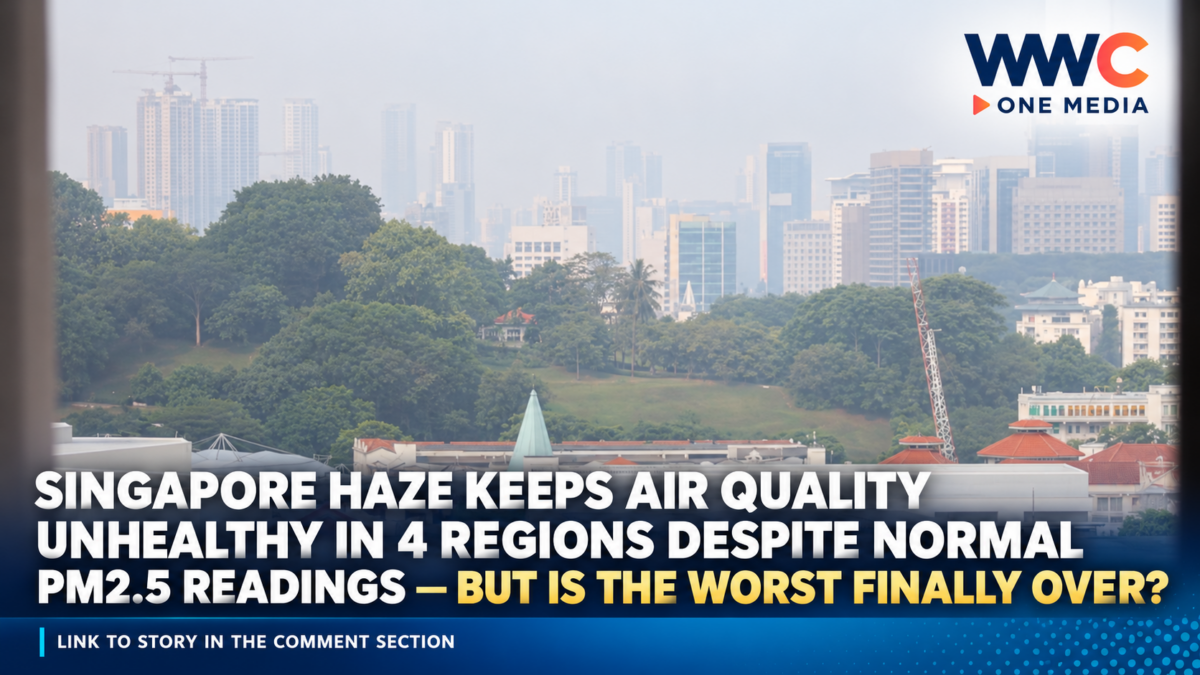
SINGAPORE | October 25, 2026 — Singapore’s battle with haze continued on Sunday morning as air quality remained unhealthy across four of the country’s five regions, even as improving fine-particle pollution readings offered fresh hope that the worst of the episode could be easing.
According to the National Environment Agency (NEA), the 24-hour Pollutant Standards Index (PSI) remained within the unhealthy range in most parts of Singapore at 10 a.m., raising continued concerns about outdoor activities, public health and the possible impact of smoke drifting from neighboring Indonesia.
However, a significant improvement emerged in the hourly PM2.5 readings, which returned to the normal band across all five regions.
The contrasting figures highlight a crucial question for residents: If fine-particle pollution readings are back to normal, why does Singapore’s overall air quality still carry an unhealthy classification?
Singapore Haze Update: Four Regions Still in Unhealthy Range
As of 10 a.m. Sunday, Singapore’s 24-hour PSI readings ranged from 100 to 132.
Southern Singapore recorded a PSI of 100, placing it at the upper limit of the moderate category.
The remaining four regions reported readings between 107 and 132, classified as unhealthy under Singapore’s air-quality standards.
Despite these elevated readings, hourly PM2.5 concentrations ranged from 31 to 48 micrograms per cubic meter across the country, falling within the normal band.
The improvement suggests that fine-particle pollution had eased in the preceding hour, even though Singapore’s 24-hour air-quality readings continued to reflect earlier pollution.
Why Is Singapore’s Air Quality Still Unhealthy?
The apparent contradiction between the PSI and PM2.5 readings comes down to how the two indicators measure air pollution.
Singapore’s 24-hour PSI reflects air quality over a longer period, incorporating concentrations of several major air pollutants.
Hourly PM2.5 readings, meanwhile, provide a more immediate indication of fine-particle pollution.
PM2.5 refers to airborne particles measuring 2.5 micrometers or smaller in diameter. These particles are particularly important during haze episodes because they can travel deep into the lungs.
As a result, hourly readings can improve before the 24-hour PSI returns to the moderate range.
This means Singapore’s improving short-term readings are encouraging, but they do not automatically signal that the overall haze episode has ended.
Smoke From Indonesia Adds to Regional Haze Concerns
The latest air-quality concerns follow reports of smoke from vegetation and land fires in Indonesia drifting toward Singapore.
In its October 24 advisory, NEA reported that smoke haze originating from Sumatra had been observed moving toward Singapore, while haze was also detected over parts of Kalimantan.
The regional dimension is particularly significant because transboundary haze has repeatedly challenged Southeast Asian governments, affecting public health, visibility, outdoor activities and environmental management.
Changes in wind direction, rainfall and fire activity can all influence how much smoke reaches Singapore.
On Saturday, October 24, the agency reported 24-hour PSI readings between 108 and 151 at 5 p.m., with the highest pollution levels recorded in western Singapore.
Hourly PM2.5 concentrations at that time ranged from 33 to 97 micrograms per cubic meter, indicating that conditions had improved in some areas while elevated pollution persisted elsewhere.
Rain and Changing Winds Could Bring Relief
Singapore’s environmental authorities have offered a cautiously optimistic outlook for the coming days.
NEA forecast that the 24-hour PSI for Sunday would range between 80 and 130, covering the moderate and unhealthy categories.
The agency also predicted that winds from the southwest or west could help limit the movement of smoke haze toward Singapore.
Showers forecast across Singapore and nearby areas could further improve air-quality conditions.
Similar winds were expected on Monday, October 26, and Tuesday, October 27.
If these weather conditions persist, they could help reduce pollution and improve visibility.
However, further improvements will depend on regional weather patterns and the extent of smoke generation from fires in surrounding areas.
Health Warning: Who Should Avoid Strenuous Outdoor Activities?
Despite the more encouraging PM2.5 readings, Singapore’s authorities have urged residents to continue taking precautions.
For planning outdoor activities on Sunday, NEA issued the following guidance:
- Healthy adults: Reduce prolonged or strenuous outdoor physical exertion.
- Children, elderly people and pregnant women: Minimize prolonged or strenuous outdoor activities.
- People with chronic heart or lung disease: Avoid prolonged or strenuous outdoor physical exertion.
For immediate activities, residents should check the latest hourly PM2.5 readings.
When those readings enter the elevated band, healthy individuals should reduce strenuous outdoor activity, while vulnerable groups should avoid strenuous exertion for the next hour.
NEA emphasizes that both air-quality indicators are useful, but serve different purposes.
The 24-hour PSI forecast supports advance planning, while the hourly PM2.5 reading provides guidance on more immediate activities.
Why Singapore’s Haze Situation Matters Beyond Its Borders
Singapore’s latest haze episode illustrates the environmental challenges shared across Southeast Asia.
Smoke from land and vegetation fires can travel across national boundaries, affecting communities far from where the fires originate.
The situation also raises broader questions about fire prevention, environmental enforcement, land management and cooperation among neighboring countries.
For Singapore, the immediate focus remains on protecting public health while monitoring regional conditions that can shift within hours.
For Indonesia and neighboring countries, preventing future episodes depends partly on addressing the fires and land-management practices that contribute to recurring transboundary pollution.
Is the Worst of Singapore’s Haze Finally Over?
The return of normal hourly PM2.5 readings across all five regions is a positive development, particularly after elevated pollution levels were reported earlier in the weekend.
Still, Singapore’s 24-hour PSI readings show that air quality had not fully recovered as of Sunday morning.
With rain and favorable winds expected, conditions could improve over the next several days.
But the trajectory remains uncertain, particularly if regional fire activity intensifies or changing winds carry additional smoke toward the island.
For millions of people living and working in Singapore, the question is no longer simply whether the haze will clear — but whether the improvement will last.
Residents can follow official air-quality readings and health advisories through NEA’s myENV app and haze.gov.sg.