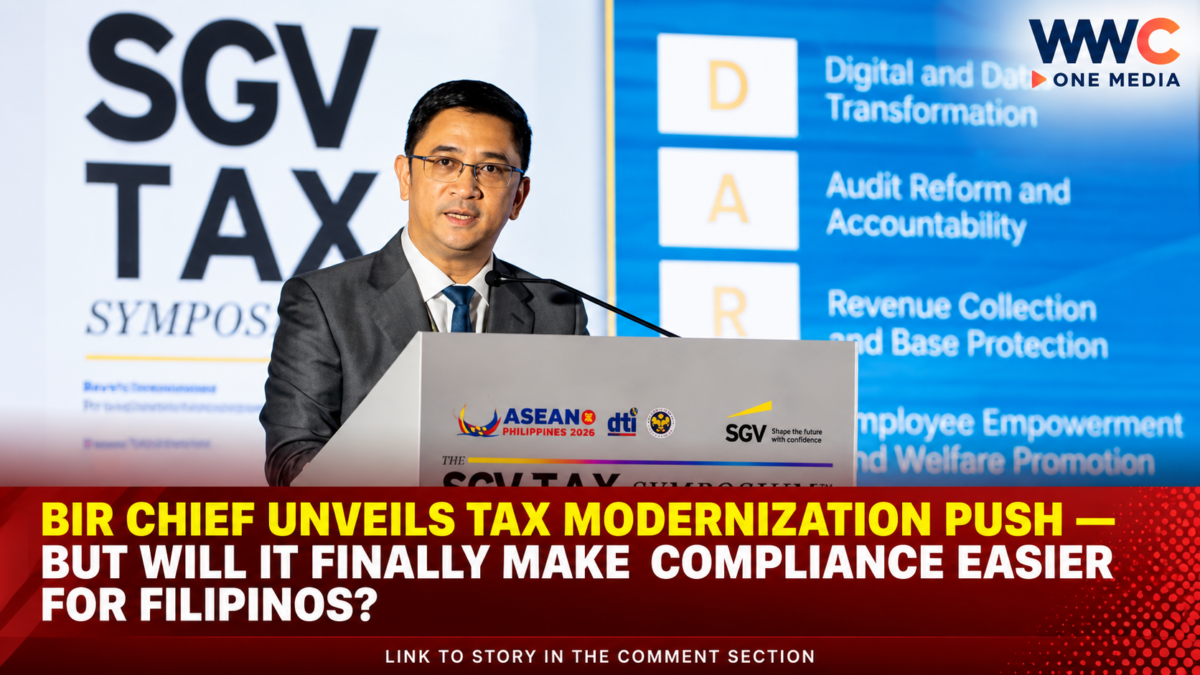
MANILA, Philippines — The Bureau of Internal Revenue (BIR) is pushing ahead with digital transformation and tax administration reforms as the government seeks to make compliance more efficient, strengthen enforcement, and improve accountability in the country’s tax system.
BIR Commissioner Charlito Martin R. Mendoza outlined the agency’s modernization priorities during the fifth SGV Tax Symposium, emphasizing immediate improvements for taxpayers alongside longer-term institutional changes designed to make tax administration more effective.
The reforms come as businesses and tax professionals continue to call for clearer regulations, more predictable audits, and stronger transparency in the collection and management of public revenues.
Digital services aim to simplify tax compliance
One of the BIR’s priorities is expanding the use of digital tools to make transactions more convenient for taxpayers and improve the agency’s ability to verify information.
Among the measures cited by Mendoza are QR-enabled certificates of registration and registration seal patches, which help the public verify whether online businesses and merchants are registered with the BIR.
The commissioner reported that approximately 53,000 online merchants and content creators had registered and obtained the BIR seal patch as of the period cited in his remarks.
The agency is also advancing its Electronic Invoicing System (EIS), which is intended to modernize the documentation of business transactions. Electronic invoicing could make tax reporting more efficient, improve audit verification, and help accelerate the processing of tax refunds.
The BIR has separately consulted private-sector stakeholders on the proposed electronic invoicing guidelines, with implementation requirements expected to apply according to the agency’s rules and applicable deadlines. The Philippine News Agency reported that taxpayers covered by the December 31, 2026 deadline were expected to comply, while other categories would be covered by separate guidelines. Source: PNA
New audit framework seeks greater predictability
Another major component of the modernization drive is audit reform.
The BIR has adopted a single-instance audit framework that generally limits taxpayers to one electronic Letter of Authority per taxable year, subject to applicable exceptions. The framework is intended to reduce overlapping examinations and make the audit process more predictable.
The agency has also pursued system-assisted, risk-based audit selection and stronger accountability mechanisms.
These measures form part of the BIR’s broader D.A.R.E.S. reform agenda:
- Digital and Data Transformation — modernizing tax systems and using data more effectively.
- Audit Reform and Accountability — improving audit procedures and oversight.
- Revenue Collection and Base Protection — strengthening compliance and addressing tax evasion.
- Employee Empowerment and Welfare Promotion — supporting professionalism and institutional capacity.
- Service Excellence and Stakeholder Engagement — improving taxpayer services and consultation.
In a separate report, GMA News described the BIR’s audit reform agenda as an effort to establish stricter safeguards and improve accountability in tax examinations. Source: GMA News
The success of these changes will depend not only on the rules themselves but also on consistent implementation, transparent procedures, and the ability of taxpayers to understand and challenge assessments through appropriate channels.
Tax transparency remains a broader policy challenge
The discussion at the SGV symposium also highlighted concerns beyond the BIR’s internal modernization program.
SGV & Co. Head of Tax Jules E. Riego called for the Philippines to revisit its strict bank secrecy rules and strengthen international financial information exchange as part of efforts to combat corruption and tax evasion.
Riego also pointed to the Philippines’ participation in international tax transparency arrangements, including the Common Reporting Standard (CRS), as an area requiring attention. The standard facilitates the automatic exchange of financial account information among participating jurisdictions for tax purposes.
The wider discussion reflects a challenge facing tax authorities worldwide: improving enforcement while protecting legitimate taxpayer rights and ensuring that financial information is handled under appropriate legal safeguards.
Greater access to reliable information can help authorities identify potential tax evasion and cross-border financial abuses. However, any changes to bank secrecy and information-sharing rules would require appropriate legal and policy action rather than administrative modernization alone.
Government also pursuing broader tax relief
The BIR’s modernization efforts are unfolding alongside proposed national tax reforms intended to ease the burden on individuals and businesses.
The Philippine News Agency reported in July 2026 that President Ferdinand Marcos Jr.’s tax reform agenda included proposals to expand income tax exemptions and exempt small businesses from the minimum corporate income tax.
The BIR said it was prepared to implement measures that Congress may enact while continuing reforms within its existing authority. Source: PNA
These proposals are distinct from the BIR’s administrative modernization program. Digital services and revised audit procedures can change how taxpayers interact with the agency, but changes to tax rates, exemptions, and other statutory obligations may require legislation.
For businesses, the combined policy direction could mean more streamlined transactions and more predictable tax administration, alongside changes in the tax rules if proposed legislation is approved.
What the reforms could mean for taxpayers
For ordinary taxpayers, entrepreneurs, online sellers, and larger corporations, the practical test will be whether modernization translates into fewer unnecessary procedures, more reliable digital services, clearer compliance requirements, and fairer audits.
The BIR must also balance convenience with effective enforcement. Better digital systems can help detect inconsistencies and improve revenue collection, but taxpayers will still need to maintain accurate records, issue the required invoices, file returns, and meet applicable deadlines.
Ultimately, the modernization agenda will be judged by its results: whether taxpayers receive better service, businesses face less uncertainty, and government revenue collection becomes more transparent and accountable.
The central question is no longer simply whether the Philippines can modernize its tax system. It is whether the reforms can deliver a system that is easier to comply with, fairer to taxpayers, and more effective at protecting public revenue.