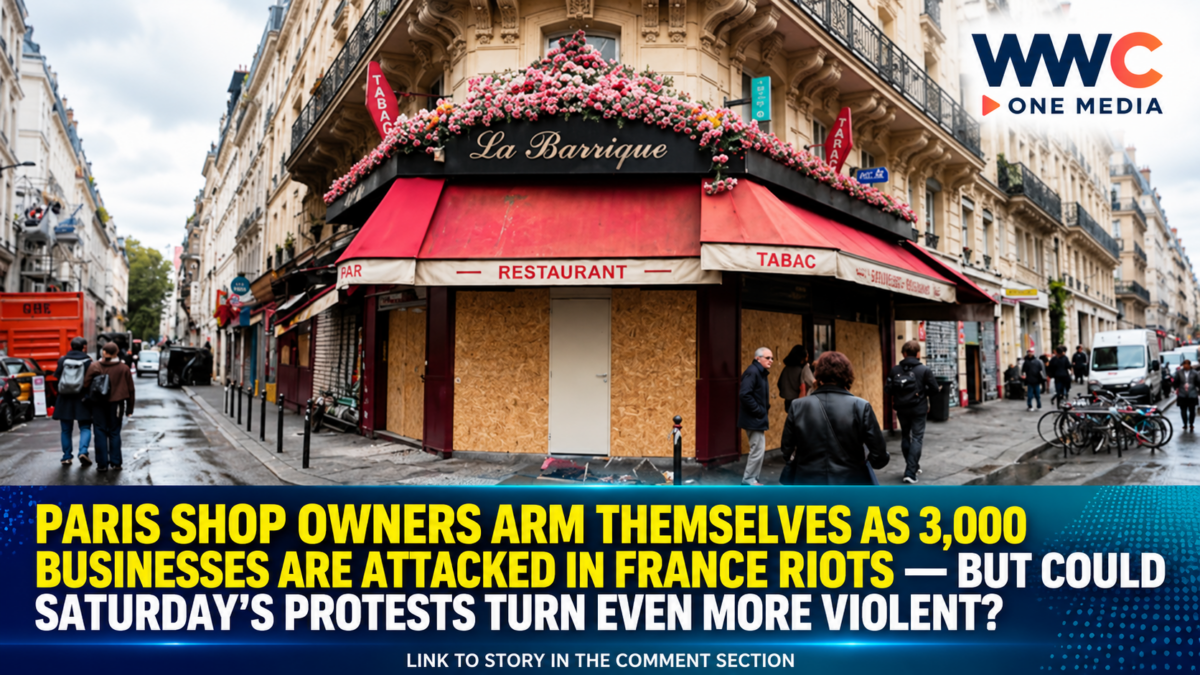
PARIS, FRANCE — October 23, 2026 — Fear is gripping parts of Paris as shop owners barricade storefronts, residents prepare to leave the capital, and businesses strengthen security ahead of another round of nationwide protests scheduled for Saturday, October 24.
France is struggling to recover from one of its most destructive episodes of civil unrest in years, after demonstrations over soaring living costs erupted into violent clashes, looting, vandalism and widespread property damage.
The latest wave of anxiety comes just days after the October 17 riots, when approximately 3,000 businesses across France were attacked, according to figures reported by AFP and Channel News Asia.
In Paris alone, police recorded 450 vandalized shops, including 228 that were looted.
Now, with more demonstrations approaching, one question hangs over the French capital: Can authorities prevent another outbreak of violence, or will the escalating confrontation between protesters and the government trigger an even deeper national crisis?
PARIS BUSINESSES PREPARE FOR ANOTHER POSSIBLE NIGHTMARE
Along Boulevard Magenta, a major commercial street in Paris, merchants have been installing wooden barriers over windows and entrances to protect their businesses.
The street was among the locations targeted during the previous weekend’s disorder, when masked individuals smashed windows and raided shops.
Although cleanup operations have continued, reminders of the violence remain visible across affected neighborhoods, including shattered glass, boarded-up storefronts and other debris.
For some business owners, preparing for another protest weekend has become a matter of personal safety.
Yves Gollet, a Paris gun-shop owner, told AFP that sales of legal weapons at his store had increased tenfold following the riots.
He said frightened merchants were purchasing defensive equipment after experiencing or witnessing violent confrontations with looters.
The reported surge in sales reflects growing concerns among business owners who fear another breakdown in public security.
However, the behavior of rioters and looters should not be confused with that of all demonstrators, many of whom are participating in protests over economic and social grievances.
STORE OWNERS FACE FEAR, LOSSES AND UNCERTAINTY
Behind the destruction are business owners struggling with damage, lost income and uncertainty over whether they can safely reopen.
Paris hairdresser Jose Guedj described the previous Saturday’s unrest as terrifying. His salon’s damaged glass entrance had been covered with protective boards.
Despite the experience, Guedj expressed hope that the government’s security preparations would prevent a repeat of the violence.
Another businessman, 60-year-old paint-store owner Emmanuel Renales, reportedly began sleeping inside his damaged shop following the attacks.
Renales said he was considering closing his business during the upcoming demonstrations.
The financial consequences extend far beyond individual storefronts.
Industry representatives estimate that the nationwide attacks have inflicted hundreds of millions of euros in damage, although a final verified economic loss figure has not yet been established.
FRANCE’S PROTEST MOVEMENT GROWS BEYOND ITS ORIGINAL DEMANDS
The unrest began with student demonstrations over inadequate educational resources, deteriorating school facilities and shortages of teaching staff.
But the protests have since expanded into a broader national movement fueled by frustration over living costs, economic inequality and public services.
According to reporting by Reuters, AFP and Channel News Asia, hundreds of thousands of people joined demonstrations across France on October 17.
The Yellow Vest movement, trade unions, students and other groups have become involved in the wider protests.
What began as a dispute over conditions in schools has evolved into a serious political challenge for President Emmanuel Macron’s administration.
The government must now confront public anger over economic conditions while preventing violence on the margins of otherwise legitimate demonstrations.
MACRON GOVERNMENT TIGHTENS SECURITY AS FRESH RALLIES APPROACH
French authorities have announced new restrictions and security measures following the previous weekend’s unrest.
AFP reported on October 22 that Macron’s government intended to introduce additional curfews and restrictions on protests where authorities identified significant public-safety risks.
Paris police have permitted a planned Saturday march in the eastern part of the capital, starting at Bastille, but have restricted it from entering central areas containing major shopping districts and public buildings.
Authorities have also announced plans to deploy approximately 20% more police officers on Saturday than during the previous weekend.
Other French cities have introduced restrictions of their own.
Meanwhile, some protest organizers have challenged the limitations, raising questions about how the government can balance freedom of assembly with the need to prevent further destruction.
RESIDENTS TAKE PRECAUTIONS AS FEAR SPREADS
The anxiety is not limited to businesses.
Paris authorities have urged residents to remain vigilant and take precautions, including bringing bicycles, rubbish bins and outdoor furniture indoors to reduce the risk of objects being damaged or used during disturbances.
In the central Les Halles district, residents and merchants remain uncertain about what the coming weekend could bring.
Some have chosen to stay home, while others are considering temporarily leaving the capital.
An 82-year-old Paris resident interviewed by AFP said she planned to spend the weekend away from the city following the frightening scenes she witnessed during the previous unrest.
The precautions underline how the crisis is affecting everyday life, even among residents who are not participating in the demonstrations.
WHY THE NEXT PROTESTS COULD BE CRUCIAL FOR FRANCE
The coming demonstrations will test both the strength of the protest movement and the government’s ability to restore security.
Business owners are demanding protection. Protest organizers want their concerns about rising living costs and public services heard. Police face the challenge of separating peaceful demonstrations from opportunistic violence.
There are also significant economic implications.
Continued unrest could disrupt retail activity, tourism and major cultural events in Paris, particularly if businesses feel compelled to close or visitors avoid affected districts.
Art Basel Paris has already announced an early closure due to security concerns surrounding the demonstrations.
Political pressure could also intensify as France approaches its 2027 presidential election.
Yet fresh violence is not inevitable. Organizers, officials and residents will be watching whether the planned demonstrations remain peaceful and whether additional security measures can prevent further clashes.
A CITY WAITING FOR SATURDAY
For Paris merchants, the barricaded storefronts represent more than damage prevention. They reflect an erosion of confidence that daily business can continue safely during a period of intense political unrest.
For ordinary French citizens, the protests have become a national debate over living standards, public services, political accountability and the right to demonstrate.
With thousands expected to mobilize again, France faces a delicate test of public order and civil liberties.
As Paris prepares for Saturday, October 24, the question is whether the country can channel growing anger into peaceful political action — or whether another outbreak of violence will push the crisis into an even more dangerous phase.