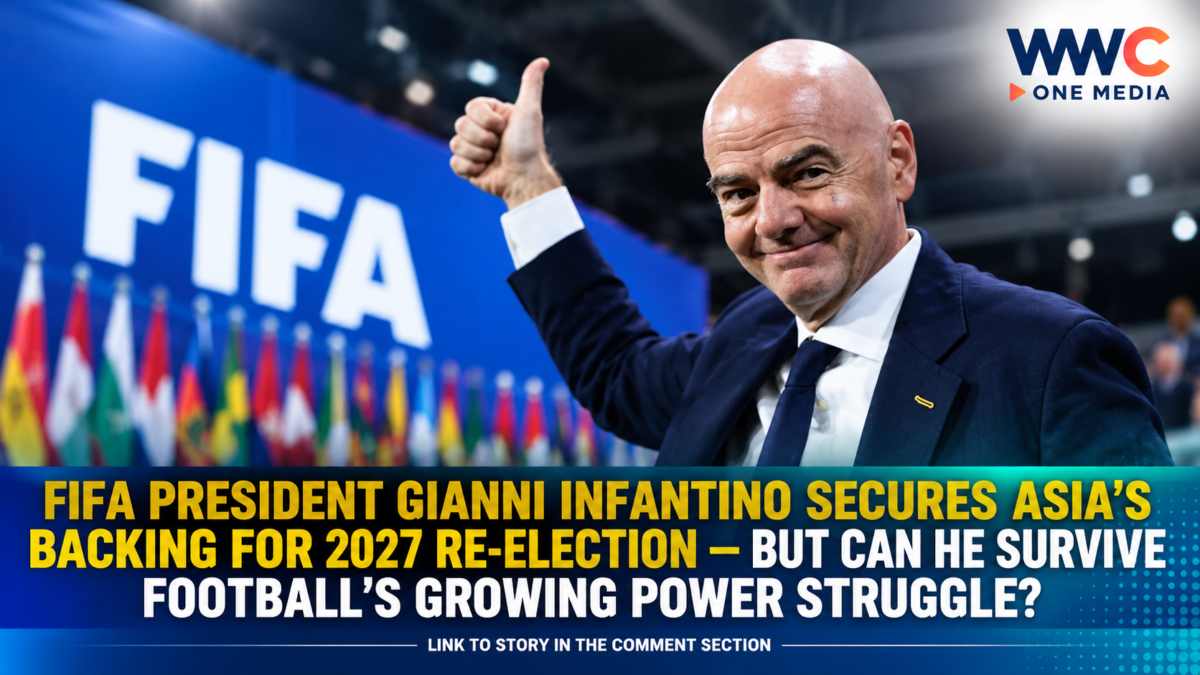
TOKYO, JAPAN — October 23, 2026 — FIFA President Gianni Infantino has received a major political boost ahead of the 2027 FIFA presidential election after the Asian Football Confederation (AFC) reaffirmed its support for his re-election campaign, potentially reshaping a leadership battle that has exposed deep divisions within international football.
AFC President Sheikh Salman bin Ibrahim Al Khalifa confirmed the governing body’s backing on Friday during an extraordinary congress in Tokyo, where Infantino was present.
The announcement comes at a politically sensitive moment for football’s most powerful governing body, following months of controversy surrounding Infantino’s leadership and a failed proposal to bring private investors into FIFA’s flagship competitions.
Asia Throws Its Weight Behind Infantino
Speaking before Asian football representatives in Tokyo, Sheikh Salman reiterated his commitment to supporting Infantino as the FIFA president seeks another mandate.
His endorsement is particularly significant because the AFC represents 47 national football associations, making Asia an influential voting bloc in FIFA’s presidential election.
Infantino, who has led FIFA since February 2016, is seeking a fourth term that would extend his presidency through 2031 if successful.
The latest declaration restores an important public alliance after the AFC previously joined other regional confederations in expressing dissatisfaction with Infantino’s handling of a controversial investment proposal.
A Dramatic Turnaround After FIFA’s Investment Controversy
The endorsement follows a turbulent period inside FIFA.
Earlier in 2026, Infantino faced strong criticism over a proposal involving the sale of a 20% stake in major FIFA competitions, including the World Cup, to private investors.
The plan was abandoned following opposition from influential football bodies.
European governing body UEFA, the AFC and CONCACAF were among the organizations that challenged Infantino’s leadership over the proposal.
Reuters reported in August that senior figures within these confederations had discussed the possibility of pursuing a no-confidence vote against him.
The renewed AFC endorsement therefore represents a significant political development, although it does not eliminate criticism of FIFA’s governance or guarantee how individual national associations will vote.
Why Asia Could Decide the 2027 FIFA Presidential Election
FIFA has 211 member associations, each with a vote in its presidential elections.
With 47 members, the AFC represents more than one-fifth of the electorate.
Infantino has also received public support from African and South American football leaders, potentially strengthening his prospects as he approaches the March 2027 election.
The Confederation of African Football previously announced unanimous support for his candidacy, while South America’s CONMEBOL also backed his leadership.
However, endorsements from regional organizations should not be confused with confirmed individual votes.
National football associations remain central to the final election outcome, particularly if a serious challenger emerges.
European Opposition Adds Uncertainty
Despite the apparent strengthening of Infantino’s position in Asia, opposition from European football officials remains a significant challenge.
UEFA has been among the most prominent critics of the abandoned investment proposal, which raised wider questions about financial transparency, commercial influence and decision-making inside global football.
The controversy also exposed tensions over who should control revenues generated by FIFA’s biggest competitions.
For critics, the leadership dispute is about far more than one presidential election. It concerns the future governance and commercial direction of the world’s most popular sport.
For Infantino’s supporters, his tenure has brought expanded competitions, increased football development funding and greater international attention to regions outside Europe’s traditional football powerhouses.
Can Anyone Challenge Infantino?
Infantino confirmed earlier this year that he would seek another term as FIFA president in 2027.
As of October 23, no rival candidate had formally emerged, according to recent Associated Press reporting.
Potential challengers face a November 18 nomination deadline, leaving a limited window to organize an alternative campaign and secure the necessary backing.
The outcome may depend on whether opposition groups can unite behind a single credible contender and persuade enough national associations to support a change in leadership.
With Africa and South America already having pledged support, Asia’s renewed endorsement could make that task considerably harder.
What Happens Next?
The next major milestone is the November nomination deadline, which will determine whether Infantino faces an organized challenge.
If a challenger enters the race, attention will turn to how FIFA’s member associations respond to the leadership controversy and whether regional endorsements translate into actual electoral support.
For now, Infantino appears to have regained an important political advantage.
But the bigger question remains: Is Asian football’s renewed support the beginning of another comfortable victory for Infantino, or could lingering divisions inside FIFA still produce an unexpected challenge before March 2027?