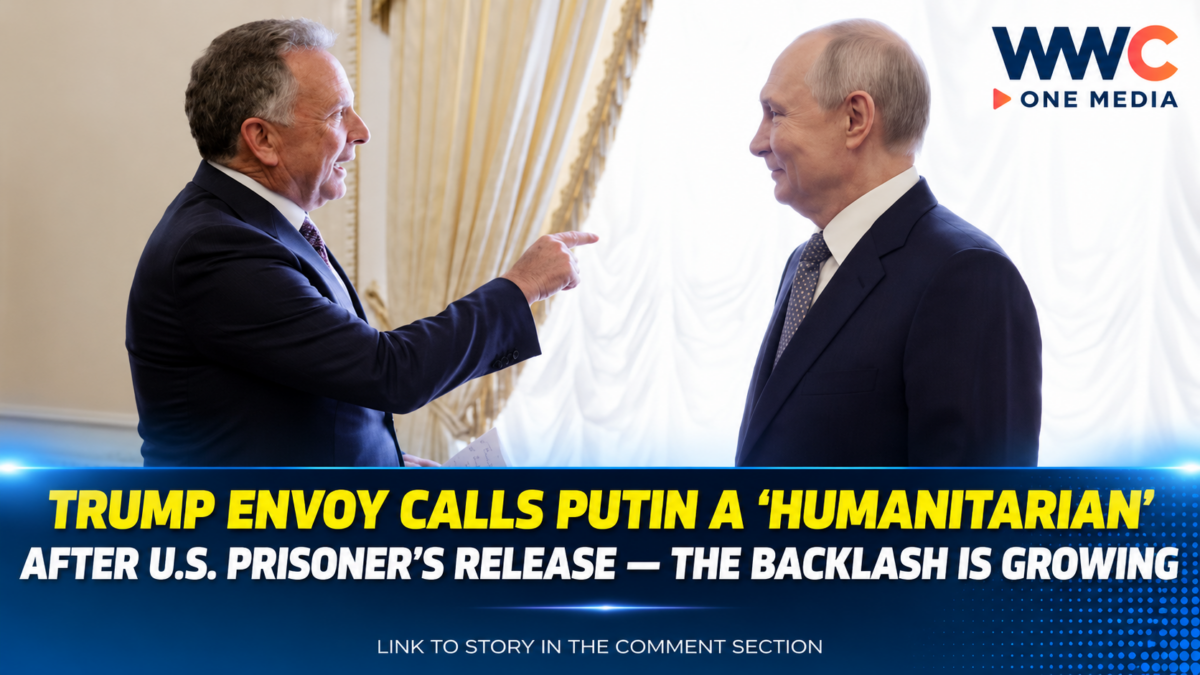
U.S. President Donald Trump’s special envoy Steve Witkoff has drawn intense criticism after describing Russian President Vladimir Putin as a “humanitarian” following the release of an American citizen held in Russia for more than four years.
Witkoff made the remark during a meeting with Putin in St. Petersburg on Wednesday, October 21, as Washington pursued diplomatic efforts to end Russia’s war against Ukraine. The statement quickly ignited a political controversy, with critics arguing that the language was inappropriate given the extensive human toll of the conflict.
Remark follows release of detained American
Witkoff praised Putin after Russia released Stephen Hubbard, a 74-year-old retired American teacher from Michigan who had been detained since 2022.
Russian authorities accused Hubbard of fighting as a mercenary for Ukraine. He was convicted and sentenced to prison in 2024, but he and his legal team disputed the allegations. The U.S. government had designated him as wrongfully detained.
During the meeting, Witkoff thanked Putin for allowing Hubbard to return to his family and said the Russian leader was also a humanitarian, drawing a direct connection between the release and his praise.
Hubbard’s return was a significant development for his family. However, the envoy’s choice of words immediately overshadowed the diplomatic gesture, reigniting debate over the Trump administration’s approach to Moscow.
The Associated Press and CBS News reported on Hubbard’s release and the backlash surrounding Witkoff’s remarks.
U.S. lawmakers question Witkoff’s praise
Republican Senator Thom Tillis of North Carolina publicly challenged the envoy’s description of Putin, questioning how the Russian leader could reasonably be called a humanitarian.
Republican Senator John Cornyn of Texas also rejected the characterization, while other critics argued that the praise failed to account for the suffering caused by Russia’s invasion of Ukraine.
Democratic lawmakers joined the criticism. Senator Mark Kelly of Arizona questioned the basis for describing Putin in humanitarian terms, reflecting concerns that diplomatic language could minimize the consequences of the war.
The objections came from both sides of the political divide, highlighting how sensitive the issue remains in Washington even as the Trump administration seeks negotiations with Moscow.
Trump and Vance defend the diplomatic approach
Trump did not fully endorse or reject Witkoff’s characterization. Asked about the comment, the president suggested it could be understood in the specific context of securing Hubbard’s release, while declining to describe Putin definitively as a humanitarian.
Vice President JD Vance defended Witkoff’s approach, arguing that a diplomat may need to speak positively to a counterpart who has just released an American detainee.
The defense reflects a central challenge in negotiations with adversarial governments: officials may use conciliatory language to achieve a practical result, but their words can carry broader political and moral implications.
Critics counter that securing an individual’s release does not erase the wider record of a government’s conduct.
Ukraine war casts a long shadow over diplomacy
Witkoff’s remarks came as the Trump administration continued efforts to restart negotiations involving the United States, Russia and Ukraine.
The full-scale Russian invasion began in February 2022 and has caused widespread destruction, displacement and civilian suffering. Putin also faces an arrest warrant issued by the International Criminal Court over alleged war crimes involving the unlawful deportation and transfer of Ukrainian children. The warrant is not a criminal conviction, and Putin has not been tried by the ICC.
Against that backdrop, critics say calling Putin a humanitarian risks sending a troubling signal to Ukraine and its allies, particularly as Kyiv remains concerned about the terms of any future peace agreement and the level of U.S. support.
Witkoff’s supporters, meanwhile, point to the practical demands of diplomacy and the need to maintain communication with Moscow if negotiations are to advance.
Will the talks produce meaningful progress?
Following the St. Petersburg meeting, Russian officials said Moscow was prepared in principle to resume trilateral negotiations with Ukraine and the United States, potentially in mid-November. The discussions could focus on postwar security arrangements.
However, the announcement did not mean a peace deal had been reached. Major disagreements remain over the terms for ending the war, security guarantees and the future of Ukrainian territory occupied by Russia.
The controversy surrounding Witkoff illustrates the difficult balance facing Washington: keeping diplomatic channels open while responding to criticism that conciliatory gestures could weaken accountability or undermine confidence among Ukraine’s supporters.
The key question now is whether the latest diplomatic contacts will produce concrete progress toward ending the war—or whether the political fallout from Washington’s approach will further complicate an already fragile negotiating process.