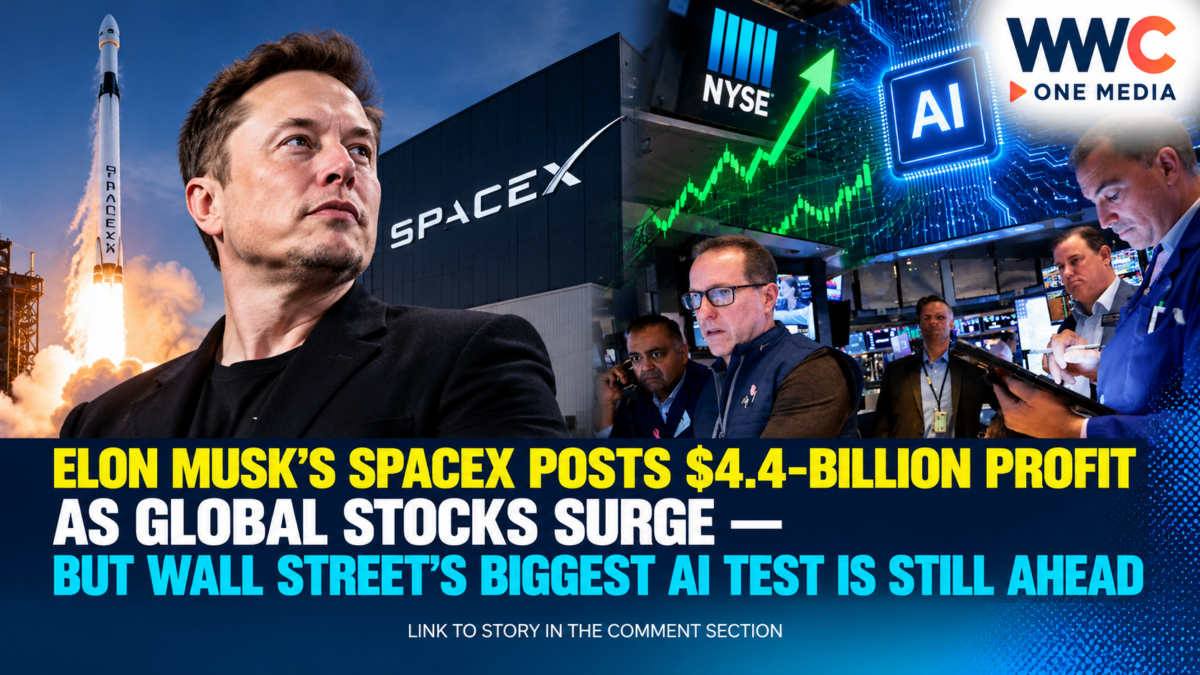
NEW YORK — A blockbuster earnings report from Elon Musk’s SpaceX helped power a rally across global stock markets on Wednesday, October 21, as investors welcomed fresh evidence that the artificial intelligence boom is translating into substantial corporate profits.
SpaceX reported US$4.4 billion in net profit for the July–September quarter, more than double analysts’ expectations, compared with a US$1.1 billion loss a year earlier.
Revenue soared 161% to US$14.6 billion, underscoring the company’s rapid expansion beyond rocket launches and satellite connectivity into artificial intelligence computing.
The results marked SpaceX’s first quarterly profit since becoming publicly traded following its record-setting June 2026 initial public offering.
Investors responded aggressively.
SpaceX shares jumped more than 12% at their intraday peak before finishing Wednesday at US$159.31, up nearly 8%.
The rally lifted other AI-related technology companies and helped push major U.S. stock indexes higher, with positive sentiment spreading to markets in Asia and Europe.
But the earnings celebration has also revived a central concern surrounding the AI industry: Can technology companies sustain their extraordinary growth while spending billions on computing infrastructure?
SpaceX Reports a Stunning Financial Turnaround
SPACEX THIRD-QUARTER 2026 EARNINGS
Quarterly net profit
$4.4B
Quarterly revenue
$14.6B
Revenue growth
+161%
Year over year
Previous year’s comparable quarter
−$1.1B
Net loss
Reported results for July–September 2026.
The turnaround is significant because the company has invested heavily in several capital-intensive businesses.
SpaceX’s activities span reusable rockets, the Starlink satellite communications network and advanced computing infrastructure.
Its artificial intelligence operations have become a particularly important source of growth.
According to Associated Press reporting, AI-related revenue now accounts for more than half of SpaceX’s quarterly sales, although Starlink remains a major profit contributor.
For investors, that mix is important.
The company is no longer being valued solely on its ability to launch spacecraft and expand satellite internet coverage. Its performance is increasingly tied to demand for AI computing services and expectations of continued growth.
However, the company still faces enormous capital expenditures, and strong earnings in one quarter do not guarantee the same profit margins in future periods.
SpaceX Shares Jump Nearly 8% After Earnings
SpaceX shares experienced a volatile but strongly positive trading session.
OCTOBER 21, 2026 — SPACEX MARKET REACTION
Closing share price
$159.31
+7.8%Approximately
Intraday peak gain: More than 12%Intraday highs and closing performance are different measures and should not be presented interchangeably.
The stock’s advance reflected both the earnings surprise and the company’s optimistic outlook for future demand.
Market analyst Patrick O’Hare of Briefing.com noted that SpaceX’s financial performance and indications of strong demand for its computing capacity had impressed investors.
Still, even after the rally, the stock remains exposed to changes in expectations for growth, capital expenditure and technology valuations.
AI Stocks Lead Wall Street Higher
U.S. STOCK MARKET — OCTOBER 21 CLOSING RESULTS
| Nasdaq Composite | +1.05% | 26,702.86 |
| Dow Jones | +0.69% | 52,856.09 |
| S&P 500 | +0.58% | 7,757.17 |
October 21 closing data, not live market levels.
The Nasdaq recorded the strongest gain among the three main U.S. indexes as investors returned to AI-related companies.
Shares of Super Micro Computer surged approximately 9.6% after an upbeat revenue and profit-margin outlook.
Other technology companies also benefited:
- Dell Technologies rose 5.3%.
- Hewlett Packard Enterprise gained 3.7%.
- Semiconductor stocks collectively rose approximately 2%.
- The S&P 500 information technology sector advanced 1.6%.
The gains suggested that SpaceX’s results were helping restore confidence in companies supplying or benefiting from the global expansion of AI infrastructure.
Tesla–SpaceX Merger Speculation Adds Another Catalyst
SpaceX’s earnings coincided with fresh discussion about a possible corporate combination with Tesla.
Musk indicated that joining the two companies could have strategic advantages, given their overlapping ambitions in robotics, manufacturing, advanced computing and artificial intelligence.
Tesla shares gained approximately 3.4% during Wednesday’s session, according to Associated Press.
However, a Tesla–SpaceX merger has not been finalized or approved.
Any such deal would require detailed negotiations, independent governance reviews and applicable shareholder approvals.
Investors should distinguish speculation about a possible combination from an announced transaction with binding terms.
Asian Markets Rebound as Semiconductor Shares Surge
The optimism spread beyond Wall Street.
Asian equities rallied on Wednesday, with South Korean and Japanese technology companies among the leading beneficiaries.
In South Korea, major memory-chip producers SK Hynix and Samsung Electronics each gained at least 7%, according to AFP.
Japanese technology companies Kioxia, Advantest and SoftBank posted gains ranging from approximately 2% to 4%.
The rally followed a difficult period for technology stocks amid concerns about AI infrastructure spending, debt financing and profitability.
The latest movements demonstrate the degree to which sentiment toward American technology companies can influence suppliers and related businesses across Asia.
Europe Rallies — But France’s Bond Market Sends a Warning
European stocks also benefited from improving investor sentiment.
CNA reported gains across markets in the United Kingdom and Paris, with the French stock market climbing 1.1%.
However, individual French companies experienced dramatically different results.
Shares of eyewear manufacturer EssilorLuxottica surged more than 16% after reporting a 24% increase in sales of lenses designed to slow childhood myopia.
By contrast, supermarket operator Carrefour plunged more than 13% after warning that recent unrest would hurt earnings.
The company said approximately 50 stores had been looted and estimated a potential operating-profit impact of €80 million to €200 million.
At the same time, France’s benchmark 10-year government bond yield closed above 5% for the first time since 2002, reflecting concerns about fiscal policy and political uncertainty.
These developments show that the global market rally was not uniform. While technology shares gained, individual companies and government debt markets continued to face substantial pressure.
The Biggest Risk: Can AI Profits Keep Up With AI Spending?
SpaceX’s results have offered encouraging evidence that demand for advanced computing infrastructure can generate significant revenue.
But investors are increasingly focused on a different question: whether the profits will ultimately justify the enormous cost of building that infrastructure.
AI companies and their suppliers must finance data centers, computing chips, electricity infrastructure, networking equipment and software development.
The challenge is to convert those expenses into sustainable earnings.
SpaceX itself faces considerable future capital requirements as it expands its operations.
The technology sector therefore faces two tests: maintaining customer demand and generating enough cash to support continued expansion.
Market gains based on optimistic forecasts can reverse if growth slows, costs increase or companies disappoint investors.
Why This Matters for the Philippines and ASEAN
The AI-driven rally could influence investment sentiment across Asian markets, including the Philippines.
South Korea, Taiwan and Japan have major semiconductor and technology companies that supply the infrastructure behind AI expansion.
Southeast Asian economies are also attracting investment in data centers, cloud services and related facilities.
For Philippine businesses, the longer-term opportunities could involve power infrastructure, telecommunications, IT services and digital transformation.
However, a rally in SpaceX or the Nasdaq does not automatically mean Philippine shares will rise.
Domestic corporate earnings, interest rates, currency movements and global risk appetite will continue to determine market performance.
The Bigger Question: Is the AI Rally Built to Last?
SpaceX’s first profitable quarter as a publicly traded company has become a major positive signal for investors.
The company reported a dramatic earnings turnaround, strong revenue growth and expanding AI demand.
Its results helped lift global markets at a time when many investors were questioning the profitability of the artificial intelligence boom.
Yet the broader picture remains mixed.
Technology companies are still spending heavily, France’s bond market is under pressure, and some businesses are disappointing investors despite the market recovery.
The bottom line: SpaceX’s US$4.4-billion quarterly profit helped ignite a global stock-market rally on October 21, but sustaining that momentum will depend on whether AI-related companies continue delivering earnings strong enough to justify their valuations and spending plans.