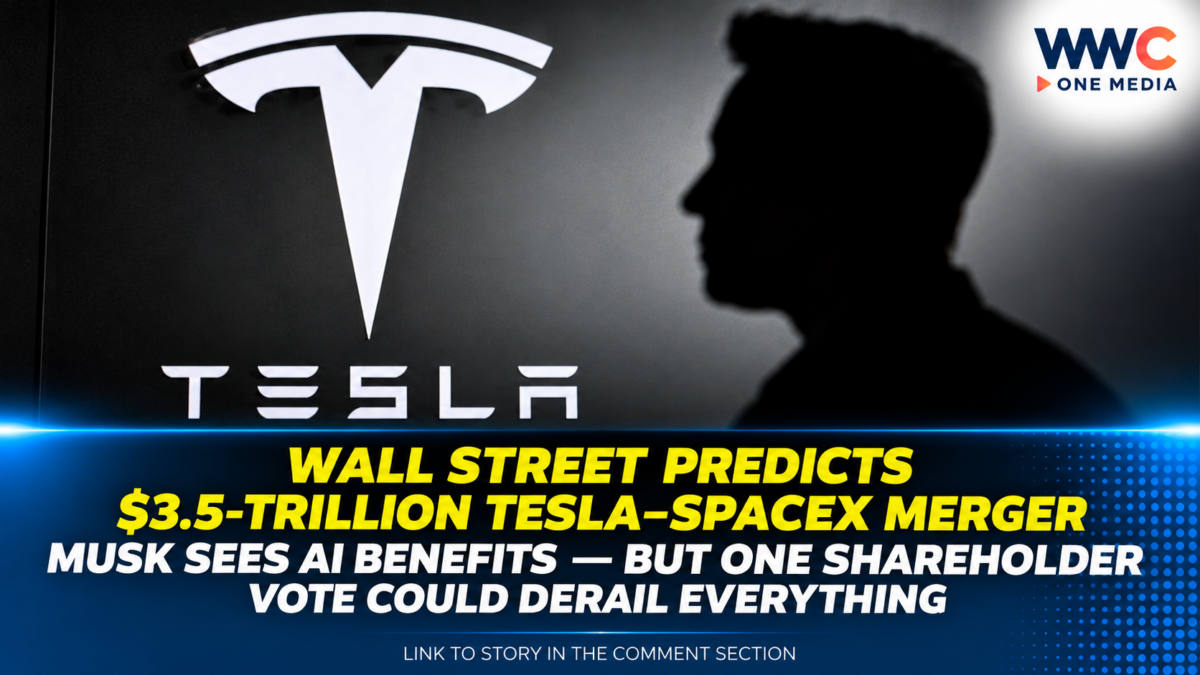
NEW YORK, UNITED STATES — Wall Street is increasingly convinced that billionaire entrepreneur Elon Musk could eventually combine two of his most valuable companies, Tesla and SpaceX, in a potential corporate merger that could create a technology powerhouse valued at approximately US$3.5 trillion.
However, Musk has cautioned that the widely anticipated transaction remains uncertain, despite acknowledging potential strategic benefits.
In comments reported by Reuters on Wednesday, October 21, Musk indicated that the decision rests with independent committees and Tesla shareholders, rather than with him alone.
The billionaire, who holds influential ownership positions in both companies, described himself as a conflicted party in the potential transaction.
The distinction is critical: Tesla and SpaceX have not announced an approved merger, agreed on a final share-exchange ratio, or secured the shareholder approval necessary to complete a combination.
Yet speculation is intensifying as the companies expand their artificial intelligence businesses, collaborate on semiconductor development and invest heavily in next-generation infrastructure.
Some Wall Street analysts believe a deal could materialize by the end of 2027, but the timetable remains speculative.
Why Wall Street Thinks a Tesla–SpaceX Merger Makes Sense
For investors, the possible merger extends far beyond electric vehicles and rocket launches.
Tesla has been increasingly positioning itself as an artificial intelligence and robotics company, developing autonomous driving systems, robotaxis, the Optimus humanoid robot and advanced computing technology.
SpaceX, meanwhile, has expanded beyond its traditional aerospace business into satellite communications, artificial intelligence and large-scale technological infrastructure.
That creates several potential areas of cooperation.
Both companies require substantial computing power, specialized chips, advanced manufacturing capabilities and large investments in research.
By combining operations, analysts believe the companies could potentially reduce duplicated costs, coordinate technological development and improve their ability to finance expensive projects.
Justus Parmar, chief executive of Fortuna Investments and an investor in both businesses, told Reuters that a merger could make strategic sense as both companies deepen their focus on AI and autonomous systems.
However, potential advantages do not establish that combining the companies would generate greater shareholder value than keeping them separate.
The results demonstrated how artificial intelligence has become a major commercial engine for SpaceX.
Its AI operations contributed more than half of quarterly revenue, while Starlink continued to provide an important source of profit.
The expansion comes at a substantial financial cost.
Reuters reported that SpaceX could spend another US$35 billion to US$40 billion in the fourth quarter to support further development.
Analysts believe the company’s enormous capital requirements could make a merger with Tesla attractive, particularly if the combined entity could share infrastructure or gain access to financing on more favorable terms.
These remain projected benefits rather than confirmed merger savings.
The Terafab Project Could Bring Tesla and SpaceX Even Closer
One of the most significant developments is the companies’ joint work on the Terafab semiconductor manufacturing project.
The initiative aims to expand their ability to produce specialized chips needed for large-scale computing, AI and autonomous technologies.
The project could benefit both Tesla’s automotive and robotics operations and SpaceX’s expanding technology businesses.
This has become a major point in Wall Street’s merger arguments.
Analysts at Barclays have suggested that the growing overlap between the companies’ projects makes a combination increasingly logical.
However, joint projects do not necessarily require a full corporate merger.
Tesla and SpaceX could continue collaborating through commercial agreements while remaining independent.
The question for shareholders is whether a single corporate structure would deliver enough additional benefits to justify the financial and governance complications.
The Biggest Obstacle: Elon Musk Cannot Approve the Deal Alone
Despite Musk’s influence, the proposed transaction faces a complicated approval process.
Reuters reported that special committees at Tesla and SpaceX are responsible for evaluating a potential transaction.
Musk has said he cannot participate in those committees because of his conflicts of interest.
The arrangement is intended to provide independent oversight of a transaction involving companies in which the same individual holds substantial influence.
Tesla’s shareholder voting requirements create another significant obstacle.
According to Musk, the transaction would require approval from a majority of all outstanding Tesla shares, rather than merely a majority of the shares participating in the vote.
That makes shareholder turnout especially important.
Uncast votes could effectively work against approval under that threshold.
With investors holding different views on Tesla’s future, AI ambitions and Musk’s management, approval cannot be assumed.
A Merger Could Dramatically Increase Musk’s Voting Control
Another issue attracting investor attention is corporate control.
Musk reportedly controls approximately 85% of SpaceX’s voting power through super-voting shares, compared with roughly 20% at Tesla.
Analysts have modeled how an all-stock merger could alter that balance.
Reported voting power and hypothetical merger outcome
SpaceX — current
Bill Birmingham of REX Financial estimated that a merger could give Musk approximately 57% of the combined voting rights.
Ryan Zurrer of Dialectic offered an estimate of about 58% under a hypothetical share-exchange arrangement.
Those figures are not finalized ownership projections.
They depend heavily on how a deal would be structured, how shares would be exchanged and what voting rights would accompany the transaction.
The possibility of increased control could raise questions among shareholders about the balance between Musk’s interests and those of minority investors.
Tesla’s SolarCity Acquisition Offers a Warning
A potential Tesla–SpaceX merger could attract intense legal and governance scrutiny.
Tesla’s 2016 acquisition of solar-energy company SolarCity remains an important historical comparison.
Musk had interests connected to both companies, prompting years of legal challenges concerning whether the transaction was fair to Tesla shareholders.
The deal was ultimately upheld following litigation, but questions about governance and independent oversight continued to shape discussions around related-party transactions.
A Tesla–SpaceX combination would present a substantially larger financial and operational undertaking.
Investors would likely examine the valuation methodology, share-exchange ratio, committee independence and implications for minority shareholders.
Josh Gilbert, eToro’s lead analyst for Asia-Pacific, emphasized to Reuters that transactions involving common leadership naturally attract scrutiny over governance.
These concerns do not prove that a proposed merger would be improper. They demonstrate why the decision-making process matters.
Tesla’s New Roadster Adds Fuel to Merger Speculation
The unveiling of Tesla’s redesigned Roadster has intensified the conversation.
During the recent presentation, a Roadster fitted with SpaceX-developed rocket thrusters demonstrated capabilities that attracted worldwide attention.
The demonstration offered a highly visible example of technological collaboration between Musk’s companies.
For some investors, it strengthened the argument that Tesla and SpaceX are increasingly interconnected.
Yet a high-profile product demonstration should not be interpreted as evidence that a merger agreement is imminent.
It demonstrates cooperation in product development, not the existence of an approved transaction.
The broader merger debate remains focused on whether the companies’ increasingly overlapping technological ambitions justify full corporate integration.
Wall Street Sees a Possible 2027 Deal, but Investors Remain Divided
Several analysts believe a merger could be announced within the next year or completed by the end of 2027.
Barclays has examined potential structures involving an all-stock acquisition, while other investment firms have highlighted the companies’ complementary technological assets.
However, some market observers are cautious.
Ipek Ozkardeskaya of Swissquote has argued that Tesla shareholders could reject a combination if they believe the company would be better served by pursuing AI partnerships with other businesses.
This illustrates a central investment question.
A merger might create operational efficiencies, but it could also expose Tesla shareholders to SpaceX’s heavy capital spending requirements and unfamiliar business risks.
The ultimate decision will depend on the financial terms and whether shareholders conclude that the proposed combination would serve their interests.
Tesla’s Earnings and December Meeting Could Provide New Clues
Investors are watching two important corporate events.
October 21, 2026 — Tesla Third-Quarter Results
Tesla is scheduled to report earnings after the U.S. market closes. Investors will examine margins, AI spending and management commentary for indications of future plans.
December 3, 2026 — Tesla Annual Shareholder Meeting
Analysts will watch for potential disclosures about merger discussions, governance procedures and shareholder approvals.
Neither event guarantees an announcement.
As of the Reuters October 21 report, the committees had not agreed on transaction terms, and Musk continued to emphasize that the deal was uncertain.
Reuters
What This Means for Global Markets and Asian Investors
A Tesla–SpaceX combination would have implications across several industries, including electric vehicles, semiconductors, satellite communications, robotics and artificial intelligence.
For Asian investors, the potential transaction would bring together two businesses with substantial global influence.
Tesla’s manufacturing and automotive supply chains are deeply connected to international technology markets, while SpaceX operates a rapidly expanding satellite and infrastructure business.
A merger could reshape investment exposure, corporate financing and competition across these sectors.
However, no investor should treat the reported US$3.5-trillion combined valuation as a guaranteed transaction price.
The actual consideration, ownership distribution and value of a combined business would depend on terms that have not been finalized.
The Bigger Question: Is This About Technology, Money or Control?
Wall Street’s optimism is based on several arguments.
Tesla and SpaceX are moving toward overlapping technological objectives. Both require substantial computing infrastructure. Their existing collaborations could potentially generate broader efficiencies under a shared corporate structure.
At the same time, a merger could substantially change Musk’s voting control and the risk profile of both businesses.
Those considerations mean the proposed transaction is far more complicated than combining two famous brands.
The bottom line: Elon Musk sees potential advantages in merging Tesla and SpaceX, but independent committees, shareholder voting requirements, governance concerns and unresolved transaction terms stand between speculation and an actual agreement.
For now, there is no confirmed merger — only an increasingly serious discussion about whether two of Musk’s most influential companies should become one.