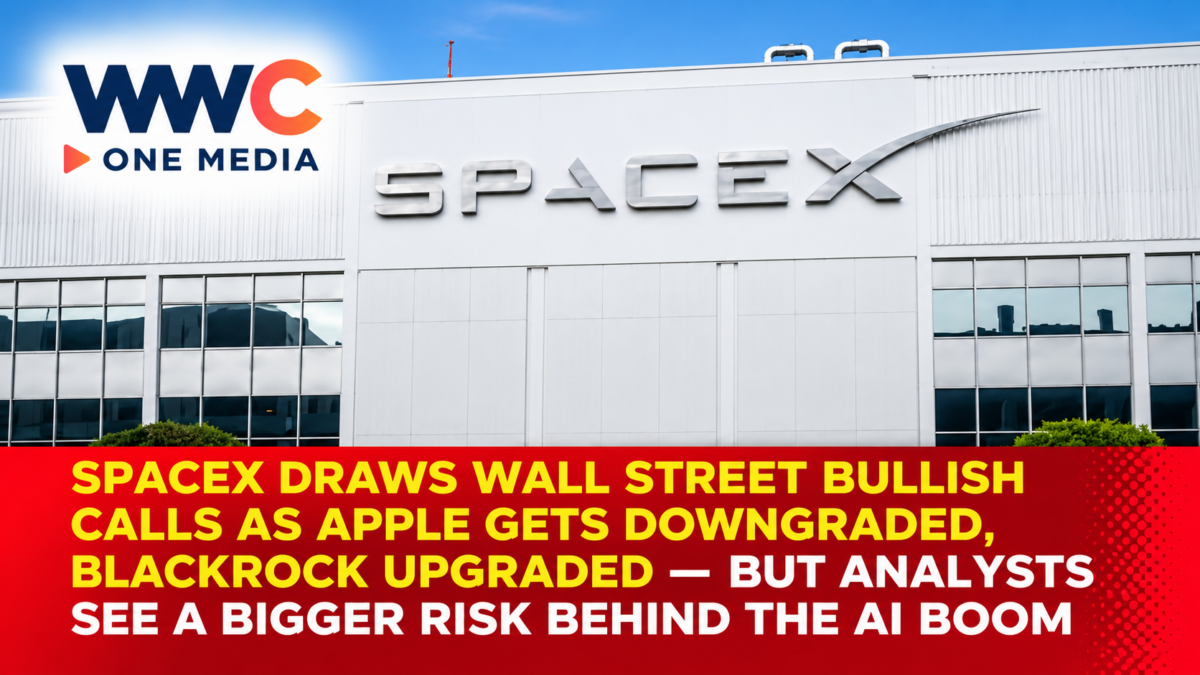
NEW YORK — Wall Street’s biggest investment banks are sending sharply different signals about the future of America’s leading companies, with SpaceX attracting bullish research coverage while Apple faces growing questions about iPhone demand and BlackRock wins renewed confidence from analysts.
The contrasting recommendations emerged during Tuesday’s October 20 round of analyst calls, as investors prepared for major earnings announcements and assessed whether the artificial intelligence boom could sustain its extraordinary pace of investment.
Among the closely watched developments, Macquarie maintained its positive recommendation on SpaceX, Loop Capital downgraded Apple, and TD Cowen upgraded investment management giant BlackRock.
Raymond James also upgraded cloud security and content delivery company Akamai Technologies, reflecting interest in selected businesses following recent share-price weakness.
But behind the wave of research calls lies a much larger question.
As technology companies pour billions of dollars into artificial intelligence infrastructure, investors are increasingly looking beyond innovation and asking whether revenue, profitability and cash flow will justify their valuations.
SPACEX ATTRACTS BULLISH WALL STREET ATTENTION
Elon Musk’s SpaceX remains one of Wall Street’s most closely followed technology and aerospace companies as investors assess the commercial opportunities associated with satellite communications, rocket launches and artificial intelligence infrastructure.
On October 20, Macquarie analyst Paul Golding maintained an Outperform rating on SpaceX with a $250 price target.
The recommendation followed a separate move by Evercore ISI on October 16, when the investment firm raised its SpaceX price target to $275 from $230 while maintaining an Outperform rating.
The positive assessments reflect expectations that SpaceX could benefit from expanding satellite services and increasing demand for AI computing capacity.
SpaceX’s Starlink business already provides satellite internet connectivity, while the company has been developing additional capabilities in computing infrastructure and advanced technology.
However, the opportunities require substantial spending.
Developing data centers, computing systems, launch facilities and satellite infrastructure involves large capital commitments.
Even businesses experiencing significant revenue growth must eventually generate sufficient cash flow to sustain those investments.
For SpaceX investors, the challenge is determining how much future growth is already reflected in the company’s share price.
SPACEX’S AI AMBITIONS COME WITH ENORMOUS FINANCIAL REQUIREMENTS
SpaceX’s expansion into artificial intelligence has created a new source of excitement, but also a significant concern.
The company is investing heavily in computing infrastructure as demand for advanced AI processing continues to grow.
Analysts have highlighted the potential benefits of expanding computing capacity, including opportunities to provide AI infrastructure services to external customers.
However, financing that expansion could require substantial additional borrowing.
MarketWatch reported that Morgan Stanley analyst Adam Jonas identified future financing requirements as an important risk despite maintaining a constructive view of SpaceX.
The debate illustrates a broader issue affecting AI infrastructure developers.
Strong demand does not automatically guarantee that a company can finance expansion profitably.
Data centers require expensive computing equipment, cooling systems, electricity infrastructure and specialized facilities.
Projects may generate significant future revenue, but their construction costs often arrive long before all expected payments are received.
As a result, investors are increasingly distinguishing between companies with strong operating cash flow and those that depend heavily on external financing.
APPLE GETS DOWNGRADED DESPITE STRONG STOCK PERFORMANCE
Apple became one of the most significant names receiving a more cautious Wall Street assessment.
Loop Capital analyst Ananda Baruah downgraded the iPhone maker from Buy to Hold and lowered his price target from $370 to $330.
The downgrade followed a period of strong stock performance that had lifted Apple’s valuation.
Baruah cited concerns about iPhone shipment expectations and the potential impact of higher component costs on profitability.
In particular, weaker smartphone shipment forecasts and increased memory costs could pressure Apple’s gross margins.
The downgrade suggests that some analysts believe Apple’s strong recent rally has already incorporated much of the company’s near-term growth potential.
However, the move does not mean the company is expected to experience a financial collapse.
It reflects a more cautious assessment of the relationship between Apple’s current valuation and its expected earnings.
Other analysts remain more optimistic about the company’s longer-term outlook.
The differing opinions demonstrate how market professionals can reach different conclusions about the same business.
APPLE’S NEXT PRODUCT LAUNCH COULD BECOME A MAJOR CATALYST
Apple’s downgrade comes ahead of another major product announcement scheduled for October 28.
Investors are anticipating new Mac computers and other devices as the company continues expanding its product ecosystem.
The company is also scheduled to release its fiscal fourth-quarter financial results in November.
Both events could provide additional information about consumer demand, profit margins and the company’s technology strategy.
Apple continues to benefit from its global customer base, hardware ecosystem and services business.
However, premium smartphone manufacturers face competitive pressure, changing consumer preferences and fluctuations in component costs.
For Wall Street, the central question is whether Apple’s future product launches and services growth can justify expectations already reflected in the share price.
BLACKROCK GETS A MAJOR WALL STREET ENDORSEMENT
BlackRock, one of the world’s largest investment management companies, received an upgrade from TD Cowen.
The investment firm raised its rating to Buy from Hold and increased its price target to $1,405 from $1,212.
The upgrade reflected improving confidence in BlackRock’s earnings growth prospects.
TD Cowen sees a potential path toward earnings per share exceeding $100, supported by growth in the asset management business.
BlackRock manages investment products used by institutional and individual investors, including exchange-traded funds, fixed-income products and alternative assets.
Its financial performance can be influenced by stock and bond market valuations, investment inflows and changes in investor demand.
An increase in assets under management can contribute to revenue growth, although market declines and client withdrawals can have the opposite effect.
For investors, the analyst upgrade indicates confidence in BlackRock’s ability to expand earnings.
However, the price target remains a forecast rather than a guaranteed outcome.
AKAMAI ATTRACTS A STRONG BUY RATING
Akamai Technologies also secured an analyst upgrade.
Raymond James raised its rating from Outperform to Strong Buy while maintaining a $170 price target.
The investment firm’s decision was partly based on valuation following a period of share-price weakness.
Akamai provides cloud infrastructure, cybersecurity and content delivery services used by businesses operating online.
Its services help companies protect digital systems, manage traffic and deliver online content.
The cybersecurity sector continues to attract investor interest because organizations must protect increasingly complex digital operations.
However, competition remains intense, with numerous companies developing cloud security and network protection technologies.
Akamai’s future performance will depend on customer demand, product execution and the company’s ability to convert its capabilities into sustainable revenue growth.
The upgrade illustrates how Wall Street analysts sometimes identify opportunities in stocks that have declined even when the underlying businesses remain competitive.
COREWEAVE’S DEBT PRESSURE CREATES A WARNING FOR AI INVESTORS
While some analysts are optimistic about artificial intelligence, the financial pressure affecting CoreWeave has intensified scrutiny of the broader industry.
The Nvidia-backed cloud computing provider has expanded rapidly to meet growing demand for advanced AI processing.
However, its business model requires substantial investment in computing equipment and data centers.
CoreWeave’s borrowing costs and the performance of its bonds have become important indicators of investor concern about highly leveraged AI infrastructure businesses.
Goldman Sachs upgraded CoreWeave to Buy on October 19, reflecting a more optimistic assessment of the company’s opportunities and valuation.
Nevertheless, other market participants remain cautious about its financing requirements.
The different interpretations demonstrate that AI-related companies are not being evaluated uniformly.
Some analysts see opportunities in strong demand and substantial customer contracts.
Others focus on debt, the timing of future cash flow and the risk that infrastructure spending may outpace earnings.
WALL STREET DIVIDES OVER THE FUTURE OF SPACEX
Separate reporting from The Wall Street Journal highlighted contrasting investment views on SpaceX.
Jay Hatfield, chief executive of Infrastructure Capital Advisors, emphasized the company’s position in launch technology, satellite communications and emerging computing services.
He pointed to the potential advantages of its technology and financing position.
By contrast, CFRA Research analyst Keith Snyder expressed concern about the company’s aggressive spending.
The divide reflects a familiar challenge for investors evaluating businesses undergoing rapid expansion.
A company may possess valuable technology and strong commercial opportunities while simultaneously facing substantial financial risks.
High capital expenditure can support future growth, but it can also reduce cash flow and increase financing requirements.
The outcome depends on whether investments ultimately generate attractive returns.
ANALYST CALLS ARE NOT GUARANTEES OF STOCK PERFORMANCE
The latest recommendations demonstrate the influence of Wall Street research on market sentiment.
Analysts study corporate earnings, valuations, competitive conditions, financial statements and industry developments before assigning ratings and price targets.
A Buy or Outperform rating generally indicates an expectation of attractive relative performance.
A Hold or Neutral rating suggests a more balanced view of risks and potential returns.
However, different financial institutions use different rating systems.
Price targets are also based on assumptions about future earnings, market conditions and valuation multiples.
Those assumptions can change rapidly.
Consequently, an upgrade should not be interpreted as proof that a stock will rise, just as a downgrade does not guarantee a decline.
Investors must consider the underlying business fundamentals rather than relying exclusively on analyst recommendations.
STRONG CORPORATE EARNINGS SUPPORT A MIXED U.S. MARKET
The analyst calls arrived during a busy corporate earnings season.
Major U.S. companies including General Motors, Northrop Grumman, 3M and Hasbro released financial results that produced sharply different stock reactions.
Some businesses rallied after delivering stronger-than-expected profits.
Others declined despite reporting earnings growth, as investors focused on future expenses and profitability.
The broader market has also faced pressure from elevated energy prices and concerns about spending across the artificial intelligence industry.
These developments demonstrate that investors are becoming increasingly selective.
Companies must do more than announce ambitious projects or strong quarterly sales.
They must also demonstrate that their operations can generate sustainable financial results.
WHAT THIS MEANS FOR ASIAN AND PHILIPPINE INVESTORS
The latest Wall Street recommendations have implications beyond the United States.
Major American technology companies depend on global supply chains involving semiconductor production, electronics manufacturing and cloud infrastructure.
Asian economies play important roles in these industries.
Changes in investment spending by SpaceX, Apple and other major corporations could eventually influence demand for equipment, components and related services.
For Philippine investors with exposure to international equities, analyst recommendations may provide information about changing market expectations.
However, U.S. stock investments also involve foreign-exchange risk, market volatility and differences in financial regulation.
The ratings should be considered alongside company disclosures and the investor’s own financial objectives.
THE BIGGER QUESTION: IS WALL STREET GETTING MORE SELECTIVE?
The October 20 analyst calls reveal an increasingly divided investment environment.
SpaceX continues to attract positive assessments because of its technology, satellite communications business and opportunities in artificial intelligence.
Apple is facing more cautious expectations after a strong stock market rally and concerns about smartphone demand.
BlackRock is drawing optimism over its earnings prospects.
Akamai is gaining renewed attention because of its valuation and cybersecurity business.
Meanwhile, CoreWeave illustrates how the enormous cost of AI infrastructure can create financial challenges even when customer demand remains strong.
The common theme is that Wall Street is placing greater emphasis on the relationship between growth opportunities and financial sustainability.
Investors may still be enthusiastic about artificial intelligence, aerospace technology and digital infrastructure, but they are becoming more selective about which companies can turn that enthusiasm into lasting profits.
And as investment banks issue new recommendations, one question remains:
Will SpaceX and other high-growth technology companies justify Wall Street’s optimism — or could escalating AI infrastructure costs become the next major test for investors?