
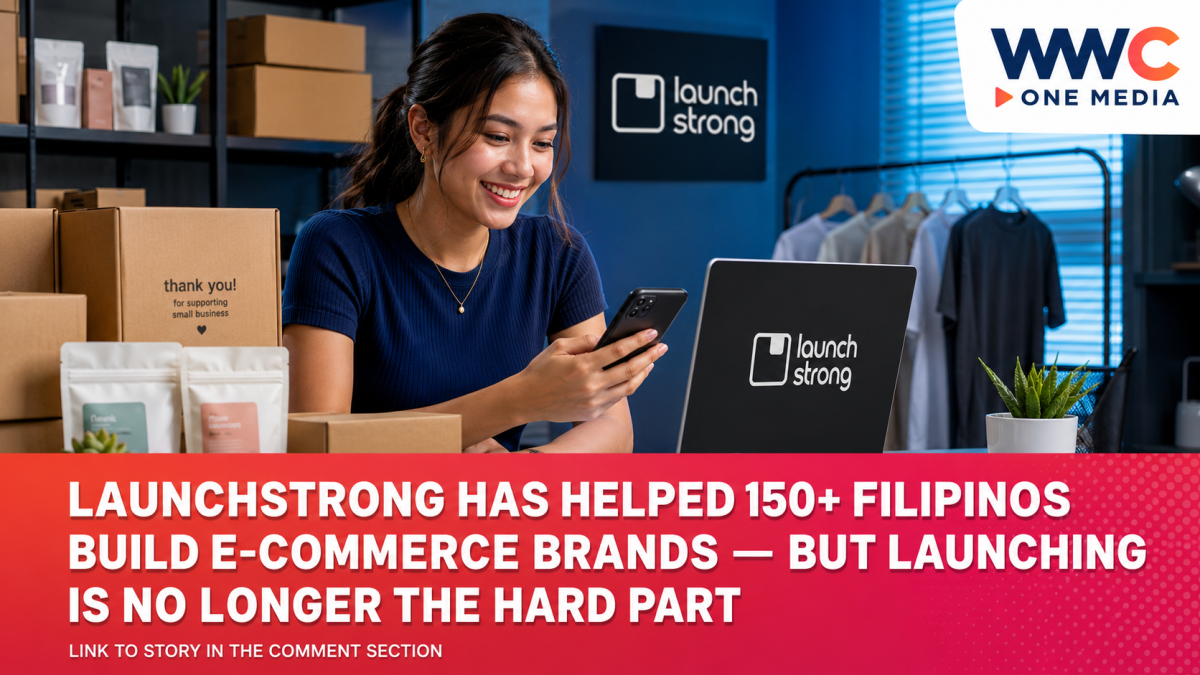
MANILA, Philippines — Starting an online store in the Philippines has arguably never been easier. Turning one into a profitable business that survives rising competition, platform costs, logistics headaches and relentless customer-acquisition expenses is another matter entirely.
That widening gap between launching a product and building a sustainable company is what Philippine-founded e-commerce mentorship program LaunchStrong is attempting to address as it marks its first year.
Founded in 2025 by entrepreneur Jungie Gumiran, LaunchStrong says it has mentored more than 150 first-time Filipino founders and helped facilitate the development of more than 100 homegrown consumer brands across categories including wellness, food and beverage, personal care, pet care and fashion.
The program says roughly 80 percent of participants who entered without an existing product or previous e-commerce experience have moved toward launching their first online businesses. The figure is a company-reported outcome and has not been independently audited in the publicly available reports reviewed for this article.
That distinction matters because LaunchStrong is entering a Philippine online retail industry filled with opportunity—but also increasingly intense competition.
From Business Idea to Actual Brand
LaunchStrong operates as a five-week live mentorship program covering the building blocks that many inexperienced sellers encounter only after spending money: product ideation, market validation, sourcing, pricing, positioning, branding, launch planning, customer acquisition and early-stage growth.
Among the brands identified as having gone through or been supported by the program are Eat Move Love, Pharmatrust, Magic Bowl, Tonios, TELA Pinoy and NanaPro Litter, spanning several consumer-product categories.
But Gumiran’s bigger argument is that getting a product onto Shopee, Lazada, TikTok Shop, Shopify or another digital storefront is only the beginning.
“E-commerce in the Philippines is becoming much easier to enter, but harder to win,” Gumiran said in a statement accompanying the program’s anniversary.
His warning centers on something often hidden behind screenshots of impressive online sales: revenue does not automatically mean profit.
Marketplace commissions and fees, advertising expenses, fulfillment, shipping subsidies, returns, discounts, inventory and working capital can all eat into the economics of an apparently fast-growing store.
A founder can therefore be selling thousands—or even millions—of pesos worth of products while still struggling to generate sustainable cash flow.
The Philippine E-Commerce Opportunity Is Getting Bigger
LaunchStrong’s expansion comes as the Philippine digital economy continues to grow rapidly.
The Google, Temasek and Bain & Company e-Conomy SEA 2025 report projected the Philippine digital economy would reach about US$36 billion in gross merchandise value in 2025, up roughly 16 percent year on year. BusinessWorld and the Philippine Daily Inquirer separately reported the projection, with e-commerce remaining a major engine of that expansion.
BusinessMirror reported that e-commerce represented more than 60 percent of the country’s digital-economy GMV, reinforcing just how central online retail has become to the Philippine digital economy.
The longer-term opportunity is even larger. The same regional study estimated that Philippine digital-economy GMV could reach roughly US$70 billion to US$140 billion by 2030, although such projections remain subject to consumer behavior, economic conditions, regulation and technological change.
Across Southeast Asia, meanwhile, e-commerce GMV was projected to reach about US$185 billion in 2025, while video commerce alone had grown to account for roughly a quarter of regional e-commerce GMV.
That evolution is changing what founders need to succeed.
It is no longer enough to source a product, upload photographs and wait for marketplace traffic.
Online brands increasingly need compelling short-form content, creators and affiliates, paid advertising, strong customer retention, competitive fulfillment and enough pricing power to absorb the cost of operating across major platforms.
The Bigger Problem: Everybody Can Become a Seller
The same technology that makes entrepreneurship more accessible is also lowering barriers for competitors.
A product idea can be copied quickly.
Advertising audiences can become expensive.
Marketplace promotions can compress margins.
Influencer-driven demand can disappear as quickly as it arrives.
And sellers that depend heavily on one platform remain exposed whenever algorithms, advertising systems, commission structures or promotional rules change.
That helps explain why LaunchStrong’s pitch emphasizes business economics and decision-making, rather than simply teaching participants how to open an online shop.
Google, Temasek and Bain’s regional research points in a similar direction: Southeast Asia’s digital economy has been shifting away from growth at any cost toward monetization and sustainable profitability.
For small Filipino brands, that shift could prove decisive.
The next generation of e-commerce winners may not necessarily be the businesses generating the loudest launch-day buzz. They could instead be the founders who know their gross margins, inventory turnover, customer-acquisition costs and repeat-purchase rates before aggressively scaling.
Gumiran Brings His Own E-Commerce Track Record
LaunchStrong founder Jungie Gumiran’s approach draws partly from his experience building wellness company JUJU Lifestyle.
According to information released by LaunchStrong and reported by InsiderPH, JUJU Lifestyle has served more than 300,000 customers.
Gumiran has also operated AdsLevelUp, through which he is reported to have trained or coached more than 30,000 entrepreneurs, executives, freelancers and marketers across more than 200 workshops and training sessions since 2019. These figures, like LaunchStrong’s participation statistics, originate from the organization and its founder rather than an independently audited disclosure.
His own LaunchStrong materials describe the program as taking participants from an initial idea toward a “launch-ready” brand while covering content, sales strategy, online storefronts and Meta advertising.
More Than 100 Brands Is Only the Beginning
LaunchStrong says it intends to expand its support for first-time founders during its second year, with another five-week live mentorship cohort scheduled for December 2026.
Gumiran said the goal is eventually to help Filipino consumer brands compete nationally and later move beyond the Philippine market.
That ambition arrives at an interesting moment.
Millions of consumers are already comfortable buying online. Marketplace infrastructure is mature. Digital payments are widespread. Social commerce is reshaping product discovery. And artificial intelligence is making everything from content production to customer service easier for smaller companies.
But those same tools are available to almost everyone.
That means the decisive advantage for the next Filipino e-commerce success story may no longer be simply knowing how to launch.
It may be knowing what happens after the orders start coming in.
Because in the next stage of the Philippine e-commerce boom, getting the first sale could be the easy part.
Surviving long enough to reach the hundred-thousandth may be the real test.
WWC ONE MEDIA J.M.D




Leave a Reply