
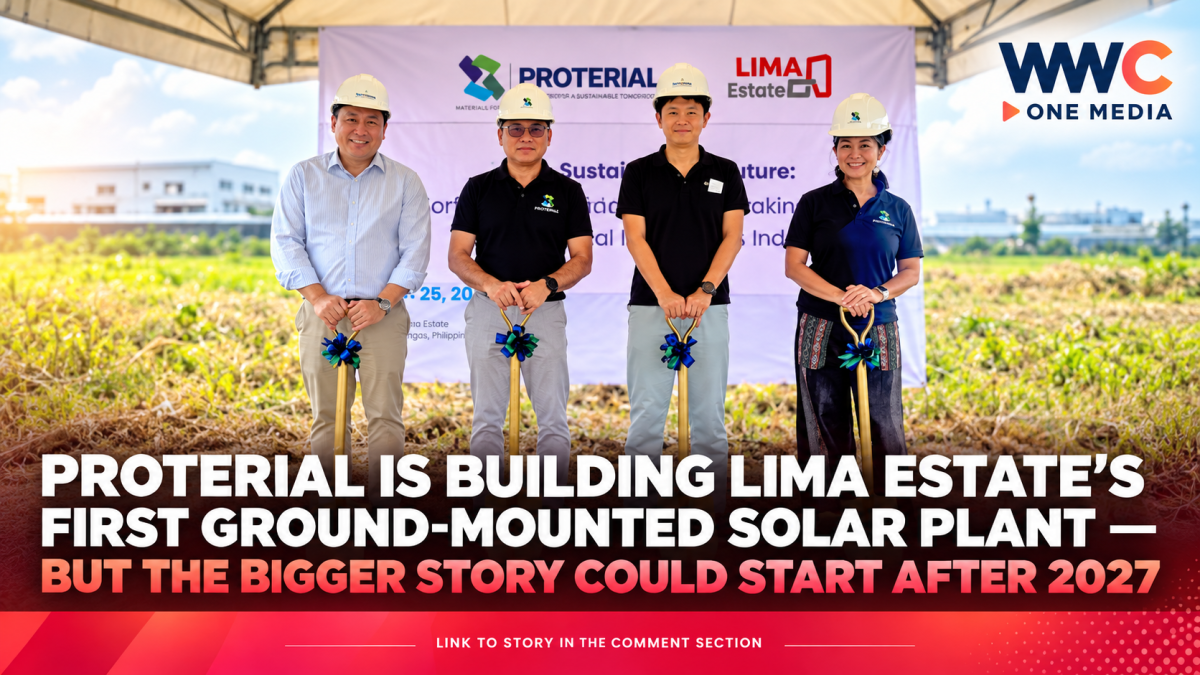
BATANGAS, Philippines — One of Southern Luzon’s biggest industrial hubs is taking another step toward cleaner manufacturing, and this time the solar panels are going on the ground.
Advent Upgrade Solar Inc. (AUSI) and Proterial Philippines Inc. have signed a 20-year power purchase agreement for a 1,587.20-kilowatt-peak, or roughly 1.59-megawatt-peak, ground-mounted solar photovoltaic system at Proterial’s manufacturing facility inside LIMA Estate in Batangas.
The project is targeted to begin commercial operations in the first quarter of 2027 and is expected to become LIMA Estate’s first ground-mounted solar installation, adding another layer to the industrial park’s growing renewable-energy infrastructure.
For Proterial, the agreement is more than a power-supply contract. It is part of a broader effort to cut emissions from energy-intensive manufacturing while reducing exposure to conventional electricity costs over the long term.
Proterial Philippines President Yoshiaki Yamashita said the partnership would help the company reduce its carbon footprint, improve energy efficiency and support the Philippines’ shift toward a more sustainable energy system.
More Than 28,000 Tons of CO2 Could Be Avoided
Once operational, the Batangas solar facility is projected to prevent more than 1,400 metric tons of carbon dioxide emissions every year, according to reports on the agreement.
Across the full 20-year contract, that would translate to roughly 28,000 tons of avoided CO2 emissions, although actual performance will ultimately depend on solar generation, plant operations and other technical factors over the project’s lifetime.
The deal also carries historical significance for Proterial Philippines.
The manufacturer, previously known as Hitachi Cable Philippines, has operated at LIMA Estate since 1997, making it one of the estate’s long-standing industrial locators. Its latest investment effectively turns a decades-old manufacturing presence into a test case for how established Philippine factories can integrate on-site renewable power without abandoning existing facilities.
Why LIMA’s “First” Needs Some Context
The new facility is being described as LIMA Estate’s first ground-mounted solar project, an important distinction.
Solar energy itself is not new to the estate.
Aboitiz InfraCapital previously reported that LIMA already had roof-mounted solar systems with around 17 MW of capacity across the estate, alongside renewable electricity supplied to qualified customers. The estate has also pursued electric transportation, smart water systems and other decarbonization initiatives.
So the Proterial project does not mark the beginning of solar adoption at LIMA. Instead, it expands the estate’s renewable-energy model from rooftop installations and renewable supply contracts into a dedicated ground-mounted system serving an industrial manufacturer.
That could prove more important than the size of this single project.
AUSI Is Quietly Building a Commercial Solar Portfolio
AUSI is a joint venture between Aboitiz Power Distributed Renewables Inc. and Upgrade Energy Philippines, positioning the company to target large commercial and industrial customers looking for long-term renewable-energy arrangements.
The Proterial agreement is not AUSI’s only major 20-year solar deal in 2026.
Earlier this year, AUSI partnered with Ortigas Land for another 1,587.20-kWp solar system at GH Mall in Greenhills, also under a 20-year PPA. The company has likewise partnered with Cebu-based Marcel FoodSciences for a 793.6-kWp rooftop solar installation expected to generate about 1.4 million kilowatt-hours of renewable electricity during its first year.
Bank financing is also moving into the sector.
Bank of the Philippine Islands said in July that it was financing two AUSI solar projects in Polillo, Quezon and LIMA, Batangas, as part of the bank’s broader renewable-energy financing portfolio.
Together, those deals suggest that distributed solar is increasingly moving beyond small rooftop installations and becoming part of the long-term energy strategy of Philippine manufacturers, malls and other large electricity users.
Proterial’s Philippine Project Fits a Much Bigger Global Plan
The Batangas project also fits into Proterial’s worldwide decarbonization program.
The Japanese materials group is targeting a 38% reduction in Scope 1 and Scope 2 carbon emissions by fiscal 2030 compared with fiscal 2015, with carbon neutrality targeted by fiscal 2050.
Proterial also wants renewable-energy generation from its own facilities to reach at least 35,000 MWh annually by fiscal 2030.
In February 2026, the company announced nearly 8 MW of captive solar installations at three manufacturing sites in China, expected to reduce CO2 emissions by approximately 5,500 tons annually. It has also installed solar systems at facilities in Japan and Vietnam.
That makes the Batangas deal part of a wider strategy rather than a standalone Philippine sustainability project.
LIMA Is Growing Alongside the Energy Transition
The timing also matters because LIMA Estate itself is expanding rapidly.
BusinessWorld reported in 2025 that the roughly 1,000-hectare mixed-use estate had around 120 operating industrial locators, with another 20 to 25 companies in various stages of construction at the time. Other Aboitiz disclosures have placed the broader estate’s locator count above 180 as commercial, residential and industrial development has expanded.
Located across Lipa and Malvar, Batangas, LIMA has evolved from a traditional industrial park into a much larger economic estate combining factories, offices, commercial areas, housing and infrastructure.
That expansion increases electricity demand — and makes the source of that electricity increasingly important.
The Bigger Philippine Energy Picture
Corporate solar projects such as Proterial’s may look small compared with the massive utility-scale solar farms now being developed across Luzon, but their cumulative impact could be significant.
The Philippine government is targeting renewable energy to account for at least 35% of the country’s power-generation mix by 2030 and 50% by 2040. The Department of Energy said in August 2026 that renewable energy had already crossed the 25% level, supported by projects awarded through successive Green Energy Auction rounds.
Large solar farms will be essential to reaching those targets.
But factories generating electricity directly where it is consumed could solve a different part of the equation: helping industrial companies reduce grid purchases, emissions and long-term energy exposure without waiting for the entire national power system to decarbonize.
That is what makes the Proterial deal worth watching.
A 1.59-MWp installation will not transform Philippine electricity on its own. But if more of LIMA Estate’s manufacturers follow the same model — particularly across an industrial ecosystem with well over a hundred locators — the first ground-mounted solar plant could become less important for what it generates than for what it convinces others to build next.
WWC ONE MEDIA M.J.E




Leave a Reply