
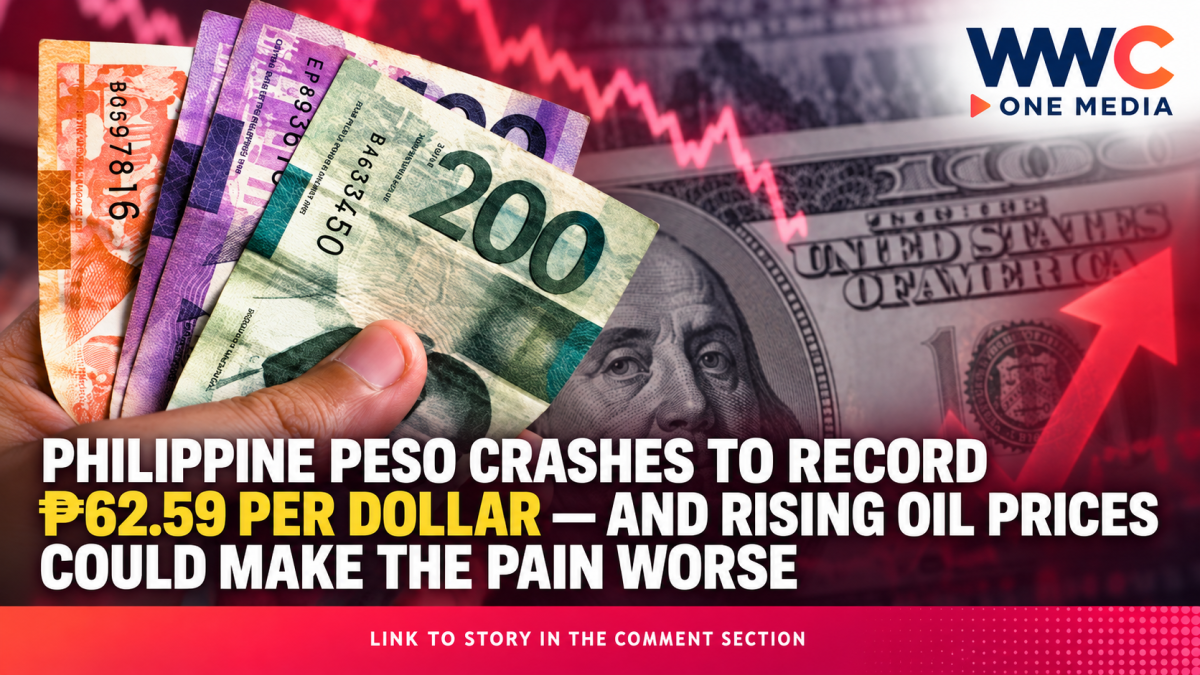
MANILA, Philippines — The Philippine peso has fallen to another historic low, closing at ₱62.59 against the US dollar on Friday, September 4, as surging global oil prices, a stronger greenback and rising US Treasury yields pile fresh pressure on the Philippine economy.
The currency weakened by seven centavos from Thursday’s ₱62.52 close, eclipsing the previous record of ₱62.565 set just two days earlier. It marked the peso’s fifth record-low finish in six trading sessions, underscoring how quickly pressure has intensified in the foreign-exchange market.
During Friday’s trading, the peso opened at ₱62.43 and strengthened briefly to around ₱62.335 before sliding as low as roughly ₱62.65. Foreign-exchange turnover reached about $1.52 billion, according to Bankers Association of the Philippines data reported by local media.
Oil Is Emerging as One of the Biggest Threats
The peso’s weakness is arriving at an especially difficult time for an economy heavily dependent on imported energy.
Global oil prices have surged amid renewed fighting involving the United States and Iran and continuing concerns over supply routes in the Middle East. Brent crude ended the week at $92.68 per barrel, up about 7.6% for the week, while US crude climbed nearly 10%, according to Reuters.
That matters directly to the Philippines.
Because the country imports much of its petroleum requirements and oil is priced internationally in dollars, a weaker peso and higher crude prices can hit the economy twice: the dollar price of fuel rises while more pesos are needed to buy each dollar.
That combination can eventually filter into transportation costs, electricity, manufacturing, agriculture and consumer prices.
RCBC chief economist Michael Ricafort pointed to elevated global oil prices and geopolitical tensions as key factors behind the peso’s latest weakness.
But It Isn’t Just Oil
UnionBank chief economist Ruben Carlo Asuncion said the latest slide was driven primarily by external forces, including a firm US dollar, elevated US yields and investor caution surrounding US economic data.
Domestic political developments may have contributed to short-term volatility, but external financial conditions remained the more important driver, according to his assessment.
The dollar received additional support after stronger-than-expected US employment figures reinforced expectations that the US Federal Reserve could keep monetary policy tight—or potentially raise rates again.
US employers added 162,000 jobs in August, strengthening expectations for tighter Federal Reserve policy. Higher US interest rates and Treasury yields can make dollar-denominated assets more attractive to global investors, putting additional pressure on emerging-market currencies such as the peso.
Inflation Has Eased — But the Peso Creates Another Problem
There was one piece of encouraging economic news.
Philippine headline inflation eased slightly to 6.1% in August from 6.2% in July, according to the Philippine Statistics Authority. Core inflation also moderated to 4.1%.
But inflation remains elevated, and the weaker currency threatens to complicate the outlook by raising the peso cost of imported commodities.
The pressure is particularly significant for lower-income households. Inflation among the bottom 30% income households remained at 8.2% in August, significantly above the national headline rate.
That means another prolonged surge in fuel, transport or food costs could disproportionately affect households already spending a large percentage of their income on necessities.
BSP Is Already Fighting Back
The Bangko Sentral ng Pilipinas has tightened monetary policy, raising its target reverse repurchase rate by 25 basis points to 5.0%.
The BSP said higher interest rates are intended to anchor inflation expectations and prevent price pressures from spreading further through the economy.
Higher Philippine interest rates can also provide some support for the peso by making peso-denominated assets relatively more attractive.
But there is a trade-off.
Higher borrowing costs can also make loans more expensive for households and businesses, potentially slowing investment, consumption and economic growth.
Who Wins and Who Loses From a Weak Peso?
The peso’s decline does not affect every sector equally.
Importers face higher costs, particularly businesses dependent on fuel, machinery, raw materials or other dollar-priced inputs.
Consumers can eventually feel the impact if companies pass those higher costs through in the form of higher prices.
On the other side, OFW families receiving dollar remittances may receive more pesos for every dollar sent home, while exporters and business-process outsourcing companies earning revenues in foreign currency can also benefit from favorable conversion rates.
But those gains can be partly erased if domestic prices rise rapidly because of imported inflation.
The Bigger Question: Is ₱62.59 the Bottom?
For now, the peso remains caught between several powerful forces: expensive oil, geopolitical uncertainty, elevated US yields, a firm dollar and persistent domestic inflation.
The government has acknowledged the economic risks. Malacañang said the administration and economic managers are working to manage inflation and currency pressures, while emphasizing more disciplined government spending and coordination with the BSP.
The next direction of the peso may depend less on any single Philippine economic indicator and more on what happens thousands of kilometers away—from oil markets in the Middle East to interest-rate decisions in Washington.
And that may be the uncomfortable part of the story.
₱62.59 may be the newest record—but if oil stays expensive and the dollar keeps strengthening, the bigger question is whether it will remain the record for very long.
WWC ONE MEDIA M.J.E




Leave a Reply