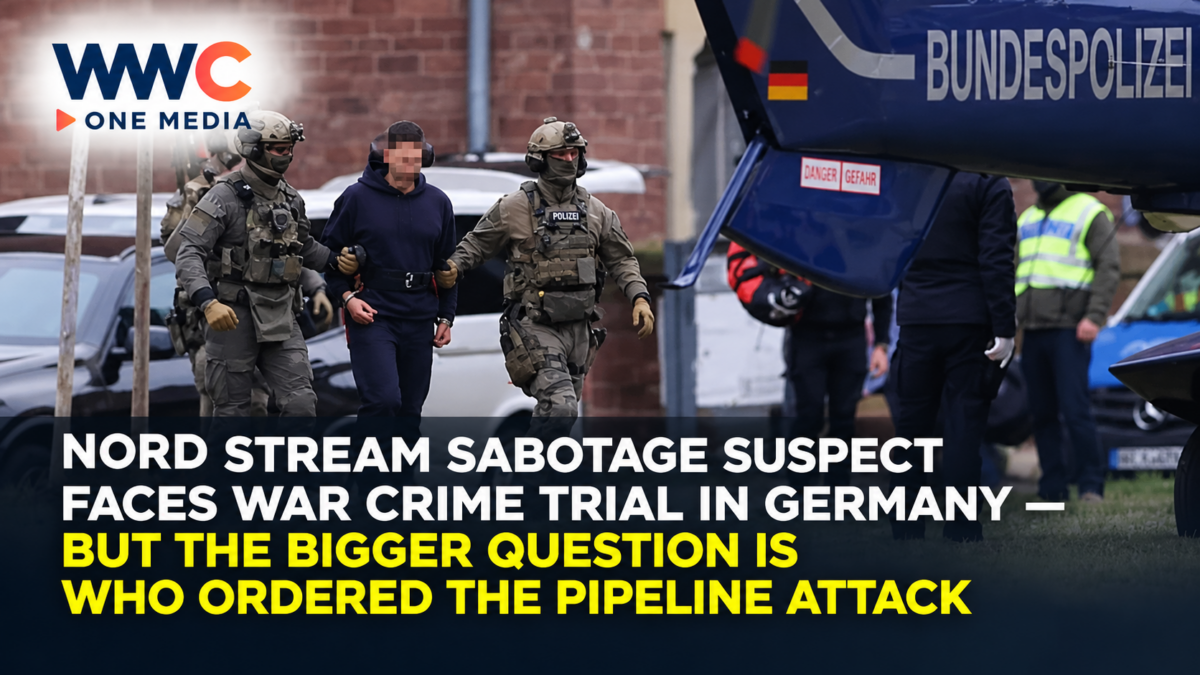
HAMBURG, GERMANY — October 14, 2026 — A former Ukrainian military officer accused of organizing the explosions that destroyed sections of the Nord Stream gas pipelines in 2022 has gone on trial in Germany, facing serious criminal allegations that could reopen one of the most politically sensitive controversies of the Russia–Ukraine war.
The defendant, identified by German authorities as Serhii K. and publicly named in Italian extradition proceedings as Serhii Kuznietsov, is accused of participating in a covert operation that damaged critical energy infrastructure beneath the Baltic Sea.
German prosecutors allege that he helped coordinate a group of operatives who used a rented yacht, diving equipment and explosives to attack the pipelines near the Danish island of Bornholm.
Among the charges is participation in a war crime through an attack on civilian infrastructure.
The defendant denies involvement in the explosions, and Ukraine’s government has rejected allegations that it was responsible.
The trial, which began Wednesday at the Hanseatic Higher Regional Court in Hamburg, marks a crucial new phase in an investigation that has lasted more than four years.
But the most consequential question may go beyond whether one defendant committed a crime.
Who authorized the operation, and what could the answers mean for Germany’s relationship with Ukraine?
Former Ukrainian Officer Appears in German Court
German prosecutors allege that Serhii K. helped lead a team that carried out the September 26, 2022, pipeline explosions.
The attack damaged the Nord Stream 1 and Nord Stream 2 gas systems, which were constructed to carry natural gas from Russia to Germany through the Baltic Sea.
According to the prosecution’s account, the group included divers and an explosives specialist.
Investigators believe the operation involved a yacht hired from a German company using forged identification documents.
The vessel allegedly departed from the German port of Rostock before traveling toward the area where the pipelines were damaged.
Prosecutors say the team attached explosive charges to underwater infrastructure and detonated them.
The accused faces allegations involving explosives, property destruction, disruption of public services and prohibited attacks on civilian objects during armed conflict.
These are charges the prosecution must prove.
Their inclusion in an indictment does not establish that the defendant carried out the sabotage.
Why German Prosecutors Call It a War Crime
The case has taken on exceptional significance because the prosecution is treating the alleged destruction of the pipelines as more than ordinary criminal sabotage.
Under international humanitarian law, civilian infrastructure generally receives protection from deliberate attacks during armed conflict.
An important legal question is whether a particular facility qualifies as a civilian object, a military objective or an object whose status depends on how it is used.
German prosecutors argue that the Nord Stream pipelines constituted protected civilian infrastructure.
They allege the attack was connected to the war in Ukraine and intended to prevent Russia from earning revenue from natural gas exports.
On that theory, the operation could amount to a war crime under Germany’s Code of Crimes against International Law.
However, the defense disputes the legal characterization.
The court must determine both whether the defendant was involved and whether the conduct proven at trial meets the legal requirements for the charged offenses.
An attack on energy infrastructure is not automatically a war crime solely because the infrastructure was damaged.
The legal assessment depends on factors including the object’s status, military use, applicable law and the circumstances of the attack.
Defense Challenges the Charges
Lawyers for Serhii K. have requested that the proceedings be dismissed.
They argue that the allegations against their client have not been adequately established.
The defense also questions whether the Nord Stream pipelines should be treated exclusively as civilian infrastructure.
Its argument draws on the broader context of Russia’s war against Ukraine and the role of energy exports in financing the Russian state.
The defense has also raised concerns about the fairness of the proceedings because the accused says military secrecy obligations restrict what he can disclose.
According to Reuters, he exercised his right to remain silent during the opening proceedings.
His lawyers have challenged aspects of the extradition process as well.
These arguments do not establish his innocence, just as the prosecution’s accusations do not establish his guilt.
They frame the issues that the court must examine before reaching a verdict.
The Explosions That Shook Europe in 2022
On September 26, 2022, underwater explosions severely damaged sections of Nord Stream 1 and Nord Stream 2.
The pipelines run beneath the Baltic Sea and were designed to transport Russian natural gas directly to Germany.
Images of enormous gas bubbles rising to the sea surface drew international attention.
The explosions triggered investigations in several European countries and competing theories about responsibility.
At the time, Russia had already launched its full-scale invasion of Ukraine, and European governments were moving to reduce dependence on Russian fossil fuels.
The pipelines had become symbols of the political and economic tensions between Moscow and Western Europe.
Nord Stream 1 had been an important route for Russian gas deliveries, although Russia had halted deliveries through it before the explosions.
Nord Stream 2 had never begun commercial operation after Germany suspended its certification process.
The blasts nonetheless caused extensive physical damage and major methane releases.
They also intensified concerns about the vulnerability of Europe’s energy infrastructure.
A Rented Yacht Becomes Central to the Investigation
One of the most significant pieces of the prosecution’s case involves a sailing yacht reportedly used by the alleged sabotage team.
German investigators focused on a vessel named Andromeda.
According to German public broadcaster ARD’s investigative reporting, forensic specialists discovered traces of military explosives aboard the yacht.
Investigators also examined travel records, rental documents and other material as they attempted to reconstruct the movements of those suspected of taking part.
The prosecution alleges that the group used the yacht as a platform for transporting personnel and equipment to the attack area.
The charges describe the deployment of multiple explosive devices at depths of approximately 70 to 80 meters.
The Associated Press reported that the prosecution alleges at least four devices, each weighing roughly 14 to 27 kilograms, were involved.
However, the court has not yet determined the reliability and significance of every item of evidence.
Forensic findings, communications and witness testimony must be evaluated under the rules governing criminal proceedings.
German Investigators Examine Possible Ukrainian Links
The investigation has become politically sensitive because German prosecutors allege that the operation involved individuals connected to Ukraine’s military.
According to Reuters, investigators believe the accused worked alongside other personnel in an operation carried out on behalf of unidentified Ukrainian state entities.
That is a prosecution allegation, not a final determination that the Ukrainian government authorized the sabotage.
Ukraine has denied responsibility.
President Volodymyr Zelenskyy has also rejected allegations that his government ordered the explosions.
The distinction is crucial.
Evidence that individuals with Ukrainian military backgrounds participated in an operation would not, by itself, establish who ordered it or whether Ukraine’s political leadership knew about it.
Those questions require separate proof.
The trial may reveal additional evidence about alleged participants, planning and command structures.
But it remains possible that not every question about responsibility will be resolved during the proceedings against this defendant.
Germany Faces a Difficult Diplomatic Situation
The case is unusually sensitive because Germany remains one of Ukraine’s most important European supporters.
Berlin has provided significant military, financial and humanitarian assistance since Russia launched its full-scale invasion in February 2022.
German leaders have repeatedly emphasized Ukraine’s right to defend itself against Russia’s aggression.
At the same time, German authorities are investigating the destruction of infrastructure important to Germany’s former energy supply system.
The result is a difficult political situation.
If prosecutors establish criminal responsibility involving Ukrainian operatives, domestic pressure for explanations could increase.
Opposition politicians may also use the proceedings to question Germany’s policies toward Ukraine.
However, criminal proceedings against individuals do not automatically establish responsibility for a foreign government.
Germany’s political relationship with Ukraine and the defendant’s individual criminal liability are distinct matters.
German officials have emphasized the independence of the judicial process and the fact that no verdict has been reached.
Russia Demands Answers About the Pipeline Attack
Russia has repeatedly called for those responsible for the Nord Stream explosions to be identified.
Moscow has also accused Western intelligence services of involvement in the attack.
Those allegations have not been established by the current German trial.
The Kremlin said ahead of the proceedings that it wanted a verdict identifying the perpetrators and those who authorized the operation.
But Russia’s statements must be distinguished from the evidence presented in court.
The trial is examining specific criminal allegations under German law.
It is not a general proceeding to adjudicate every accusation made by governments since the explosions.
According to the Associated Press, a Russian attempt to participate as a co-plaintiff was rejected.
The case nevertheless remains of significant interest to Moscow because the damaged infrastructure formed part of Russia’s former energy relationship with Germany.
A Second Suspect Faces Extradition Proceedings
The Hamburg trial is not the only legal process connected to the Nord Stream investigation.
Another Ukrainian suspect has been detained in Croatia under a European arrest warrant.
The individual is alleged to have been involved in the sabotage operation.
According to the Associated Press, he has sought asylum in Croatia while challenging extradition to Germany.
The existence of a second suspect demonstrates that investigators are continuing to pursue alleged members of the wider operation.
However, the accusations against the second individual have also not been resolved through a final criminal judgment.
Each suspect is entitled to individual assessment of the evidence and the presumption of innocence.
Environmental Damage Adds Another Dimension
The Nord Stream explosions caused large releases of natural gas into the Baltic Sea and atmosphere.
Because natural gas contains methane, the leaks also raised environmental concerns.
Methane is a powerful greenhouse gas, especially over shorter time horizons.
Environmental studies have examined the scale of emissions associated with the damaged pipelines.
The incident highlighted how attacks on energy infrastructure can have consequences extending beyond immediate economic disruption.
Those consequences may include environmental damage, maritime safety risks and broader costs associated with infrastructure replacement.
For Europe, the explosions reinforced the importance of protecting pipelines, submarine cables and other critical systems beneath surrounding seas.
Europe’s Energy Strategy Has Changed Since the Blasts
The attack took place during a major transformation in Europe’s energy policy.
Before Russia’s full-scale invasion of Ukraine, Germany relied heavily on imported Russian natural gas.
That dependence became a major strategic vulnerability as relations between Moscow and Western capitals deteriorated.
Since 2022, Germany and other European countries have expanded access to alternative gas supplies, including liquefied natural gas.
They have also pursued renewable energy and other measures intended to reduce reliance on Russian imports.
The Nord Stream pipelines became symbols of the risks associated with concentrated energy dependence.
But the economic consequences of Europe’s energy transition cannot be attributed solely to the explosions.
Russian supply restrictions, the wider war, global energy prices and policy choices all influenced the region’s energy market.
The sabotage represented a major infrastructure and security shock within that broader crisis.
Could the Trial Change Europe’s Support for Ukraine?
The proceedings could intensify debate about Germany’s support for Kyiv.
Critics may argue that any evidence linking Ukrainian personnel to the attack requires additional scrutiny.
Supporters of Ukraine emphasize that Russia’s invasion remains the larger context of the conflict and that Ukraine’s right to defend itself is not dependent on the outcome of this criminal case.
The legal questions are separate from those political judgments.
A German court must assess whether the evidence proves the defendant’s participation in the alleged conduct and whether that conduct meets the relevant criminal-law standards.
It is not tasked with determining Germany’s overall foreign policy.
Nevertheless, courtroom revelations could affect public discussion, particularly if they provide new information about the planning or authorization of the sabotage.
The political implications will depend on the evidence actually established, not simply on the allegations.
What Happens Next?
The Hamburg Higher Regional Court has scheduled 16 trial dates between October 14 and December 17, 2026.
Additional hearings are expected in January and February 2027.
The court has not announced a verdict date.
Prosecutors are expected to present evidence supporting their account of the alleged operation.
The defense will have opportunities to challenge the evidence and legal arguments.
The proceedings may examine forensic findings, communications, travel records and the alleged relationship between the suspected operatives.
For Germany, the case represents an effort to establish criminal responsibility for the destruction of critical infrastructure.
For Ukraine, it creates a politically sensitive legal challenge at a time when German support remains important.
For Europe, the trial offers a closer examination of one of the most dramatic infrastructure attacks of the modern era.
A former Ukrainian officer is now on trial in Germany over the Nord Stream explosions, facing an allegation involving war crimes. But the bigger unresolved question is whether the proceedings can establish who actually ordered the 2022 operation—and what that discovery could mean for Europe’s energy security and its relationship with Ukraine.