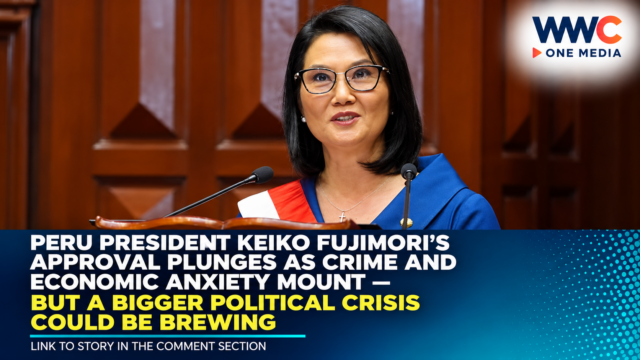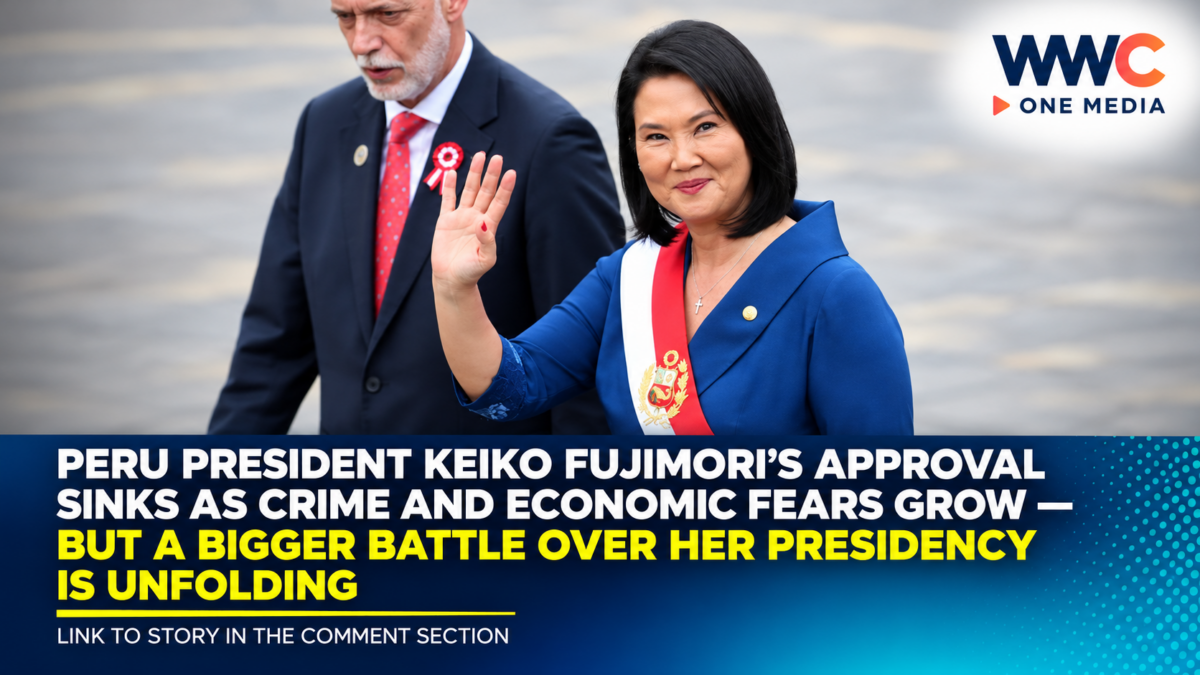
LIMA, PERU — October 14, 2026 — Peruvian President Keiko Fujimori is facing a growing crisis of public confidence less than three months after taking office, with fresh opinion polls showing declining support as concerns about crime, economic conditions and the government’s performance overshadow her promises to restore stability.
A new regional survey by CB Global Data found that Fujimori’s positive rating fell to 46.3% in October, down from 52.4% in September.
The 6.1-percentage-point decline was the steepest monthly drop among the Latin American leaders included in the survey, according to Peruvian news outlets Infobae and Caretas.
Her negative rating rose to 50.8%, placing dissatisfaction above public support.
The decline is particularly significant because Fujimori entered office on July 28 promising tougher action against organized crime, stronger economic management and a break from years of political instability.
But her administration is discovering that electoral victory does not automatically guarantee lasting public confidence.
With Congress already limiting parts of her proposed security agenda, the bigger question is whether Fujimori can deliver visible improvements before her falling popularity becomes a more serious obstacle to governing.
Fujimori’s Approval Falls Below 50% in October Poll
The latest CB Global Data regional ranking shows a notable deterioration in Fujimori’s public standing.
Her positive image declined from 52.4% in September to 46.3% in October, a loss of 6.1 percentage points.
At the same time, her negative image climbed to 50.8%.
The survey placed Fujimori seventh in its ranking of Latin American presidents, down from fourth the previous month.
The October study was conducted between October 5 and October 8 across multiple Latin American countries.
These results are not an election forecast. They provide a snapshot of public sentiment during the early months of her administration.
The figures suggest that Fujimori’s initial political momentum is weakening, although future surveys will be needed to determine whether the decline continues.
For a president elected after a closely contested national vote, a loss of public support can make it harder to build alliances, defend controversial policies and manage expectations.
September Polls Already Showed a Sharp Collapse in Support
The October figures follow national polling that raised concerns about Fujimori’s popularity weeks earlier.
A Datum Internacional survey reported by the Spanish news agency EFE found that the president’s approval had fallen from 60% in August to 42% in September.
That represented an 18-percentage-point decline within one month.
Disapproval increased from 24% to 44%.
A separate Ipsos poll for Perú21 also found 42% approval in September, compared with 57% in August.
Its disapproval figure reached 48%.
Meanwhile, the Institute of Peruvian Studies recorded 37% approval and 49% disapproval in an early-September national survey.
Although the organizations used different samples and methodologies, their findings pointed toward growing dissatisfaction with the administration.
Importantly, the earlier 18-point decline and October’s 6.1-point decline are from different polling series.
They cannot be added together to calculate one continuous change in Fujimori’s approval.
The central finding is that several separate surveys have identified a difficult political environment for the new president.
Crime Becomes the Defining Test of Her Presidency
Public insecurity is one of the most urgent problems confronting Fujimori’s administration.
Peru has experienced serious challenges involving extortion, organized criminal networks, killings and threats against businesses and transportation workers.
These problems were central to the 2026 presidential campaign.
Fujimori promised a tougher response, presenting public safety as a major priority for her government.
However, citizens appear increasingly skeptical about how quickly those commitments can produce results.
In the September IEP survey, 59% of respondents identified public insecurity as an urgent government priority.
Fighting corruption followed at 30%, while economic management was cited by 28%.
Other priorities included education, healthcare and job creation.
The results demonstrate that voters are concerned not only about political disputes but also about problems affecting their daily lives.
For small businesses, extortion can increase operating costs or make commercial activity dangerous.
For workers, insecurity can affect transportation, employment and family welfare.
Public safety has therefore become both a social challenge and an economic issue.
Peru’s Crime Problem Is Deeply Entrenched
The security challenge extends beyond a handful of widely publicized incidents.
Bloomberg Línea reported during the election campaign that Peru recorded more than 2,200 homicides in 2025, alongside more than 25,000 reported extortion complaints.
The outlet cited government records and local reporting.
Criminal violence has affected areas including Lima, Trujillo and Chiclayo.
Transport operators, merchants and other businesses have reported threats from organized groups demanding payments.
These conditions help explain why security played such a prominent role in the election.
But stronger policing and tougher sentences do not automatically resolve organized crime.
Sustained improvements may also require more effective investigations, judicial capacity, prison administration and coordination among public institutions.
The effectiveness of Fujimori’s policies will ultimately be judged by measurable reductions in crime and improvements in public confidence.
Congress Restricts Fujimori’s Security Agenda
The president is also confronting institutional resistance.
According to an October 10 report by Spain’s El País, Fujimori’s government requested authority to legislate by decree on 66 measures over 120 days.
The Chamber of Deputies narrowed that request to 20 measures over 90 days.
The approved areas included public security and preparations related to the coastal El Niño phenomenon.
Lawmakers declined to endorse several other proposals, including an expanded role for the armed forces in prison management.
Fujimori’s party, Fuerza Popular, is a major force in Congress but does not control a majority on its own.
The administration must therefore negotiate with other parties to pass legislation.
The government argues that additional powers are necessary to respond quickly to criminal activity.
Critics contend that stronger executive authority must be balanced against democratic oversight and human rights protections.
The disagreement highlights a major political test for Fujimori.
She must demonstrate that she can negotiate effectively without abandoning the security promises on which she campaigned.
Fujimori Vows Not to Retreat From Her Security Campaign
Despite mounting criticism, Fujimori has defended her administration’s public safety strategy.
In an official statement published October 5, the presidency said Fujimori would not abandon her efforts to restore order following threats directed at her.
The president said police were investigating the material associated with the threats and that relevant information had been forwarded to prosecutors.
Her comments were intended to reinforce the government’s commitment to confronting criminal organizations.
However, political determination and enforcement results are not the same.
The administration will need to demonstrate that its policies improve security while respecting legal safeguards.
For voters concerned about extortion and violence, measurable outcomes will matter more than the strength of presidential statements.
Economic Concerns Create a Second Political Front
Alongside crime, economic management is emerging as another source of pressure.
Peru is an important producer of copper and other minerals, giving it exposure to global commodity demand.
The country has opportunities to attract mining investment, support exports and develop infrastructure.
But national economic performance does not always translate immediately into better conditions for households.
Voters remain concerned about job opportunities, purchasing power and access to essential services.
The September IEP survey found that 43% of respondents believed the government was very or somewhat prepared to manage the economy.
A larger share, approximately 49%, considered it little prepared or not prepared.
These perceptions do not establish that every government policy has failed.
They do, however, show public uncertainty about whether the administration can deliver economic improvements.
The president faces the challenge of converting investment plans and business-friendly policies into gains felt beyond Peru’s financial and industrial sectors.
Peru’s Political Divisions Make Governing More Difficult
Fujimori became president after a closely contested election against left-wing candidate Roberto Sánchez.
Peru’s National Jury of Elections formally declared her the winner in July.
The official vote count gave Fujimori 9,223,396 votes and Sánchez 9,173,755 votes.
That represented a margin of fewer than 50,000 votes.
The narrow victory highlighted divisions in political preferences across Peru.
Reuters reported at her inauguration that Fujimori pledged to tackle insecurity, restore business confidence and pursue fiscal discipline.
Her presidency also followed years of intense political turnover.
These circumstances make public trust especially important.
A government elected by a narrow margin may need to build support beyond its original voters to advance major reforms.
For Fujimori, successful negotiations with Congress and improvements in public services could help establish a broader governing coalition.
Continued dissatisfaction could make those efforts harder.
Fujimori’s Political Influence Remains Strong Despite Falling Approval
The decline in Fujimori’s approval contrasts with her position as one of Peru’s most influential political figures.
An October survey of political and business leaders conducted by Ipsos for Semana Económica placed her at the top of the country’s political-power ranking.
She received a 97% score in the study’s measure of perceived influence.
But that figure does not mean that 97% of ordinary Peruvians approve of her presidency.
The study measured perceptions of political power among selected opinion leaders, not public approval among the national electorate.
The distinction is important.
A president can exercise considerable political influence while facing declining popularity.
For Fujimori, the challenge is using that influence to produce results that rebuild public confidence.
Tough-on-Crime Policies Raise Human Rights Questions
Fujimori’s political identity is closely tied to the legacy of her father, former President Alberto Fujimori.
His supporters credit his administration with defeating major insurgent threats and introducing economic reforms.
Critics point to authoritarian abuses, corruption and serious human rights violations during his presidency.
He was subsequently convicted in connection with human rights abuses.
That legacy continues to shape debates over executive power and security policy in Peru.
The current government must therefore demonstrate that effective crime prevention can be pursued within constitutional limits.
Police effectiveness, judicial accountability and respect for due process are important to the credibility of any long-term security strategy.
The debate is not simply whether the state should act against organized crime.
It is how to ensure those actions are both effective and lawful.
Fujimori Plans to Study El Salvador’s Security Model
The president is scheduled to visit El Salvador from October 28 to October 31.
According to Caretas, her planned activities include discussions with President Nayib Bukele and a visit to the country’s high-security Terrorism Confinement Center, commonly known as Cecot.
El Salvador’s aggressive anti-gang campaign has attracted international attention.
Supporters credit the government with sharply reducing gang violence.
Human rights organizations have raised concerns about mass detention and due process.
For Peru, the visit may provide an opportunity to examine aspects of another country’s security strategy.
However, Peru’s criminal environment, constitutional framework and institutions differ from those of El Salvador.
Adopting policies from another country would require careful assessment of their effectiveness and legal implications.
The proposed visit is not proof that Peru has decided to replicate the entire Salvadoran approach.
Its immediate political significance lies in Fujimori’s attempt to show that her administration is exploring stronger responses to crime.
What Happens Next?
The coming months will determine whether Fujimori can stabilize her approval ratings.
Further surveys will reveal whether the October decline continues, slows or reverses.
The government will also be judged on its ability to implement security measures, cooperate with Congress and improve economic confidence.
Peru’s mining industry, businesses and financial markets will watch for signs of policy stability.
Households will focus on issues that directly affect their lives: safety, employment, income and access to essential services.
The president still has time to rebuild support.
But the early polling decline demonstrates that expectations are already high.
Political influence alone will not resolve insecurity or economic frustration.
The administration must show that its promises can be translated into practical results.
Keiko Fujimori’s approval has fallen below 50% in the latest October regional survey as Peruvians express growing concern over crime and economic management. But the bigger test is whether she can turn tough campaign promises into meaningful progress before public dissatisfaction begins to undermine her ability to govern.