
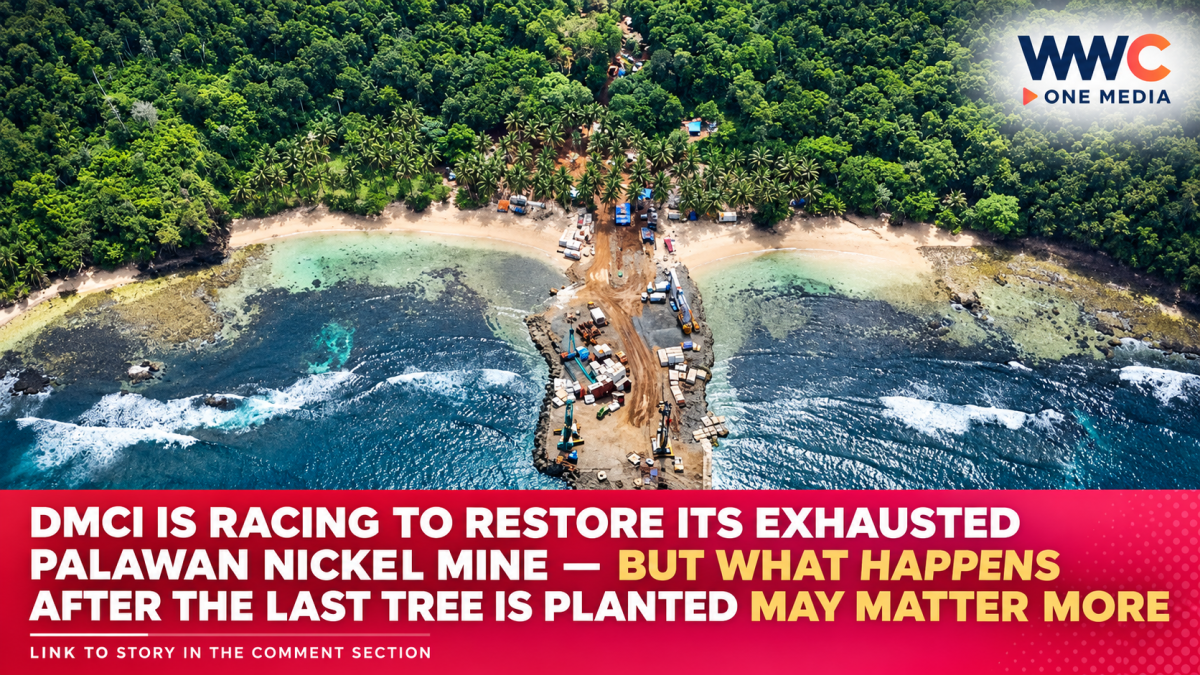
QUEZON, PALAWAN — Mining normally makes headlines when companies discover ore, open new pits or announce record production.
DMCI Mining Corp. is now trying to attract attention for the opposite reason: what happens after the ore is gone.
The Consunji-led miner says rehabilitation of its depleted Berong nickel mine in Quezon, Palawan, is running ahead of schedule, raising the possibility that major restoration work could be completed earlier than originally planned.
But DMCI Mining President and Chief Operating Officer Tulsi Das C. Reyes is resisting the temptation to call the job finished too soon.
“We’re actually ahead of schedule,” Reyes said in separate reporting on the project, adding that Berong Nickel Corp. has deliberately gone beyond minimum rehabilitation requirements. He said that, technically, the company could already declare portions of the work complete, but wants to fine-tune the site before formally doing so.
That distinction matters.
Berong is not simply another tree-planting project.
It is being rehabilitated under what DMCI describes as the Philippines’ first approved Final Mine Rehabilitation and Decommissioning Plan, or FMRDP, for a nickel mine — potentially making the site an important test of whether large-scale mineral extraction can be followed by credible ecological restoration.
And the timing could hardly be more significant.
The Philippines is simultaneously trying to expand its critical-minerals industry, increase nickel output and attract investment into mineral processing — meaning the way companies close old mines may become almost as important politically as the way they open new ones.
The Mine Ran Out of Nickel. The Work Didn’t End.
Berong’s nickel deposit was fully depleted in December 2021, ending mining operations that had begun in 2006.
The formal six-year rehabilitation program started in 2022 and remains scheduled for completion in 2027, after which the rehabilitated site is expected to be turned over to the government.
The work is far more complicated than simply replacing vegetation.
Rehabilitation includes stabilizing slopes, controlling erosion, constructing and maintaining drainage systems, replacing topsoil, revegetating disturbed areas and monitoring biodiversity as ecosystems gradually recover.
DMCI’s original rehabilitation framework covered multiple components, including 109 hectares of surface mining areas, 209 hectares associated with silt-control structures and 25 hectares of stockpile areas. About 14 hectares of mine-access road were also earmarked for rehabilitation and eventual community use.
Those categories should not simply be added together and described as the mine’s physical footprint, however. The Berong mining claim itself covers about 288 hectares, while recent reporting says approximately 137 hectares were directly disturbed by mining activity.
That distinction is important because different company disclosures measure rehabilitation using different parts of the approved plan.
Nearly 352,000 Seedlings — With a Reported 97% Survival Rate
As of 2026, Berong Nickel Corp. had invested approximately P160 million in rehabilitation.
The company reported planting nearly 352,000 seedlings, with a 97% survival rate, while its nurseries had produced more than 497,000 seedlings.
That is substantially above the project’s original P110-million rehabilitation budget.
The budget had already been increased by around P50 million several years ago, with management citing sharply higher fuel costs as one reason for the additional spending.
Company data disclosed earlier this year also said Berong had rehabilitated more than 174 hectares under its FMRDP framework, exceeding its third-year targets. Separately, July reporting said roughly 100 hectares of the 137 hectares previously disturbed by mining had been rehabilitated.
Those figures are not necessarily contradictory because they describe rehabilitation using different components and measurements of the overall plan. For an accurate article, they should not be presented as if they measure exactly the same land area.
DMCI Says It Could Finish Faster — But Doesn’t Want to Rush the Ending
This is where the story becomes more interesting.
Reyes said the rehabilitation is already sufficiently advanced that DMCI could technically declare more work complete.
But management appears reluctant to turn “ahead of schedule” into a race.
“On paper, we could be done, but we’re not yet.”
Reyes said the company wants to make sure that when it finally says the rehabilitation is finished, the work is actually finished.
That represents a subtle change from the way mine rehabilitation is often discussed.
Completing work early sounds impressive in a corporate announcement.
But ecological recovery does not necessarily follow a corporate deadline.
Trees have to survive.
Slopes have to remain stable through rainy seasons.
Drainage systems have to work.
Wildlife has to return.
And restored land has to remain viable after the mining company leaves.
So the real test of Berong will not be whether DMCI beats its timetable.
It will be whether the restoration continues working after that timetable ends.
Wildlife Is Starting to Come Back
There are early indications that some of the older rehabilitated areas are supporting returning biodiversity.
Context.ph reported that monitoring has detected several bird species as well as the return of the Palawan horned frog in areas that were restored more than a decade ago.
Berong has also used indigenous species such as almaciga and agoho, while experimenting with so-called nickel-accumulating plants that can tolerate or absorb metals present in the soil.
The company’s environmental program extends beyond the mined-out land itself, including mangrove rehabilitation, sea-turtle conservation and coral-gardening initiatives in nearby areas.
Those efforts help illustrate why mine closure is increasingly viewed as a long-term ecosystem-management project rather than a final landscaping exercise.
Berong Could Become a Test Case for Philippine Mining
There is another reason the project matters.
The Mines and Geosciences Bureau previously indicated that it wanted Berong to serve as an example of a “commendable” final mine rehabilitation program, according to Reyes.
Other miners are already looking at it.
In May, representatives from FCF Minerals Corp., government agencies and communities in Nueva Vizcaya visited Berong to study its mine-closure and rehabilitation practices ahead of FCF’s own planned FMRDP implementation.
That turns Berong into something larger than one company’s environmental obligation.
If the rehabilitation works, regulators and miners could use elements of the project as a practical model for closing other Philippine mines.
If the restored ecosystem deteriorates after turnover, however, that would provide a very different lesson.
The Irony: DMCI Is Closing One Palawan Mine While Expanding Another
The environmental story becomes more complicated when viewed alongside DMCI’s growth strategy.
While Berong is being restored, the company has begun mining at Long Point in Aborlan, Palawan, also operated through Berong Nickel Corp.
Long Point covers roughly 2,177 hectares, making it more than nine times the size of the old 288-hectare Berong mining claim.
DMCI says the deposit also has commercially attractive characteristics, including thicker ore zones and higher nickel grades than the depleted Berong operation.
The company is already considering expanding Long Point beyond its current permitted production level.
That puts the two Palawan projects side by side as a revealing corporate contrast:
At Berong, DMCI is trying to prove that it knows how to leave a mine.
At Long Point, it is trying to prove that it deserves to build a much bigger one.
And those two questions are increasingly connected.
DMCI Is Chasing a Record 3 Million Tons of Nickel
DMCI Mining is targeting approximately 3 million wet metric tons of nickel ore production in 2026, which would exceed its record 2025 output.
The company said it had already shipped about 1 million tons from Palawan in only three months, while operations in Zambales had produced roughly 1.6 million tons for the year at the time of management’s September briefing.
That would mark a sharp expansion from 2025, when DMCI Mining produced a record 2 million WMT, up 33% from 1.5 million WMT the previous year.
Reyes has previously said the company eventually wants production to rise significantly beyond present levels if permits, exploration results and market conditions allow it.
So Berong’s rehabilitation is unfolding while DMCI is simultaneously becoming a larger nickel producer.
That makes the company’s environmental record commercially relevant.
Regulators and communities deciding whether to support future mines do not have to judge DMCI solely by promises about what it will eventually do.
They can look at Berong and ask what it actually did when a mine was exhausted.
Nickel Is Becoming More Strategic — But the Market Is Still Brutal
The broader industry backdrop makes that question even more consequential.
The Philippines was the world’s second-largest nickel producer in 2024, accounting for about 9.5% of global output, according to the U.S. Geological Survey.
Nickel is important to stainless steel and certain electric-vehicle battery chemistries, giving Philippine mineral deposits strategic value as governments race to secure critical-material supply chains.
But that does not mean every nickel mine is guaranteed extraordinary profits.
Reuters reported in June that the global nickel market was still struggling with a large inventory overhang, despite expectations that Indonesian production restrictions could eventually help rebalance supply. Combined inventories tracked on the London and Shanghai exchanges had reached their highest levels since 2015.
There is another structural uncertainty: many electric vehicles and energy-storage systems increasingly use lithium-iron-phosphate batteries, which do not require nickel.
So the industry’s future will depend not only on how much nickel can be mined, but on changing battery technologies, Indonesian policy, Chinese demand and global industrial growth.
Marcos Wants More Value From Philippine Minerals
At the same time, Manila is taking a more aggressive approach to critical minerals.
President Ferdinand Marcos Jr. issued Executive Order No. 122 in August, establishing a national policy framework intended to move the Philippines beyond simply exporting raw minerals.
The government wants more domestic investment in refining, advanced materials, batteries, electronics and renewable-energy technologies, while also emphasizing responsible mining and environmental safeguards.
For DMCI, that policy represents a major opportunity.
But it also increases scrutiny.
The government’s argument is effectively that the Philippines can mine more strategically, process more minerals domestically and capture more economic value without sacrificing environmental responsibility.
Berong provides a real-world place to test that promise.
The Community Question Doesn’t End at Turnover
DMCI says it plans eventually to hand the rehabilitated site back to the government.
But Reyes also indicated that the company does not intend simply to disappear once the formal turnover is completed.
“Officially, yes, we’ll leave. But unofficially, we’ll still be around,” he said, adding that DMCI wants to see how the local government manages the site and remain available to assist.
That may prove critical.
During its operating years, Berong supported local employment and community programs. Daily Tribune reported that at the mine’s 2019 employment peak, 537 workers were employed, 97% of them from Palawan. The company also says it spent nearly P200 million through its Social Development and Management Program, while royalties paid to Indigenous Peoples totaled P161 million.
A mine closure therefore creates two rehabilitation problems.
One is ecological.
The other is economic.
Restoring forests is only part of the challenge if communities that once depended on mining income, jobs and social programs have no durable replacement.
Potential future uses for rehabilitated portions of Berong have included eco-tourism, agroforestry and inland fish farming, according to DMCI disclosures.
Whether those alternatives can generate meaningful long-term economic activity remains something that can only be judged after mining is gone.
WWC ONE MEDIA M.J.E




Leave a Reply