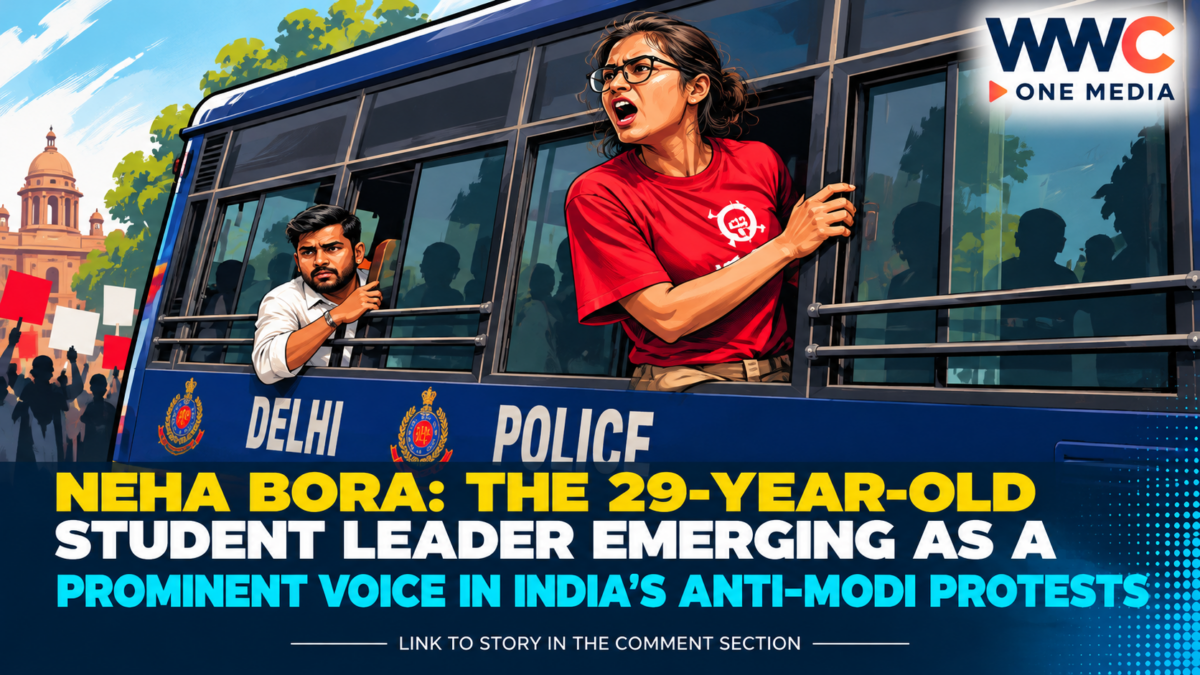
A 29-year-old doctoral student who once found her voice through theatre has emerged as one of the most visible figures in India’s growing youth protest movement against Prime Minister Narendra Modi’s government.
Neha Bora, national president of the All India Students’ Association (AISA), has drawn attention for her speeches, repeated detentions and calls for demonstrators to continue their campaign despite police restrictions in New Delhi.
Her rise comes amid protests over changes to India’s electoral rolls, which opposition groups say could disenfranchise eligible voters and benefit Modi’s Bharatiya Janata Party (BJP). The Election Commission rejects allegations that it is favouring any political group, saying the voter-list process is intended to maintain accurate records.
From Theatre Student to Political Activist
Bora grew up in Uttarakhand, a Himalayan state in northern India, and moved frequently during childhood because her father served in the army.
She later studied at Delhi University before beginning doctoral studies at Jawaharlal Nehru University’s School of Arts and Aesthetics.
As an undergraduate, she joined a theatre group. She has said that performing helped her understand people whose experiences and viewpoints differed from her own — a perspective she later carried into political activism.
Her involvement in student protests grew during demonstrations in 2019 and 2020 against India’s controversial citizenship law. Critics of the law argued that it discriminated against Muslims, while the government defended it as a measure to provide citizenship to certain religious minorities fleeing neighbouring countries.
Bora’s activism subsequently expanded to issues including unemployment, alleged examination-paper leaks and police treatment of protesters. <Cite refs={[“turn966099search0″,”turn966099search2”]}/>
Why Bora Has Become a Recognisable Face of the Protests
Bora’s profile grew during demonstrations over alleged examination-paper leaks, when she joined activists calling for the resignation of Education Minister Dharmendra Pradhan. Her speeches criticising the government’s response to protesters circulated widely online.
She has since become a prominent speaker at demonstrations in New Delhi, often connecting student concerns with broader questions about constitutional rights, inequality and government accountability.
Her approach combines Hindi and English speeches with appeals to young people who feel frustrated by unemployment, education-related controversies and what they see as a lack of accountability from public institutions. <Cite refs={[“turn966099search0″,”turn966099search2”]}/>
Protests Over 130 Million Voter-List Deletions
The latest demonstrations centre on a revision of India’s electoral rolls that protesters say has removed approximately 130 million names.
Opposition groups argue that the deletions risk excluding eligible voters and could disproportionately affect marginalised communities. They are demanding the resignation of Chief Election Commissioner Gyanesh Kumar and greater transparency over the revision process.
The Election Commission denies favouring the BJP, while the ruling party has accused opponents of undermining confidence in legitimate electoral procedures.
The dispute has become a wider debate about voter registration, political accountability and public confidence in India’s democratic institutions. The number of names removed does not, by itself, establish how many eligible voters may have been wrongly excluded. <Cite refs={[“turn966099news5″,”turn966099news9″,”turn966099search0”]}/>
Detained — But Still Urging Supporters to Continue
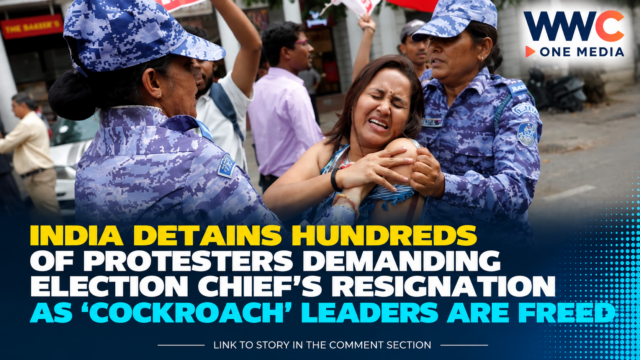
During protests on October 10, police prevented demonstrators from reaching Jantar Mantar, a designated protest site in New Delhi. Bora urged supporters to regroup at Dilli Haat, a crafts market roughly 10 kilometres away, before she was detained with other activists.
Even while in custody, she called on demonstrators to continue protesting at alternative locations. She was later released, but renewed demonstrations and further detentions followed.
The wider police operation drew criticism from activists and opposition politicians. Some protesters also alleged mistreatment in detention, although individual allegations require independent verification.
The demonstrations have continued despite heavy security deployments and restrictions on gatherings, making the handling of protests another major point of contention between activists and the authorities. <Cite refs={[“turn966099search0″,”turn966099news8″,”turn966099news9”]}/>
‘Hope Is Also Infectious’
For Bora, activism is not simply a matter of political ideology. In comments reported by Reuters, she described hope as a force that can encourage people to overcome fear and participate in public life.
Her emergence reflects how years of grievances can converge in a youth-led movement — from employment concerns and education controversies to questions about voting rights and the treatment of demonstrators.
The movement’s supporters see their campaign as an effort to demand accountability and protect democratic participation. The government and election authorities, meanwhile, reject allegations that the voter-list revision is politically motivated.
Whether the protests lead to changes in election procedures or official decisions remains uncertain. But Bora’s growing visibility shows how student activists can become central figures in a national political debate.
For now, her story is closely tied to a larger question facing India: how can authorities maintain accurate electoral rolls while ensuring that eligible citizens retain their right to vote and that peaceful dissent can take place? <Cite refs={[“turn966099search0″,”turn966099news5″,”turn966099search2”]}/>