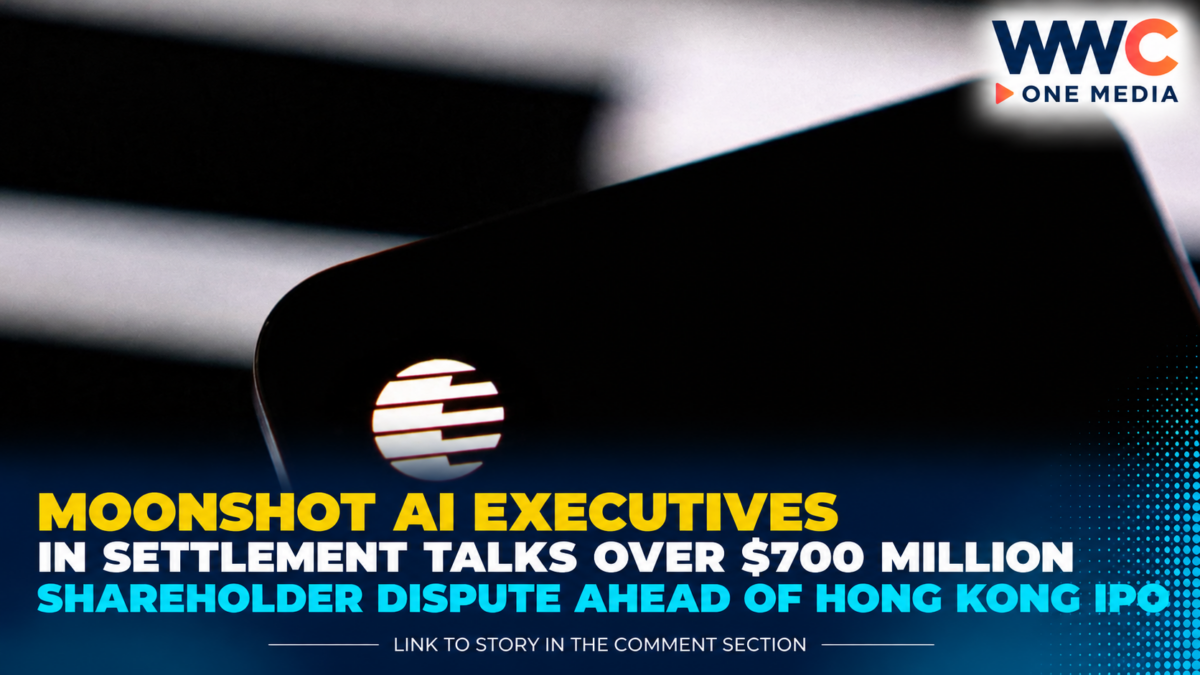
Chinese artificial intelligence startup Moonshot AI is reportedly in talks to settle a long-running shareholder dispute as it prepares for a potential Hong Kong stock market listing — a development that could put its corporate governance and ownership structure under closer scrutiny.
The dispute involves Moonshot chief executive Yang Zhilin and chief technology officer Zhang Yutao, who have been accused by former business associates at AI software developer Recurrent.ai and some of its investors of wrongdoing linked to the establishment and growth of Moonshot.
The allegations have not been independently verified by Reuters, and the executives have not been found liable based on the reports. Yang has previously denied the accusations, while Moonshot has declined to comment.
The reported settlement discussions come as Moonshot seeks to capitalise on growing investor interest in Chinese AI companies and the popularity of its Kimi models.
Why Is Moonshot Facing a Shareholder Dispute?
Yang and Zhang co-founded Recurrent.ai in 2016 before establishing Moonshot in 2023. According to corporate records cited by Reuters, both continued to serve as directors of Recurrent’s holding company.
Recurrent and some of its investors allege that the executives established Moonshot without the necessary board authorisation, made false representations to investors and enriched themselves at Recurrent’s expense.
The dispute has been in arbitration in Hong Kong since 2024.
A letter sent by Recurrent’s lawyers to Moonshot investors in March outlined several allegations, including the unauthorised transfer of servers containing important large-language-model data to a Moonshot subsidiary in April 2023. The letter also alleged that other key data was deleted in September 2024 at Zhang Yutao’s instruction.
Reuters said it could not independently verify the claims in the letter. The allegations remain disputed.
David Morrison, a senior partner at law firm MinterEllison, which represents Yang, Zhang and Moonshot, previously said the case lacked a legal and factual basis and that the firm would mount a defence.
Recurrent Seeks Compensation That Could Exceed US$700 Million
The financial stakes are substantial.
Recurrent received 9.5 per cent of Moonshot’s original shares when the startup was established. Recurrent and some of its investors are now seeking compensation equivalent to 10.5 per cent of Moonshot’s original shares.
Based on Moonshot’s reported US$30 billion valuation from a June 2026 fundraising round, that claim could be worth more than US$700 million.
The dispute also extends to Moonshot president Zhang Yutong. Recurrent and its investors are considering separate legal action in the Cayman Islands, alleging that she received a significant Moonshot shareholding that was concealed from Recurrent shareholders.
Reuters said it could not independently confirm that allegation, and Zhang Yutong did not respond to requests for comment.
The reported settlement discussions do not necessarily mean that either side has accepted the other’s claims, and it remains unclear whether an agreement is close.
Will the Dispute Affect Moonshot’s Planned IPO?
Moonshot has confidentially filed for a Hong Kong initial public offering, according to Reuters’ September report, as it seeks to take advantage of demand for Chinese AI businesses.
The shareholder dispute is not currently expected to derail the planned listing. However, leaving it unresolved could create complications for prospective investors, particularly around ownership rights, corporate governance and the disclosure of potential liabilities.
For a company seeking to attract public-market investors, questions about who owns its shares, how its intellectual property was developed and whether former shareholders have outstanding claims can become important parts of the listing process.
A settlement could reduce some of that uncertainty, although the terms of any agreement and its potential effect on the IPO remain unknown.
Moonshot’s Kimi AI Models Put It in the Global AI Race
Beijing-based Moonshot has become one of China’s prominent AI developers through its Kimi chatbot, which gained attention for its ability to process lengthy documents.
The company has since expanded into coding tools, reasoning capabilities and AI agent products. Its investors include major Chinese companies such as Alibaba, Tencent, Meituan and China Mobile.
In July 2026, Moonshot unveiled Kimi K3, a model it described as a large open-weight AI system with 2.8 trillion parameters. The company said the model delivers performance approaching that of Anthropic’s models.
Moonshot is part of a wider group of Chinese AI companies competing with American developers such as OpenAI and Anthropic. That competition has increased the importance of funding, computing resources, intellectual property and investor confidence.
A Critical Test of Corporate Governance
The reported negotiations put Moonshot at the intersection of two major issues: the race to develop advanced AI and the governance standards expected of companies preparing to enter public markets.
For Moonshot, a successful settlement could help reduce uncertainty as it moves towards a possible IPO. For investors, the central questions are whether the parties can reach an agreement, what financial obligations might result and whether any outstanding claims could affect the company’s ownership structure.
The key uncertainty is not simply whether Moonshot can go public, but whether it can resolve a potentially costly shareholder dispute before public-market investors are asked to assess its future.