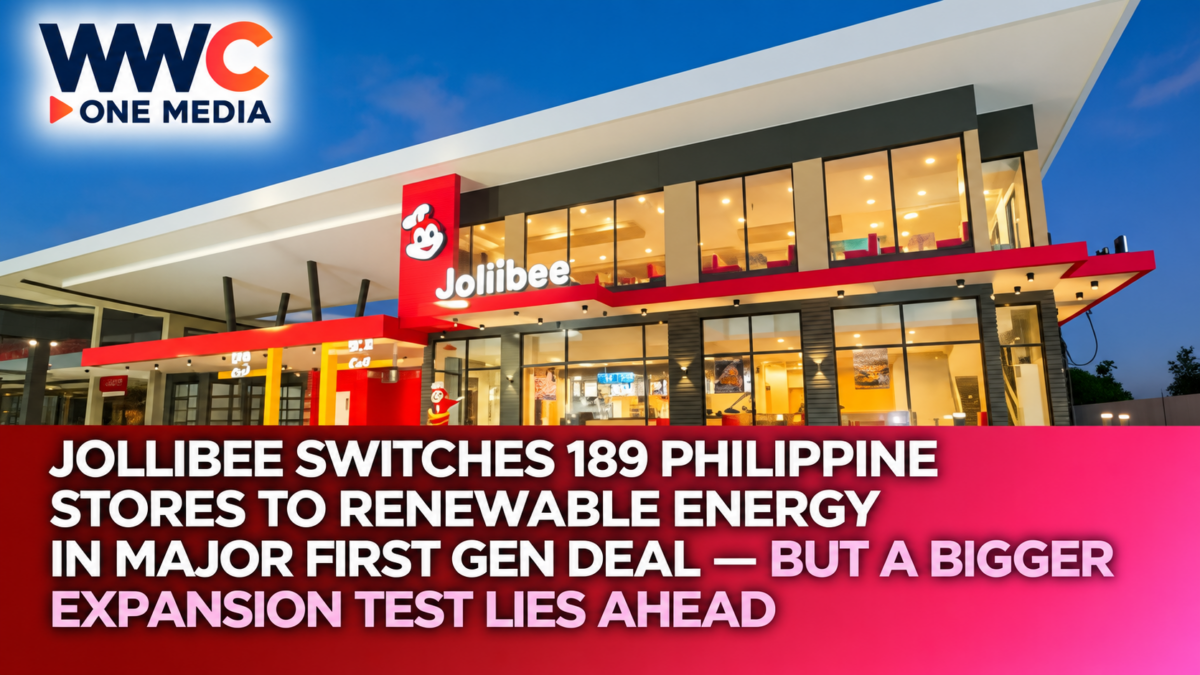
MANILA, Philippines — October 12, 2026 — Philippine fast-food giant Jollibee Group is taking a major step toward cleaner restaurant operations after expanding its partnership with Lopez-led First Gen Corporation to supply renewable electricity to 189 company-owned stores nationwide.
The agreement covers approximately 40% of Jollibee Group’s company-owned restaurants in the Philippines, making it one of the company’s most significant renewable-energy initiatives involving its retail network.
The participating outlets operate under six familiar brands: Jollibee, Greenwich, Chowking, Red Ribbon, Burger King and Panda Express.
According to InsiderPH and BusinessMirror, the restaurants will source their electricity from First Gen’s geothermal facilities in Ormoc City and Kananga, Leyte.
The final batch of power supply agreements was signed on September 26, 2026, under the Philippine government’s Retail Aggregation Program.
The arrangement allows qualified businesses to combine the electricity demand of multiple facilities and negotiate directly with power suppliers.
For Jollibee, the partnership offers an opportunity to reduce its environmental impact while improving its ability to manage energy costs.
But the bigger challenge is whether the restaurant giant can extend the program beyond its initial 189 stores and turn renewable electricity into a sustainable business advantage.
Jollibee Expands Renewable Energy to 189 Restaurants
Jollibee Group’s latest initiative marks an expansion of its existing clean-energy partnership with First Gen.
Earlier projects focused mainly on the company’s food manufacturing plants, commissaries and distribution facilities.
The new agreements extend renewable electricity procurement to restaurants operating across the country.
The participating stores account for approximately 40% of the group’s company-owned Philippine outlets.
The move is particularly significant because restaurant electricity consumption is spread across multiple locations rather than concentrated in a single manufacturing facility.
Individual stores need electricity for refrigeration, food preparation, lighting, ventilation, air conditioning and other operations.
Managing the electricity needs of nearly 200 restaurants requires coordination across locations with different consumption patterns and operational requirements.
The new arrangement is designed to address those challenges through consolidated power procurement.
Six Jollibee Group Brands Are Included
The deal is not limited to stores carrying the Jollibee name.
It includes company-owned outlets operating under:
- Jollibee
- Greenwich
- Chowking
- Red Ribbon
- Burger King
- Panda Express
These brands serve different restaurant markets but share the need for reliable and competitively priced electricity.
The group expects the consolidated arrangement to support operational efficiency while advancing its environmental commitments.
However, the agreements do not cover every outlet operating under these brands.
The 189-store figure applies to participating company-owned restaurants, not the entire Philippine network of company-operated and franchised locations.
The company has not announced that all its domestic restaurants have completed the same transition.
How First Gen Will Power Jollibee’s Restaurants
First Gen will supply electricity sourced from geothermal facilities in Ormoc City and Kananga, Leyte.
Geothermal power uses heat from beneath the Earth’s surface to generate electricity.
Unlike solar and wind power, which depend on sunlight and wind conditions, geothermal facilities can provide electricity continuously when operating normally.
This makes geothermal generation especially useful for businesses that need dependable power throughout the day.
Restaurants require electricity even outside peak dining hours.
Refrigeration systems, food storage equipment and essential infrastructure may operate continuously.
Geothermal electricity can therefore help companies pursue renewable-energy goals without relying exclusively on intermittent sources.
The arrangement does not mean a separate physical power line runs directly from Leyte to each restaurant.
The electricity is supplied through the applicable grid and commercial arrangements, with renewable-energy procurement governed by the relevant contracts and regulations.
What Is the Government’s Retail Aggregation Program?
The agreement was implemented under the Retail Aggregation Program, or RAP.
The program allows qualified electricity consumers to consolidate their electricity requirements to participate in the competitive retail electricity market.
Instead of negotiating separate supply agreements for every eligible establishment, businesses can aggregate demand from multiple locations.
This can create opportunities to secure commercial arrangements that would be more difficult for individual small electricity users.
For a nationwide restaurant company, aggregation is particularly relevant because many outlets have relatively modest electricity demand on their own.
Together, however, their combined consumption can represent a substantial electricity requirement.
The arrangement gives Jollibee Group a way to coordinate procurement across eligible locations.
The savings, if any, will depend on contract terms, electricity market conditions and the company’s actual consumption.
No verified peso amount of electricity-bill savings from the 189-store agreement was disclosed in the October 12 reports.
First Gen and Jollibee Finalize Agreements in September
The final batch of contracts was signed on September 26, 2026.
The agreement marks another stage in the relationship between the two companies.
Jollibee Group Philippines Head of Network Development Bong Filart emphasized the coordination involved in shifting nearly 200 restaurants to renewable electricity.
According to Filart, consolidating eligible stores and improving electricity sourcing supports operational efficiency and more sustainable business practices.
He also indicated that the company intends to use the experience gained from the initial rollout to extend RAP arrangements to more eligible stores.
That expansion remains a future objective rather than a completed transition.
The company has not disclosed a final target date for bringing every eligible outlet into the program.
First Gen Says the Agreement Could Reduce Energy-Cost Volatility
First Gen Chief Customer Engagement Officer Carlo Vega welcomed the expanded partnership.
The company believes renewable electricity can help Jollibee manage energy-cost volatility while lowering the environmental footprint of retail and manufacturing operations.
For restaurant businesses, electricity expenses can be an important operating cost.
Changes in energy prices can affect margins, particularly when companies face pressure from food costs, wages, rent and transportation expenses.
Longer-term electricity supply arrangements may offer businesses more predictable commercial terms, depending on contract structure.
However, renewable electricity is not automatically cheaper than every conventional alternative.
The actual financial benefit depends on negotiated prices, grid charges, fees and prevailing market conditions.
The October 12 announcement did not provide enough financial information to calculate how much Jollibee will save.
Partnership Began With More Than 17,000 Solar Panels
The companies’ relationship extends back several years.
In 2023, Jollibee Group engaged First Gen to develop solar-energy installations for its commissaries and distribution facilities in Parañaque and Laguna.
The projects involved more than 17,000 solar panels with a combined capacity exceeding 9 megawatts.
The installations were completed in 2024.
First Gen also provided a remote energy-monitoring system designed to improve the visibility and management of electricity consumption at the company’s logistics operations.
The earlier projects demonstrate that the 189-store arrangement is part of a longer energy-transition strategy.
It is not Jollibee Group’s first investment in renewable electricity.
Jollibee’s Commissaries Already Use 99% Renewable Electricity
In February 2026, Jollibee Group announced that its key Philippine commissaries and logistics facilities were operating with 99% renewable electricity.
Under that arrangement, First Gen supplied 11 megawatts of geothermal power.
The group said the transition was expected to reduce greenhouse gas emissions by more than 70% across the covered facilities.
That expected emissions reduction applies to the earlier commissary and logistics initiative.
It should not automatically be applied to the new 189-store restaurant agreement, for which a separate emissions-reduction estimate was not disclosed.
The commissary project is important because food manufacturing facilities have substantial and relatively consistent electricity requirements.
The initiative demonstrated how renewable power could support the group’s production and distribution network before the expansion to individual stores.
Cebu Commissary Also Uses Solar and Geothermal Power
Jollibee Group’s renewable-energy investments also extend to Cebu.
Its Danao Commissary, inaugurated in January 2026, uses rooftop solar panels supplied through First Gen.
According to First Gen, the facility has more than 3,900 photovoltaic panels with a capacity of approximately 2.8 megawatt-peak.
The plant also receives 1 megawatt of geothermal electricity from First Gen’s BacMan facilities in Bicol.
First Gen said the Danao facility sources approximately 99% renewable electricity.
The commissary serves as a major production hub for the Visayas and Mindanao, supporting several Jollibee Group restaurant brands.
Together with the company’s Luzon-based energy projects, the Cebu initiative shows how renewable electricity is being incorporated into different parts of the group’s operations.
Why Renewable Electricity Matters to the Philippine Food Industry
The energy transition has implications beyond Jollibee Group.
Restaurants, food manufacturers and distributors require reliable electricity for food safety and continuity of operations.
Refrigeration failures can damage inventory.
Power interruptions can disrupt production and customer service.
High electricity costs can also put pressure on profit margins.
As companies expand, their electricity requirements generally increase.
Renewable-energy procurement offers one possible way to manage that demand while reducing reliance on higher-emission sources.
However, electricity supply arrangements must be evaluated alongside other business needs.
Reliability, contract flexibility, power quality and affordability remain critical.
A successful transition must deliver practical operational benefits, not merely an environmental claim.
Philippine Businesses Are Increasing Renewable-Energy Procurement
Jollibee’s expanded agreement reflects a broader corporate trend.
Other Philippine companies have been entering renewable-energy supply arrangements with electricity providers.
Property developers, manufacturers, schools and large commercial enterprises are exploring ways to source electricity from geothermal, solar, wind and other renewable facilities.
The objective is often a combination of energy-cost management, environmental commitments and operational resilience.
The trend is also linked to changing expectations from investors, lenders and consumers concerning corporate sustainability.
For First Gen, expanding renewable-energy supply to businesses creates opportunities beyond conventional large industrial customers.
The Retail Aggregation Program may allow it and other electricity suppliers to serve groups of smaller facilities through consolidated contracts.
Could Renewable Energy Eventually Affect Menu Prices?
Consumers may wonder whether lower electricity costs could make meals cheaper.
The current agreement does not establish that Jollibee will reduce menu prices.
Restaurant prices depend on many factors, including ingredients, labor, rent, transportation, taxes, competition and electricity.
Even if the company achieves power-cost savings, management may use those savings to offset other expenses, support investments or improve profitability.
No direct menu-price reduction has been announced as a result of the First Gen agreement.
The more immediate significance is the potential to support cost management and reduce environmental impact over time.
Any claim that the renewable-energy transition has already lowered food prices would be premature.
Why the Philippines’ Energy Outlook Makes the Deal Timely
The agreement comes during a period of heightened concern over Southeast Asia’s energy security.
Reuters reported on October 12 that high imported fuel costs and supply disruptions were encouraging several Asian economies to reconsider their electricity strategies.
Renewable generation is attracting attention as governments and businesses seek to reduce exposure to volatile international fuel markets.
The Philippines remains vulnerable to global energy price movements.
Expanding domestic renewable-energy generation can help diversify the country’s electricity supply.
Geothermal power is particularly relevant because the Philippines has substantial geothermal resources.
However, corporate renewable-energy contracts do not eliminate all exposure to electricity price changes or broader grid risks.
Long-term energy security requires investment in generation, transmission infrastructure, storage and system reliability.
The Bigger Question: Can Jollibee Scale Clean Energy Across Its Entire Network?
Jollibee Group’s latest agreement is a meaningful milestone in corporate renewable-energy procurement.
The company has moved from installing solar panels at manufacturing and distribution sites to consolidating electricity demand across 189 restaurants.
The arrangement covers around 40% of its company-owned Philippine stores.
Its partner, First Gen, will supply geothermal electricity from facilities in Leyte.
The companies now have an opportunity to evaluate the operational and commercial results before extending the program to more locations.
But expansion will require eligible stores, workable electricity contracts and continued coordination.
Franchised outlets may face different commercial and regulatory circumstances from company-owned stores.
The company will also need reliable methods for tracking power consumption, costs and environmental performance.
The real measure of success will be whether the agreement produces sustained operational improvements and can be expanded economically.
For Jollibee, renewable electricity is becoming part of the strategy behind its restaurant and manufacturing operations.
For First Gen, the partnership demonstrates the potential of geothermal power in serving a network of retail establishments.
For the Philippines, the initiative offers a practical example of how large companies can use electricity-market reforms to support cleaner energy procurement.
Jollibee has secured renewable power for 189 stores in a landmark expansion with First Gen — but the bigger test is whether the fast-food giant can bring more of its nationwide restaurant network into the clean-energy transition while keeping operating costs competitive.