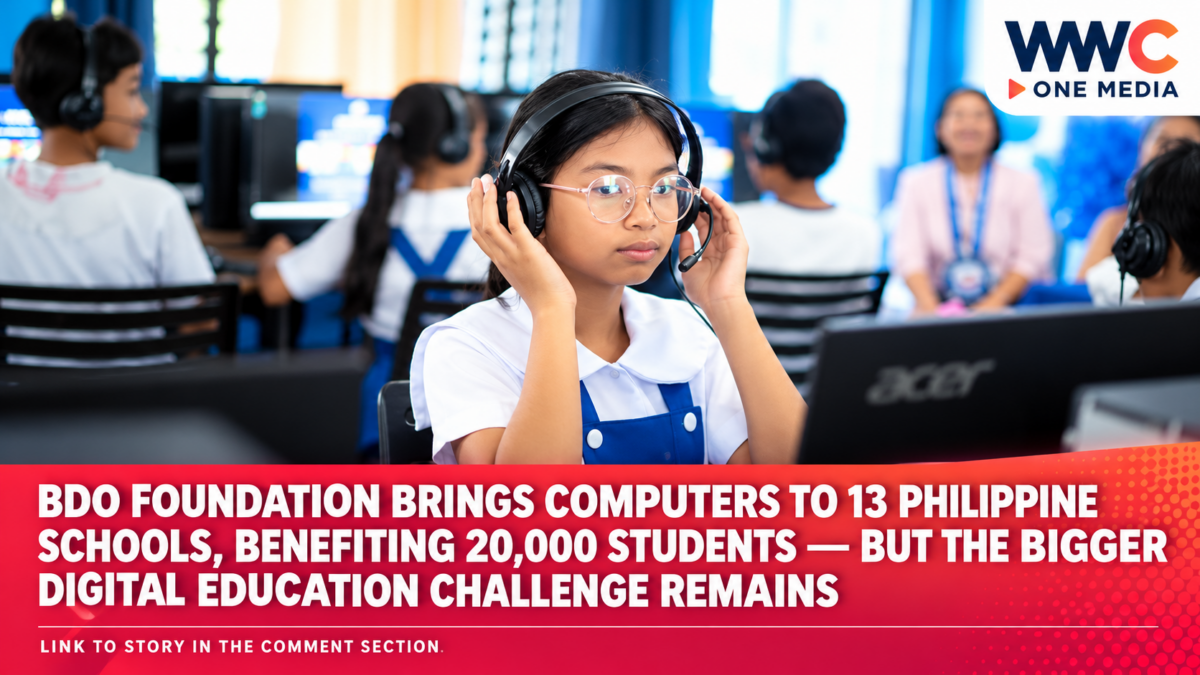
MANILA, Philippines — October 12, 2026 — More than 20,000 Filipino learners and 700 educators are gaining greater access to digital education as BDO Foundation expands its school technology support program, donating over 180 desktop computers and laptops to 13 schools and learning institutions across the Philippines.
The initiative aims to help schools integrate technology into classroom instruction, academic research and other learning activities, particularly in communities where access to reliable computer equipment remains limited.
According to InsiderPH, the program covers schools and educational institutions in Leyte, Bulacan, Catanduanes, Quezon City, Pasay City, Taguig City and Valenzuela City.
Rather than purchasing entirely new equipment, the foundation is giving refurbished computers another useful purpose in education.
The initiative provides a practical example of how businesses can redirect usable technology toward communities that need additional resources.
But the bigger question is whether donations of computers can deliver lasting educational improvements without equally strong investments in connectivity, teacher training, technical support and long-term maintenance.
BDO Foundation Expands Access to Digital Learning
BDO Foundation, the corporate social responsibility arm of BDO Unibank, has distributed more than 180 desktop computers and laptops to educational institutions across the country.
The donated devices are intended to support everyday academic work.
Students may use them to develop computer literacy, conduct research, access digital educational materials and complete classroom activities.
Teachers can also use the equipment to prepare learning resources, organize lessons and introduce technology-based instruction.
The initiative is expected to reach more than 20,000 learners and over 700 educators.
However, those numbers represent the reported population benefiting from improved institutional access.
They do not mean that every student has received an individual computer.
The impact will depend on how schools allocate the devices, organize computer access and integrate the equipment into regular teaching activities.
Which Philippine Schools and Communities Will Benefit?
The program covers 13 public and private schools and learning institutions across seven geographic areas.
Recipient communities are located in Leyte, Bulacan and Catanduanes, as well as the Metro Manila cities of Quezon City, Pasay, Taguig and Valenzuela.
The geographic spread highlights the importance of extending digital learning opportunities beyond major commercial districts.
Students in different communities can experience significant differences in access to computers, reliable internet services and other educational resources.
By placing additional devices inside learning institutions, the initiative may help more students access equipment they do not necessarily have at home.
However, the October 12 reports did not publish a complete list of all 13 beneficiary institutions or a school-by-school allocation of devices.
It would therefore be inaccurate to identify specific recipient schools or claim a particular number of computers was delivered to an individual campus without additional documentation.
Why 180 Computers Could Make a Difference
The usefulness of computer donations depends on how the equipment is shared and managed.
A school may use a group of devices to support computer classes or scheduled research periods.
Another institution may assign equipment to teachers for lesson preparation and learning activities.
Even a limited number of functioning devices can increase access when schools have few available computers.
For students, practical experience with digital tools can support research, document preparation, presentations and basic technology skills.
These capabilities matter as educational institutions increasingly use online materials and digital platforms.
But the total number of devices is also relatively modest compared with the more than 20,000 reported student beneficiaries.
Dividing 20,000 learners by 180 devices produces an illustrative ratio of approximately 111 learners per computer.
That is not a verified classroom ratio, because the donations are distributed across different institutions and their existing equipment inventories are unknown.
The figure nevertheless shows why shared access, scheduling and maintenance are likely to matter.
Refurbished Computers Support Education and Resource Efficiency
A distinctive feature of the initiative is the use of refurbished equipment.
Instead of discarding computers that can still function after appropriate servicing, the foundation is extending their useful life through educational use.
This can provide value in two ways.
First, schools receive additional learning tools without having to purchase the full quantity of equipment themselves.
Second, reusing serviceable technology can reduce premature disposal and delay the generation of electronic waste.
However, refurbished equipment must remain suitable for its intended use.
Schools need machines capable of running required applications securely and reliably.
They also need access to spare parts, software support and responsible end-of-life disposal when devices eventually become unusable.
The long-term environmental benefit depends on how equipment is refurbished, maintained and ultimately recycled.
Digital Education Requires More Than Computers
The donation comes as Philippine schools continue adopting digital approaches to teaching and learning.
Computer equipment can support that transition, but it is only one part of the necessary infrastructure.
Schools may also need dependable electricity, internet connectivity, secure networks and educational software.
Teachers require the skills and time to incorporate technology into lessons effectively.
Without those supporting resources, donated computers can remain underused.
A school with unreliable connectivity may struggle to access online learning materials.
Outdated software can limit the usefulness of otherwise functional hardware.
And technical problems can interrupt classroom activities when local maintenance support is unavailable.
For this reason, schools receiving donated equipment can benefit from clear arrangements for training, security updates, technical troubleshooting and replacement planning.
BDO Foundation’s October 12 announcement primarily documents the equipment donation. It does not establish that every beneficiary school received new internet connections or a separate teacher-training package under this specific initiative.
DOST Is Also Expanding Digital Learning Support
BDO Foundation’s donation forms part of a wider national effort to improve the use of technology in education.
On October 7, the Department of Science and Technology reported that its Eastern Visayas regional office had provided 30 Chromebooks and a television to Guinsorongan Elementary School in Samar.
The equipment was distributed through the e-TURO initiative, an educational system combining digital learning materials, a learning management platform and artificial intelligence-assisted tools for teachers.
The project is designed to help educators prepare instructional content, organize assessments and monitor student progress.
It illustrates how the country’s digital education efforts are moving beyond simply providing devices.
Schools also need useful software and support systems that help teachers deliver lessons.
The DOST project is separate from BDO Foundation’s donation and should not be counted among the foundation’s 180-plus devices.
Together, the two initiatives demonstrate different approaches to addressing the same broader challenge: improving access to meaningful technology-supported education.
BDO Foundation Has an Established Education Program
The computer donation adds to BDO Foundation’s existing social development activities.
The foundation was established in 2008 and operates as the corporate social responsibility arm of BDO Unibank.
Its programs cover financial inclusion, education, disaster response, rehabilitation and community development.
According to BDO’s official information, its work has included school-building projects, financial education and support for communities affected by disasters.
The foundation has also worked with government agencies and institutional partners to develop educational resources.
Its initiatives are not limited to classroom technology.
They also include efforts to improve school environments and help learners from underserved communities.
The latest computer donation extends that work into the area of digital access.
More Than 600 BDO Volunteers Joined Brigada Eskwela 2026
The foundation’s school-related activities continued earlier this year through Brigada Eskwela.
In a July 17 announcement, BDO reported that more than 600 employee volunteers participated in school preparation activities.
Volunteers helped clean classrooms, repaint facilities, repair school furniture and prepare learning environments ahead of the opening of classes.
The work illustrates another way companies can support education beyond financial contributions.
Physical classrooms, functioning school facilities and technology resources all contribute to the conditions under which students learn.
However, Brigada Eskwela and the October computer donation are distinct initiatives.
The number of employee volunteers should not be presented as the number of people who installed or distributed the donated computers.
Financial Education Remains Another Priority
BDO Foundation also works with government institutions to promote financial literacy.
The foundation has collaborated with organizations including the Bangko Sentral ng Pilipinas and the Department of Education on financial education initiatives.
These programs aim to help students, teachers and other community members understand savings, budgeting and responsible financial decisions.
The foundation’s official materials also describe partnerships supporting institutional capacity and education governance.
Digital literacy and financial literacy are different skills, but both are increasingly relevant to young Filipinos.
Students need to understand how to use technology responsibly while developing the ability to evaluate information and make informed financial decisions.
Providing access to computers can create opportunities to practice these skills, provided that schools have suitable learning materials and trained educators.
Why Corporate Technology Donations Matter
Private-sector donations can help address immediate equipment shortages at individual schools.
Companies often have computer hardware that remains functional after it is replaced as part of routine technology upgrades.
When properly refurbished, such equipment can support classrooms and community learning centers.
This approach can reduce the cost of expanding basic digital access.
It may also allow companies to contribute practical resources without requiring schools to purchase all equipment from new.
However, corporate donations cannot replace sustained public investment in education.
The government remains responsible for establishing educational standards, allocating public resources and addressing system-wide infrastructure needs.
Private organizations can complement those responsibilities by directing additional equipment and expertise toward identified gaps.
The strongest initiatives typically involve coordination with schools so donations match actual needs.
The Challenge of Keeping Donated Technology Useful
One important question is what happens after computers have been delivered.
Equipment must be installed, maintained and eventually replaced.
Schools may need to designate personnel to manage access and address technical problems.
Older computers may require operating-system updates, additional storage or replacement components.
Device security is also important when students and teachers use computers for research or online activities.
Schools should ensure that personal information is protected and that equipment is used in accordance with applicable privacy and cybersecurity practices.
Long-term outcomes could be measured through actual student access, teacher usage, frequency of digital lessons and the percentage of devices remaining functional.
The reported donation figures establish the scale of the contribution but do not yet demonstrate measurable improvements in academic achievement.
Those outcomes would require further evaluation.
Could the Initiative Help Narrow the Digital Divide?
Access to technology can influence students’ educational opportunities.
Learners with computers and reliable connectivity may find it easier to conduct research, develop digital skills and complete technology-based assignments.
Students without those resources can face additional difficulties.
School-based equipment offers one way to reduce that gap, especially when shared devices are available during regular class hours.
However, the digital divide has multiple dimensions.
Students may need affordable connectivity outside school.
Teachers need appropriate training.
Learning resources should be accessible and aligned with the curriculum.
And schools require the financial capacity to sustain technology programs over time.
BDO Foundation’s donation addresses the availability of equipment in participating institutions.
Its broader educational impact will depend on how effectively that equipment is used and maintained.
The Bigger Question: Can Technology Donations Create Lasting Educational Impact?
BDO Foundation’s initiative represents a tangible contribution to digital learning.
More than 180 refurbished computers and laptops have been directed to 13 institutions serving over 20,000 learners and 700 educators.
The program may improve access to research tools, classroom applications and opportunities to build digital skills.
It also demonstrates how reusable corporate equipment can support educational needs rather than becoming prematurely discarded electronic waste.
But sustained impact will require more than the initial handover.
Schools need functional devices, relevant learning software, trained teachers and adequate technical support.
Education authorities and private-sector partners also need ways to assess whether donations are producing meaningful improvements.
The important measure of success is not simply how many computers are delivered, but how many students are able to use them productively over time.
For BDO Foundation, the initiative extends its existing commitment to education and community development.
For the beneficiary institutions, the next challenge is integrating the equipment into everyday learning.
And for the Philippines, it highlights a wider national priority: ensuring that digital education opportunities extend to students regardless of their location or family income.
BDO Foundation’s computer donation could expand technology access for more than 20,000 Filipino learners — but the bigger test is whether those devices can help close the digital learning gap long after the handover ceremonies are over.