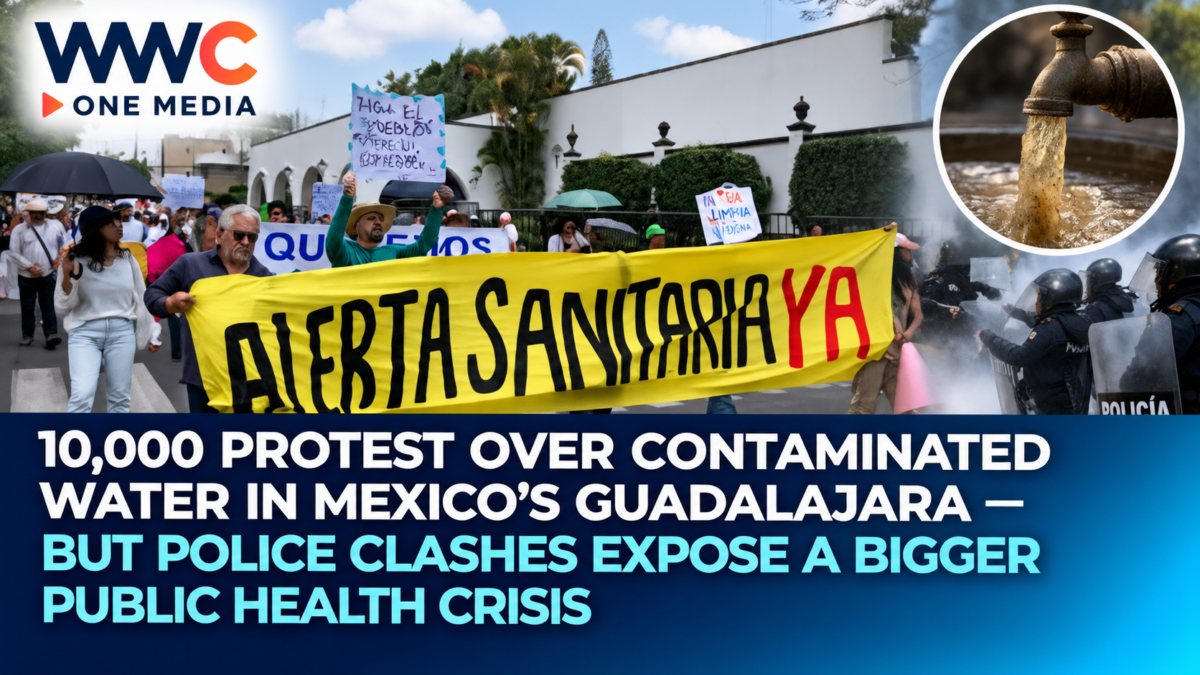
GUADALAJARA, Mexico — October 12, 2026 — Thousands of residents flooded the streets of Guadalajara, one of Mexico’s largest cities, demanding clean drinking water after months of complaints about yellow, muddy and foul-smelling tap water flowing into their homes.
The demonstration on Sunday, October 11, escalated into clashes between protesters and riot police outside Casa Jalisco, the official residence of Governor Pablo Lemus.
Police used tear gas and water jets as confrontations broke out near barricades surrounding the residence.
Several people were arrested and others injured, according to Mexican and international news reports.
The Spanish news agency EFE estimated that approximately 10,000 people joined the protest.
But the controversy extends far beyond the confrontation with police.
Residents and civil society groups say the water-quality emergency has affected hundreds of neighborhoods, raising fears over household health, public infrastructure and the government’s ability to provide one of the most basic public services.
The bigger question is whether Guadalajara can restore confidence in its drinking water before a prolonged infrastructure problem becomes an even deeper public health and political crisis.
Thousands March to Demand Clean Water
The demonstration began at La Minerva, a prominent Guadalajara landmark, before protesters moved toward Casa Jalisco.
Families, community organizations and residents from affected neighborhoods joined the march.
Their central demand was straightforward: safe, reliable water from household taps.
Residents carried signs describing water as a basic human right, not a privilege.
Many said they were exhausted by months of receiving water with unusual coloring, strong odors and visible particles.
Some residents have reported brown or black water, while others described water that appeared yellow or contained sediment.
The complaints have forced households to question whether the water can safely be used for drinking, cooking, bathing or cleaning.
For many families, the situation has created additional expenses because they must purchase bottled water or find alternative supplies.
The march demonstrated growing frustration with the pace of official action.
Confrontation Erupts Outside Governor’s Residence
The protest became tense when demonstrators reached Casa Jalisco.
Security personnel had erected metal barriers around the residence.
According to EFE, some demonstrators removed barricades and attempted to advance toward the property.
The agency reported that police responded with physical force, tear gas and water jets during confrontations lasting approximately two hours.
Other Mexican news organizations, including El País, La Jornada and Expansión Política, documented clashes involving protesters and riot police.
Reports also described demonstrators throwing objects, including stones, during the confrontation.
The events have raised questions about both the actions of participants and the proportionality of the police response.
The government has a responsibility to maintain public safety, but authorities must also respect the right to peaceful assembly.
Determining exactly what happened will require a credible review of footage, witness accounts and official records.
Arrests and Injuries Spark Further Controversy
The confrontation resulted in multiple arrests and injuries.
EFE initially reported at least nine people detained, with protest organizers also raising concerns about four people whose whereabouts were not established at the time.
Other reporting, including El País, cited a higher figure of 39 detentions and at least 59 injured people.
These figures may reflect different reporting times and definitions.
They should not be treated as a single reconciled official count.
Journalists were also reported among those affected during the unrest.
The allegations regarding unaccounted-for individuals are serious and require prompt clarification from authorities.
However, reports that people could not initially be located are not sufficient to establish that they were subjected to enforced disappearance.
The immediate priority is confirming the identities, whereabouts and legal status of those detained, as well as documenting any injuries.
More Than 320 Neighborhoods Report Water Problems
The protest followed longstanding complaints about Guadalajara’s water distribution system.
EFE reported that at least 320 neighborhoods in the metropolitan area had experienced contaminated or foul-smelling water since March, citing the Centro de Justicia para la Paz y el Desarrollo, known as CEPAD.
The organization said testing raised concerns about contamination, including possible heavy metals, fecal material and inadequate chlorination in samples.
These findings have intensified calls for independent testing and official publication of water-quality results.
However, the reported findings concern samples examined by the organization.
They do not establish that every household in all affected neighborhoods has identical contamination levels.
Water quality can vary according to the supply source, distribution network, location and testing date.
A reliable public assessment requires repeated sampling, clear laboratory methods and transparent reporting.
Nevertheless, complaints across so many communities indicate a serious problem that cannot be dismissed as an isolated incident.
Residents Report Skin Irritation and Illness
The crisis has also raised health concerns.
Residents interviewed by Mexican media described skin irritation, rashes and gastrointestinal problems that they believe may be connected to the water.
An October 8 El País investigation documented complaints from households that said they were experiencing illness while receiving discolored and foul-smelling tap water.
These accounts warrant medical and environmental investigation.
However, individual symptoms cannot by themselves establish that water exposure caused a particular illness.
A confirmed connection would require appropriate medical evidence and water testing.
The immediate public health concern is that residents may be exposed to unsafe water without having reliable information about where and when it is safe to use.
Discoloration and unpleasant odors are warning signs that merit investigation, but the actual health risk depends on the substances present and their concentrations.
Boiling water can reduce some microbial risks but does not reliably remove heavy metals or many chemical contaminants.
Residents need clear, location-specific guidance from health authorities rather than assumptions about the safety of household supplies.
Las Pintas Reservoir Becomes Central to the Crisis
The water supply problems have placed particular scrutiny on the Las Pintas system.
Bloomberg reported that officials stopped water flow from the nearby Las Pintas reservoir after contamination by wastewater following heavy rains.
The decision was intended to prevent potentially unsafe water from entering parts of the metropolitan distribution network.
Governor Pablo Lemus has acknowledged the severity of the water-quality concerns and said the administration is working on corrective measures.
But stopping a contaminated source creates another problem: reduced availability of water.
Authorities have warned that supply restrictions could continue for months.
This creates a difficult situation for affected communities.
Residents need both cleaner water and sufficient quantities for everyday use.
A policy that improves water quality but substantially reduces supply must therefore be accompanied by reliable alternative distribution arrangements.
Governor Pablo Lemus Faces Rising Political Pressure
The protests have intensified scrutiny of Governor Pablo Lemus and the state administration.
On October 10, the governor acknowledged receiving thousands of complaints and recognized residents’ right to express their frustration.
However, the confrontation outside his residence the following day deepened tensions between authorities and affected communities.
Critics argue that residents have waited too long for practical solutions.
Officials maintain that the water network requires substantial infrastructure work and that emergency measures are being implemented.
The dispute now concerns not only technical problems but also public confidence.
Residents want clear answers about which water sources are contaminated, what testing has been conducted, and how long repairs will take.
They are also demanding transparency about the financial and administrative decisions affecting Guadalajara’s water system.
Aging Infrastructure Adds to the Challenge
Guadalajara’s water crisis has developed over several years.
El País reported that the situation has worsened in 2026 and that residents have complained about water quality for much longer.
Part of the problem involves aging infrastructure associated with the older supply system drawing water from Lake Chapala.
The system requires repairs and modernization.
The state government has discussed constructing a new aqueduct, a major project that could take approximately two years.
Such infrastructure may help improve reliability over the long term.
However, new construction does not automatically resolve contamination already affecting existing distribution networks.
Authorities must also identify the sources of pollutants, prevent wastewater intrusion and ensure that treatment and disinfection systems function properly.
These are operational as well as infrastructure challenges.
Jalisco Lawmakers Demand Immediate Action
The controversy has already attracted attention within the Jalisco state legislature.
On October 6, lawmakers publicly demanded urgent action to address the quality of water reaching households in the Guadalajara metropolitan area.
They called for residents to receive water that is safe for consumption.
Legislators also criticized earlier police intervention during neighborhood demonstrations.
The statements show that the crisis was already politically significant before the mass protest on October 11.
They also place additional pressure on the water utility, SIAPA, to explain what is happening within the distribution system.
The Sistema Intermunicipal de los Servicios de Agua Potable y Alcantarillado is responsible for major water and wastewater services in the metropolitan area.
Residents and lawmakers have called for greater accountability from the agency.
A credible response would require transparent testing, clear public reporting and measurable improvements in service.
Why the Problem Is Bigger Than One Protest
The October 11 confrontation drew international attention because thousands of people protested outside the governor’s residence.
But the underlying problem has much wider implications.
Unsafe or unreliable water affects public health, school attendance, household finances and business activity.
Restaurants, hotels, hospitals and other essential services depend on consistent water quality.
Families with limited incomes are particularly vulnerable because purchasing alternative supplies can consume a greater share of household budgets.
Water problems can also increase inequality between neighborhoods.
Residents with storage tanks, filtration systems or sufficient income to purchase bottled water may be better able to cope.
Lower-income households may have fewer alternatives.
The crisis therefore raises questions about infrastructure investment, environmental protection and access to basic services.
Guadalajara Faces a Difficult Choice Between Water Quality and Water Supply
The suspension of supply from Las Pintas reflects a difficult policy trade-off.
Continuing to use a source with credible contamination concerns could expose residents to unacceptable risks.
But restricting that source reduces the amount of water available to households.
Authorities may need to distribute supplies from alternative sources, increase temporary delivery capacity or introduce scheduled water service.
These measures can create additional logistical and financial pressure.
The challenge is ensuring that emergency arrangements are communicated clearly and reach the communities most affected.
Residents also need reliable information about when water can safely be used.
Without clear guidance, households may either expose themselves to unsafe supplies or spend money unnecessarily because they lack confidence in official announcements.
The Public Health Response Will Determine What Happens Next
Guadalajara’s next steps should focus on identifying the extent and sources of contamination.
Independent water sampling can help establish where unsafe conditions exist.
Publishing results with understandable explanations would allow residents to make informed decisions.
Health authorities also need to examine reported illnesses and determine whether they are associated with water exposure.
Meanwhile, authorities should provide alternative safe supplies where necessary and explain how emergency distribution will operate.
Repairs to the water network, improvements in treatment and action against wastewater contamination will be important to any lasting solution.
Political promises alone will not rebuild confidence.
Residents need evidence that conditions are improving.
The Bigger Question: Can Guadalajara Restore Safe Water and Public Trust?
The demonstrations have transformed Guadalajara’s water-quality emergency into a major public controversy.
Thousands of residents marched because they believe their concerns have not been addressed adequately.
The confrontations with police have created additional questions about civil liberties, public accountability and the treatment of those detained.
But the central issue remains access to clean water.
For residents, the immediate concern is whether their taps will deliver water that is safe for everyday use.
For the government, the challenge is providing transparent test results, delivering emergency supplies and repairing infrastructure.
For public health authorities, the priority is identifying potential hazards and giving communities reliable guidance.
And for lawmakers, the crisis raises questions about whether the institutions responsible for water services have sufficient resources, oversight and accountability.
Guadalajara’s water crisis cannot be resolved simply by ending the street protests. The underlying contamination concerns and service failures must be addressed.
A lasting solution will require reliable infrastructure, independent monitoring and public confidence in the information provided by authorities.
Thousands of people have taken to Guadalajara’s streets demanding safe drinking water — but the bigger test is whether Mexico’s second-largest metropolitan region can repair its failing water system before public health fears and political anger deepen further.