
South Korea’s stock market delivered another powerful rally Friday as foreign investors piled back into some of the country’s biggest technology names, propelled by extraordinary semiconductor exports and hopes that the U.S. Federal Reserve might hold interest rates steady.
But just hours after Seoul closed, Wall Street received fresh economic data that could make the next move much less predictable.
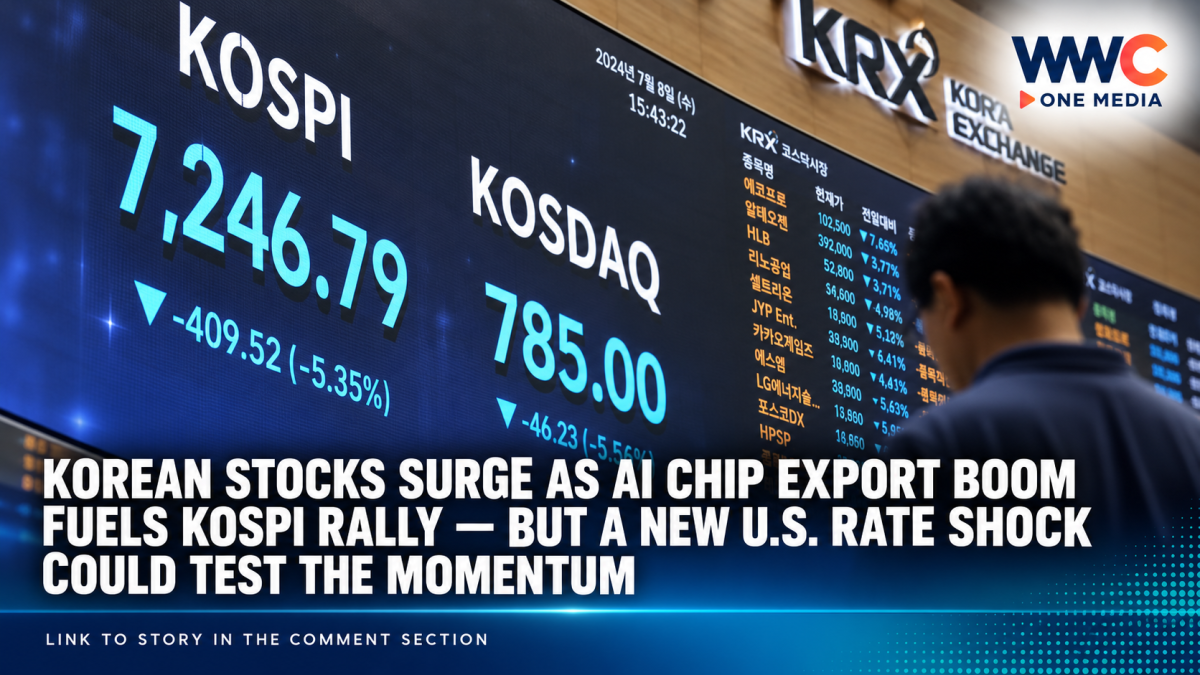
The benchmark Korea Composite Stock Price Index, or KOSPI, climbed 107.73 points, or 1.64%, to finish at 6,687.21 on September 4, extending its gains for a second consecutive session. The Korea Herald and Yonhap reported that foreign and institutional investors drove the advance, while individual investors were heavy sellers.
The rally was not simply another risk-on trading day.
Behind it sits one of the biggest export booms South Korea has seen in years—and artificial intelligence is increasingly at the center of it.
Korea’s AI Chip Boom Is Becoming Hard to Ignore
South Korea’s exports surged 68.7% from a year earlier to $98.25 billion in August, according to the Ministry of Trade, Industry and Resources.
The standout number was semiconductors.
Chip exports jumped an extraordinary 209% to roughly $46.65 billion, accounting for nearly half of the country’s total overseas shipments during the month. Semiconductor exports have now exceeded $40 billion for three consecutive months as global technology giants continue spending aggressively on AI infrastructure.
That demand directly benefits Korea’s two semiconductor heavyweights.
Samsung Electronics gained 2.2% to 255,500 won Friday, while SK hynix climbed 3.2% to 1,647,000 won.
The broader economic numbers are equally striking.
Bank of Korea data showed the country recorded a $42.08 billion current-account surplus in July, the second-largest monthly surplus on record and the 39th consecutive month in which the current account remained in positive territory.
That combination—huge chip exports, strong external balances and persistent AI investment—is giving investors a powerful reason to reconsider Korean equities.
Foreign Investors Came Back
Another important signal came from who was buying.
Korea Times reported that foreign and institutional investors returned as net buyers after five consecutive sessions of selling. Foreign investors purchased roughly 479 billion won worth of shares, while institutions bought around 1.67 trillion won.
Edaily similarly reported strong foreign and institutional buying, helping push the KOSPI above 6,600 while the KOSDAQ surged 2.95% to 813.50.
The Korean won also strengthened, trading at approximately 1,350.4 won per U.S. dollar late Friday in Seoul, an appreciation of 8.9 won from the previous session.
Together, those moves suggested investors were becoming more comfortable taking risk in Korean assets.
Then came the Federal Reserve.
One Fed Comment Helped Ignite the Rally
Federal Reserve Governor Christopher Waller gave markets a reason for optimism Thursday when he suggested that recent inflation data were finally showing signs of cooling.
Waller said that if those trends continued, he would be inclined to support leaving the federal funds rate unchanged at the Fed’s September meeting.
The Federal Reserve’s own transcript confirms that Waller said inflation remained above the central bank’s 2% goal but that recent data were showing signs of disinflation.
The comments helped push Treasury yields lower and lifted global equities. Reuters reported that investors reduced expectations of an imminent Fed rate increase following Waller’s remarks.
For South Korea, that matters enormously.
Higher U.S. rates can strengthen the dollar, pressure the won and encourage global investors to shift capital toward dollar-denominated assets. A Fed pause can produce the opposite effect—giving Asian markets more breathing room.
That helped set the stage for Friday’s Seoul rally.
But the story changed again after the Korean market had already closed.
Then America’s Jobs Report Changed the Equation
The U.S. economy added 162,000 jobs in August, significantly stronger than economists had expected, while unemployment remained at 4.1%, according to Reuters.
The stronger labor-market data quickly revived expectations that the Federal Reserve could still raise interest rates, with markets assigning roughly a 62% probability of an increase after the report.
That means one of the forces behind Friday’s Korean rally—receding fears of a U.S. rate hike—may already be facing its next test.
Investors will now have to weigh two competing signals.
Inflation may finally be cooling enough for the Fed to wait.
But the American labor market may still be strong enough to give policymakers room to tighten again.
For Korean stocks, that debate could become particularly important when markets reopen.
Oil Refiners Were Another Big Winner
Technology was not the only sector benefiting Friday.
South Korean refiners surged as renewed U.S.-Iran tensions pushed global oil prices higher.
SK Innovation gained 5.73% to 138,300 won, while S-Oil jumped 6.36% to 157,300 won.
Oil prices remained elevated amid continued disruptions and geopolitical tension surrounding the Strait of Hormuz. Reuters reported that Brent finished the week at $92.68 per barrel, gaining 7.6% over the week, as traders continued pricing in supply risks from the U.S.-Iran conflict.
For Korean refiners, higher refining margins and elevated product prices can boost earnings expectations.
For the broader Korean economy, however, persistently expensive oil is a double-edged sword.
South Korea imports most of its energy, meaning sustained price increases can raise import costs, worsen inflation pressures and eventually squeeze consumers and manufacturers.
The Bigger Story: Korea Is Becoming an AI Trade Proxy
The most important takeaway may not be Friday’s 1.64% KOSPI gain.
It is how closely South Korea’s economy and stock market are becoming tied to the global AI investment cycle.
Samsung Electronics and SK hynix sit near the center of the memory-chip supply chain that powers AI servers and data centers.
When global hyperscalers spend more on artificial-intelligence infrastructure, Korean semiconductor exports rise.
Those exports strengthen Korea’s trade balance.
That improves corporate earnings and potentially supports the won.
And that, in turn, can attract more overseas investment into Korean stocks.
It is an unusually powerful feedback loop.
But it also creates a new vulnerability.
If AI capital spending cools, memory-chip prices weaken, geopolitical tensions intensify or the Federal Reserve surprises markets with higher rates, the same forces that drove Korean equities sharply higher could quickly reverse.
For now, investors are betting that Korea’s export machine still has room to run.
The question is whether the next U.S. inflation and interest-rate signals will allow the rally to keep going.
WWC ONE MEDIA M.J.E


Leave a Reply