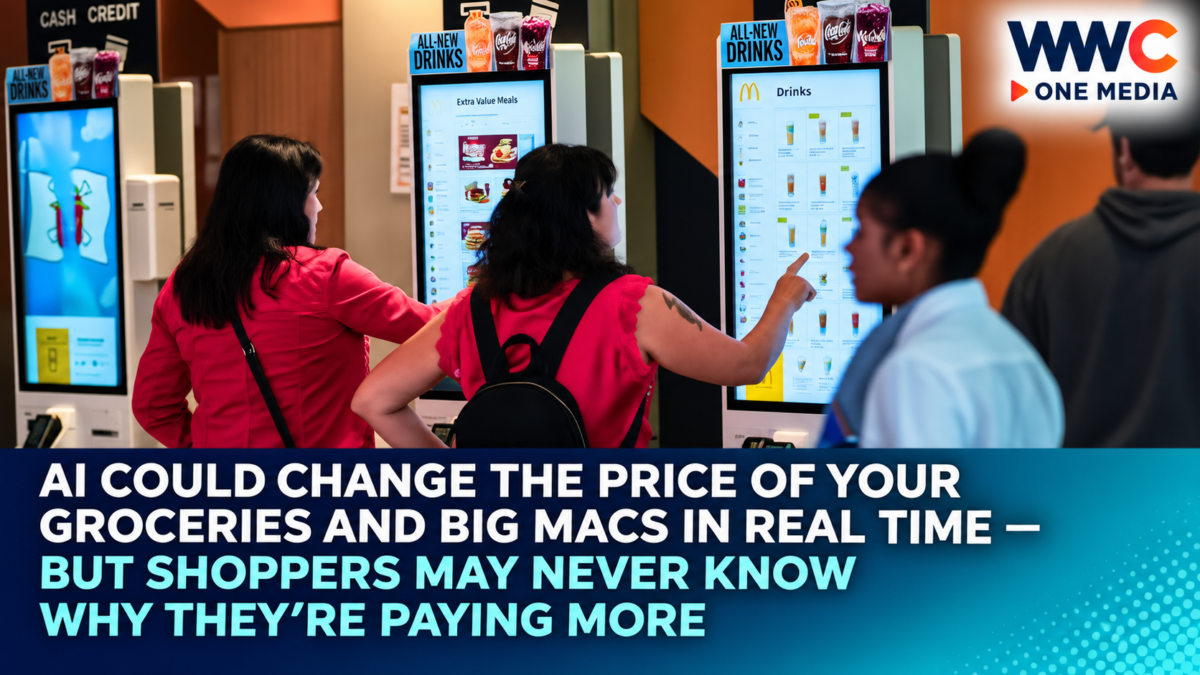
NEW YORK, United States — The next time consumers buy groceries or order a Big Mac, artificial intelligence could play a bigger role in determining the prices they see — and potentially how much they pay compared with other shoppers.
Major supermarkets, fast-food chains and technology-driven retailers are increasingly adopting AI-powered systems to analyze sales, manage inventory, recommend prices and deliver personalized promotions.
But behind the promise of greater efficiency lies a growing consumer concern: companies could use detailed personal information to estimate how much individual customers are willing to spend, potentially charging different prices for identical goods and services.
According to CNBC’s October 11, 2026 report, the spread of AI in retail is intensifying scrutiny of dynamic pricing and personalized pricing, two strategies that could reshape how Americans purchase everything from hamburgers to household essentials.
The controversy comes as McDonald’s faces a federal antitrust lawsuit over its AI-assisted pricing tools, while supermarkets such as Walmart and Kroger expand the use of digital shelf labels and other retail technologies.
However, the adoption of digital price labels or AI software does not automatically mean a retailer is charging different shoppers different prices.
That distinction is becoming central to the debate.
The biggest question is no longer simply whether AI can help businesses set prices more efficiently. It is whether consumers will know when their shopping habits, location or personal information influence the amount they are charged.
McDonald’s Faces Lawsuit Over AI-Powered Pricing System
One of the most significant recent developments involves McDonald’s, which is facing legal scrutiny over software used to support pricing decisions at its US restaurants.
On October 8, Reuters reported that a federal antitrust lawsuit accused the fast-food giant of using an AI-powered pricing system in a manner that allegedly coordinated prices among independently operated franchises.
The lawsuit claims McDonald’s pricing technology influences the prices customers pay for products such as Big Macs and fries.
It also alleges that franchise operators are pressured to follow the system’s recommendations, potentially weakening competition between restaurants.
The allegations have not been established as facts by a court.
McDonald’s disputes the claims.
The company maintains that restaurant franchisees independently determine their own menu prices and that its technology provides information and recommendations rather than automatically fixing prices.
Approximately 95% of McDonald’s 14,000 US restaurants are independently operated, making the legal distinction between corporate guidance and franchisee pricing decisions particularly important.
The lawsuit seeks class-action status and damages, but its outcome remains uncertain.
Legal experts say the dispute could help clarify how existing antitrust laws apply when companies use algorithms to recommend prices across large business networks.
Why AI Pricing Is Becoming a Major Consumer Issue
Dynamic pricing is not a completely new business strategy.
Airlines, hotels and ride-hailing services have used technology-driven pricing systems for years, adjusting charges according to demand, availability, timing and other market conditions.
A hotel room may become more expensive during a major convention, while a ride-hailing trip can cost more when demand exceeds the availability of drivers.
Artificial intelligence could make similar calculations faster and more sophisticated across additional industries.
In supermarkets, for example, software could help retailers adjust prices when products approach expiration, inventory levels change or competitors launch promotions.
But experts warn that the growing use of customer information introduces additional concerns.
Retailers can increasingly analyze purchasing histories, browsing behavior, loyalty-program activity, location data and other information.
If those data are combined with pricing algorithms, businesses could potentially estimate how much an individual consumer is willing to pay.
This creates a distinction between two practices.
Dynamic pricing changes prices based primarily on conditions such as demand, supply, inventory or timing.
Personalized pricing uses information about an individual customer or customer group to determine the price or offer presented to them.
A business can use dynamic pricing without engaging in personalized pricing.
But AI systems capable of combining extensive information about markets and consumers could make the boundary increasingly difficult to identify.
Walmart and Kroger Expand Digital Shelf Labels
The technology debate extends beyond restaurants.
Major US supermarkets are expanding electronic shelf labels, which replace traditional paper price tags with digital displays.
These systems allow store employees to update displayed prices electronically instead of manually replacing printed labels.
Walmart, Kroger, Amazon Fresh and Whole Foods are among the retailers associated with the growing adoption of electronic shelf-label technology.
Walmart has announced plans to expand digital shelf labels throughout its US store network, emphasizing greater operational efficiency and improved accuracy.
Electronic shelf labels can help retailers update prices consistently, reduce manual tasks and improve inventory-related operations.
However, consumer advocates worry that the technology could also make frequent price changes easier to implement.
Some critics have raised hypothetical scenarios in which supermarkets could increase prices during periods of high demand.
For instance, a retailer could technically use separate pricing software to change the price of ice cream during a heatwave.
But the presence of an electronic shelf label does not establish that such pricing is actually occurring.
Walmart and Kroger have publicly rejected accusations that their electronic labels are being used to impose individualized surge prices on shoppers.
The National Retail Federation also argues that digital shelf labels are display devices, not systems that independently collect personal information or determine prices.
This distinction is essential when assessing whether technology presents a potential risk or evidence of actual consumer harm.
Kroger Uses AI to Discount Food Near Expiration
Not every use of AI in grocery pricing is designed to increase prices.
Some retailers are applying technology to reduce food waste and offer customers discounts.
Kroger has used an AI-enabled platform associated with Flashfood to help identify and discount perishable products approaching the end of their shelf life.
Such systems can assist retailers in managing inventory while offering shoppers opportunities to purchase groceries at reduced prices.
For consumers, these applications demonstrate how algorithmic pricing can sometimes improve affordability.
Discounting food before it becomes unsellable may also help reduce waste and recover revenue that retailers would otherwise lose.
The commercial benefits depend on how accurately the systems identify products and whether customers take advantage of the offers.
This illustrates a critical point in the debate: AI-based price optimization is not inherently harmful.
Its impact depends on how the technology is designed, what information it uses and whether consumers are treated fairly.
Consumer Data Could Determine Who Pays More
The biggest concern is the possibility of surveillance pricing.
This practice involves using detailed information about consumers to tailor prices or offers according to their characteristics and behavior.
The US Federal Trade Commission has investigated how companies use personal data to influence pricing decisions.
In January 2025, the FTC released initial findings from a study of companies involved in pricing technology.
The agency identified the use of information such as browsing history, geographic location, shopping behavior and other consumer data in systems capable of tailoring prices.
The findings demonstrated that companies and pricing intermediaries possess tools that can use detailed customer information to influence pricing.
However, the existence of these capabilities does not establish that every supermarket or restaurant uses them to charge different customers different prices.
The concern is that consumers may have difficulty discovering how the systems work.
A shopper receiving a particular price might not know whether it reflects a storewide promotion, changes in demand or assumptions based on personal data.
Without transparency, consumers could struggle to determine whether they are receiving a fair offer.
Bank of England Economists Warn About Personalized Inflation
The economic implications could extend beyond individual shopping decisions.
In April 2026, Bank of England economists Clare Lombardelli and Rupal Patel discussed how increasingly sophisticated pricing technology could affect the way consumers experience inflation.
As businesses adopt tools capable of changing prices more frequently and tailoring them to individuals, different households may increasingly encounter different prices for similar products.
This presents a challenge for traditional inflation measurement.
Consumer price indexes rely on samples intended to represent changes in prices across an economy.
But if prices become highly individualized and change frequently, statisticians may find it more difficult to identify a representative price.
The concern is not that official inflation figures have suddenly become invalid.
Rather, more widespread personalized pricing could complicate the relationship between published inflation statistics and the prices experienced by individual households.
For policymakers, that could make it more difficult to assess affordability and price pressures across different consumer groups.
US States Begin Restricting Surveillance Pricing
Growing concern over AI-driven pricing has prompted legislative and regulatory responses.
Several US states have introduced or enacted measures intended to address the use of personal data in pricing decisions.
New York has established disclosure requirements for businesses that use customers’ personal information to set prices.
Maryland has adopted restrictions involving certain forms of personalized pricing in food retail and delivery.
New Jersey and Connecticut have also taken steps targeting surveillance pricing practices.
The specific requirements vary by jurisdiction, and the measures should not be interpreted as a nationwide ban on dynamic pricing.
At the federal level, the FTC has continued examining whether undisclosed personalized pricing practices could violate consumer protection rules.
In August 2026, the agency issued a proposed enforcement policy statement concerning the use of personal data to determine prices.
The proposal emphasized the importance of disclosure when businesses use individualized information in pricing systems.
As of October 12, the policy discussion remained ongoing.
Industry organizations have called on regulators to distinguish between practices that impose individualized prices and ordinary promotional programs that offer discounts to customers.
Grocery Industry Warns Against Overly Broad Regulation
Retail trade associations argue that government rules must carefully distinguish between harmful pricing practices and legitimate technology used to improve customer service.
In October 2026, FMI — The Food Industry Association and the National Grocers Association urged the FTC to avoid overly broad enforcement language.
They warned that ordinary loyalty rewards, digital coupons and individualized promotional discounts could be affected if regulators fail to distinguish them from practices intended to exploit consumers.
Retailers argue that pricing technology can improve efficiency, reduce operational costs and provide more relevant promotions.
Consumer advocates counter that companies should not be allowed to use sensitive personal data to charge customers more without meaningful disclosure.
The disagreement highlights the complexity of regulating AI in retail.
A personalized coupon that reduces a shopper’s grocery bill may be beneficial.
A hidden pricing system that charges someone more because data suggest they have few alternatives raises a different set of fairness concerns.
Regulators must determine where the legal boundaries should be drawn.
Consumer Groups Warn Digital Pricing Could Raise Costs
Labor unions and consumer advocacy organizations have also raised concerns about the widespread adoption of electronic shelf labels.
A September 2026 report highlighted by The Guardian examined the potential employment and consumer consequences of digital shelf-label technology.
The analysis, associated with the AFL-CIO Tech Institute, estimated that widespread implementation could put tens of thousands of retail jobs at risk as businesses automate manual pricing-related tasks.
The report also warned that digital technology could make some forms of rapid or personalized pricing easier to implement.
Those figures are scenario estimates, not confirmed job losses attributable to electronic shelf labels.
Retail industry representatives dispute claims that electronic labels necessarily create surveillance pricing or higher consumer prices.
The debate reflects competing priorities involving efficiency, employment, consumer protection and technology adoption.
Why AI Pricing Matters to Filipino Consumers
Although the immediate legal controversy centers on the United States, the underlying technology has implications for retailers and consumers in the Philippines and across Southeast Asia.
Filipino households increasingly use online shopping platforms, delivery applications, digital wallets and customer loyalty programs.
These services may collect information about purchasing patterns, location, preferred products and consumer behavior.
As AI becomes more widely adopted, businesses could use those data to improve promotions, manage inventory and personalize shopping experiences.
However, the possibility of individualized pricing raises questions about consumer transparency and personal data protection.
In the Philippines, companies handling personal data must comply with applicable privacy requirements, including the Data Privacy Act.
The law does not automatically prohibit every form of dynamic or personalized pricing, and the US regulatory developments do not directly establish Philippine legal obligations.
Nevertheless, retailers using consumer information to influence prices should consider whether customers understand how their data are collected and processed.
For consumers, checking prices across different platforms, reviewing loyalty-program terms and monitoring final checkout totals can help identify unexpected differences.
The issue is particularly relevant when households are already managing tight budgets and higher expenses for food, transportation and everyday necessities.
Could AI Make Grocery Shopping Cheaper Instead?
Supporters of AI-driven retail technology argue that automated pricing could create important consumer benefits.
Stores could identify products that need to be discounted, reduce food waste and respond more efficiently to inventory changes.
Shoppers could receive promotions based on their preferences or benefit from lower prices during periods of weaker demand.
But these advantages depend on how the systems are used.
There is no guarantee that cost savings generated through AI will be passed on to consumers.
Retailers may instead use the technology to improve profit margins.
At the same time, excessive personalization could make price comparisons more difficult if different customers receive different offers.
The central issue is therefore not whether computers should assist businesses with pricing.
It is whether consumers can understand the prices they are offered and retain meaningful opportunities to compare alternatives.
The Bigger Question: Will AI Decide How Much Every Shopper Can Afford?
Artificial intelligence is transforming retail operations, offering businesses tools to analyze enormous volumes of information and make faster decisions.
For supermarkets and restaurants, the potential benefits include better inventory management, more efficient promotions and improved demand forecasting.
But the same technology could also enable more sophisticated pricing strategies based on individual consumer behavior.
The emerging conflict is particularly sensitive because food and everyday essentials represent unavoidable expenses for most households.
Customers may accept changing prices for airline tickets or hotel rooms, but personalized pricing for groceries could trigger stronger concerns about affordability and fairness.
The McDonald’s antitrust lawsuit illustrates the growing legal uncertainty surrounding algorithmic pricing, while the expansion of electronic shelf labels demonstrates how rapidly retail technology is evolving.
Yet neither development proves that widespread individualized grocery surge pricing is already happening.
The most important challenge for regulators and retailers is preventing technology designed to improve efficiency from becoming a system that quietly exploits differences in consumers’ willingness or ability to pay.
If AI enables fairer discounts and better stock management, shoppers could benefit.
But if businesses use extensive personal information to maximize the price charged to individual consumers without adequate transparency, public trust could deteriorate.
The future of grocery shopping may involve more artificial intelligence than ever before — but the real question is whether that technology will help customers save money or allow retailers to discover exactly how much more they can charge.