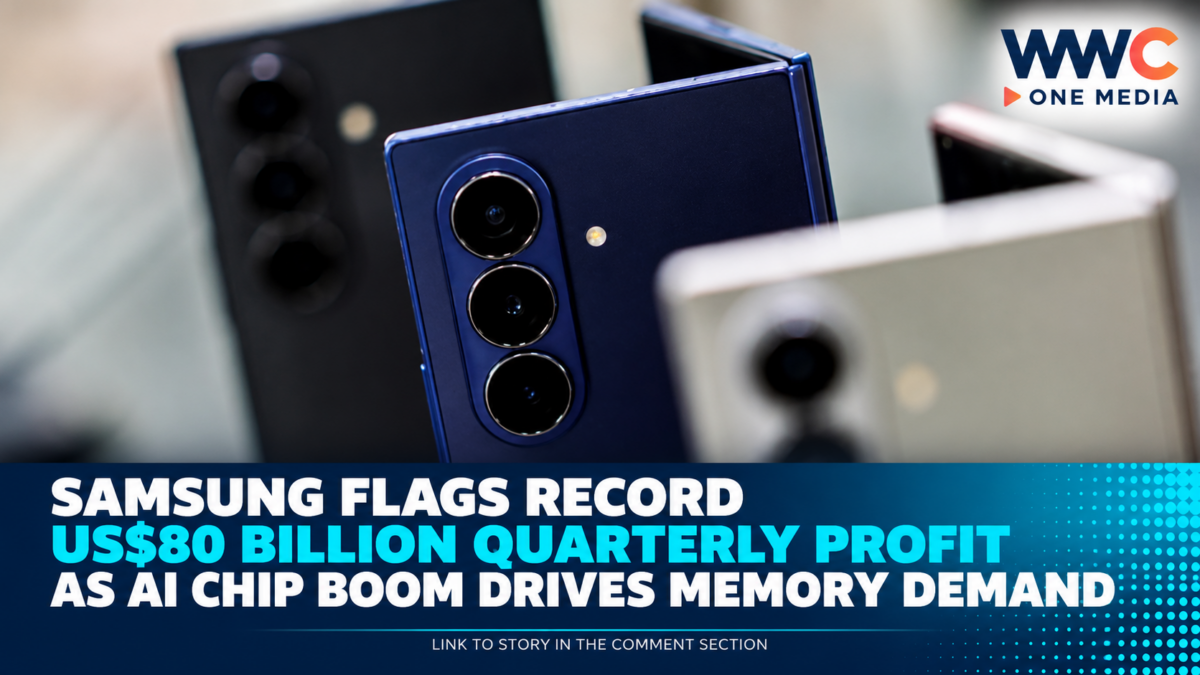
Samsung Electronics is on track to post the highest quarterly operating profit ever reported by a technology company, as booming demand for artificial intelligence chips drives a surge in memory prices and sales.
The South Korean electronics giant estimated on Oct. 8 that its third-quarter operating profit reached 107.4 trillion won (about US$80.1 billion or S$102 billion) for the July-to-September period. That represents a 782.5 per cent increase from 12.17 trillion won a year earlier.
The preliminary figure also marks the first time a technology company has crossed the 100 trillion won threshold in quarterly operating profit, according to Reuters. Samsung’s estimate was slightly above the 106.1 trillion won average forecast from analysts surveyed by LSEG.
Samsung’s revenue was estimated at 195 trillion won, up 126.6 per cent from a year earlier and about 14 per cent higher than the previous quarter. The company is expected to release its full third-quarter results, including a breakdown by business division, on Oct. 29.
AI Boom Fuels Memory Chip Windfall
The extraordinary results are being driven primarily by Samsung’s semiconductor business.
Demand for memory chips has surged as technology companies pour billions of dollars into data centres and AI infrastructure. High-bandwidth memory, or HBM, has become particularly important because it allows AI systems to process huge volumes of data at high speed.
At the same time, supplies of conventional DRAM and NAND memory have remained tight, pushing chip prices sharply higher.
Analysts expect AI-related demand to continue absorbing a growing share of global memory capacity, potentially keeping supply below demand into 2027 and beyond. Samsung and Micron have indicated that the memory imbalance could persist through 2028.
Samsung’s HBM shipments are also believed to have increased significantly during the quarter. Analyst Douglas Kim estimated that the company’s HBM bit shipments rose by nearly 50 per cent from the previous quarter as Samsung worked to narrow the gap with rival SK Hynix in the rapidly expanding AI-memory market.
Memory Prices Have Soared
The shortage has transformed the economics of the memory-chip industry.
Market data cited by Seoul Economic Daily showed that the average price of an 8-gigabit DDR4 DRAM chip reached US$26 at the end of the third quarter, compared with US$6.30 a year earlier. NAND flash prices also rose dramatically over the same period.
That price surge has substantially increased the profitability of major memory producers, including Samsung, SK Hynix and Micron.
TrendForce expects conventional DRAM contract prices to rise another 10 to 15 per cent in the fourth quarter, although that would represent a much slower increase than the roughly 60 per cent jump recorded in the second quarter.
The moderation has become an important issue for investors, who are increasingly asking how long the extraordinary AI-driven memory boom can continue.
Samsung’s Other Businesses Face Pressure
The semiconductor windfall does not mean all of Samsung’s businesses are performing equally well.
Higher memory prices are actually increasing production costs for Samsung’s smartphone and consumer-electronics operations, putting pressure on their margins.
Analysts estimate that Samsung’s mobile business suffered a loss of more than US$1 billion during the third quarter, significantly worse than expected.
Samsung’s contract chipmaking, or foundry, business is also expected to remain loss-making, partly because of high fixed costs and relatively low factory utilisation.
The company has been investing heavily to compete with Taiwan Semiconductor Manufacturing Co. in advanced chip manufacturing, but closing the gap remains a major challenge.
Samsung Breaks a Big-Tech Profit Record
The latest numbers put Samsung at the top of the quarterly profit rankings among major technology companies.
Its 107.4 trillion won operating profit is equivalent to roughly US$80 billion, exceeding the previous quarterly operating-profit records reported by companies such as Nvidia and Apple.
The result is also Samsung’s fourth consecutive quarterly operating-profit record, following its previous record of 89.4 trillion won in the second quarter.
The scale of the increase demonstrates how rapidly the economics of the semiconductor industry have changed as AI infrastructure spending accelerates.
But investors are increasingly focused on whether the growth is sustainable rather than simply how large the latest number is.
Investors Question How Long the AI Boom Can Last
Samsung’s shares have not responded with the same enthusiasm as its earnings.
The company’s stock has fallen more than 25 per cent from its record high reached in June, reflecting concerns about the durability of the AI investment boom, the stronger South Korean won and the possibility that memory-price growth will slow.
Analysts expect fourth-quarter operating profit to rise by around 8.2 per cent from the third quarter, considerably slower than the roughly 20 per cent sequential increase expected for the third quarter.
That would still represent exceptional profitability, but it suggests the pace of improvement could begin to moderate.
There are also longer-term risks. Chinese competition, potential US semiconductor tariffs, higher production costs and a possible slowdown in AI spending could all affect Samsung’s future performance.
The Next Test Comes Later This Month
Samsung’s preliminary earnings provide a broad picture of its performance, but investors are still waiting for details on how much each division contributed to the record result.
The company’s full earnings announcement on Oct. 29 is expected to provide more information about its memory business, HBM sales, foundry operations, smartphones and consumer electronics.
Investors will also be watching for details of Samsung’s shareholder-return plans.
For now, however, the numbers underline the extraordinary financial impact of the global AI build-out.
As technology companies race to build increasingly powerful AI systems, demand for the memory chips needed to run those systems has turned Samsung’s semiconductor business into a record-setting profit engine — pushing the company past 100 trillion won in quarterly operating profit for the first time.