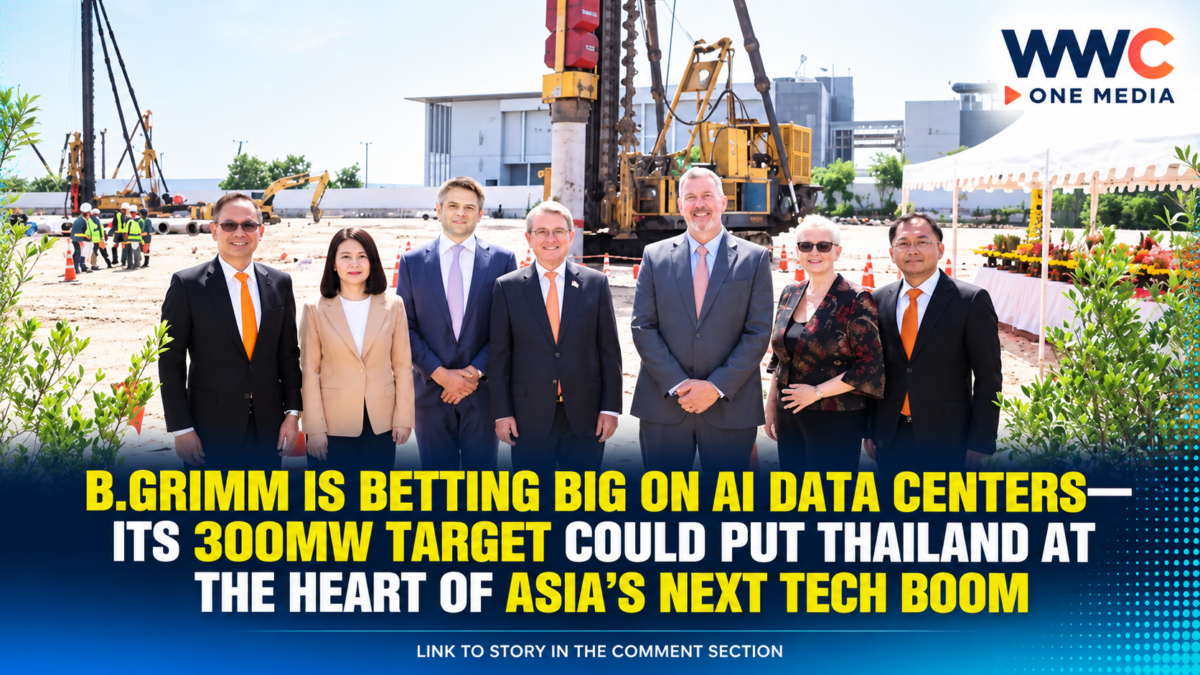
BANGKOK — Thailand’s energy giant B.Grimm Power is making a dramatic shift beyond traditional electricity generation, betting that the next major source of growth will come from the enormous power requirements of artificial intelligence and cloud computing.
The company is targeting 300 megawatts of data-center capacity by 2030, expanding its ambitions beyond its initial project in Thailand and looking at opportunities in both domestic and overseas markets, according to recent company and Thai business-industry reporting.
The strategy could transform B.Grimm from simply a power producer into a broader digital-infrastructure and energy platform—at a time when AI companies, cloud providers and hyperscalers are racing to secure electricity and data-center capacity across Asia.
And there is already a major project underway.
B.Grimm’s first big AI infrastructure bet
B.Grimm’s flagship data-center partnership is with Singapore-based Digital Edge, which is backed by infrastructure investor Stonepeak.
The joint venture is developing an AI-ready hyperscale campus in Chonburi’s Eastern Economic Corridor (EEC).
The project was originally announced at around 96MW of IT capacity, although subsequent project materials have described the campus as a roughly 100MW development. B.Grimm holds 40% of the joint venture, with Digital Edge holding the remaining 60%.
That distinction is important because different company and financing announcements use slightly different capacity figures.
What is consistent is the scale of the project.
It is designed to provide infrastructure for hyperscalers, AI workloads, cloud services and enterprise computing, placing B.Grimm directly in the middle of one of the fastest-growing infrastructure markets in Asia.
The first campus is already moving toward launch
The Chonburi project is no longer just a proposal.
Recent Thai business reporting said construction was around 40% complete, with the first approximately 47MW phase expected to begin operations in November 2026 and the second phase following in 2027.
Earlier project documents had described the first 48MW phase as targeting commercial operation in the fourth quarter of 2026, followed by the second 48MW building in 2027.
That puts B.Grimm close to a critical milestone.
If the first phase enters service as planned, the company will move from building data-center infrastructure to operating a revenue-generating digital asset.
Then the target gets much bigger
The initial campus is only the beginning.
B.Grimm’s longer-term ambition is to expand its data-center business to 300MW by 2030, with both Thailand and overseas markets in its sights.
That would represent roughly three times the capacity of the initial 100MW-scale Chonburi campus.
The company’s strategy is effectively to combine two businesses that increasingly depend on each other:
electricity + computing infrastructure.
AI data centers require enormous quantities of reliable power.
B.Grimm already has expertise in generation, energy infrastructure and industrial power supply.
The company is now attempting to monetize that advantage directly by becoming part of the data-center value chain.
A $1 billion partnership opened the door
The Digital Edge relationship is particularly important because it gives B.Grimm access to a specialist data-center operator rather than forcing the Thai company to build the business entirely from scratch.
When the partnership was announced in June 2025, the companies said they planned a US$1 billion investment program for hyperscale and AI-ready data-center campuses across Thailand.
The partnership combines B.Grimm’s local energy and infrastructure capabilities with Digital Edge’s experience operating data centers across Asia-Pacific.
That model could now become the template for B.Grimm’s next projects.
Thailand’s biggest data-center financing deal
The Chonburi campus has already attracted significant financial backing.
In May, Digital Edge and B.Grimm secured an US$880 million green loan, described by the companies as the largest financing ever secured for a data-center project in Thailand.
The financing supports development of the 100MW BKK Campus in the EEC.
The lending syndicate included major domestic and international banks such as Bangkok Bank, Bank of Ayudhya, HSBC, KASIKORNBANK, Mizuho, Natixis, Siam Commercial Bank, SMBC and Standard Chartered.
That matters because data centers are extraordinarily capital-intensive.
The financing demonstrates that banks are prepared to put substantial amounts of money behind Thailand’s AI infrastructure buildout—provided projects have credible customers, power arrangements and experienced operators.
AI is turning electricity into a strategic asset
The B.Grimm strategy reflects a much bigger change taking place across Southeast Asia.
AI models require huge computing clusters.
Those clusters require data centers.
Data centers require enormous amounts of electricity.
And that means access to reliable power is increasingly becoming as important as access to land, fiber networks and cloud customers.
That is why energy companies are increasingly moving into digital infrastructure.
B.Grimm has a particularly obvious advantage: it can potentially bundle power expertise with data-center development.
Its own corporate materials describe the strategy as Digital Infrastructure-as-a-Service, combining energy platforms with digital infrastructure.
B.Grimm is already chasing data-center power demand elsewhere
The company’s relationship with data-center customers is not limited to its Digital Edge venture.
B.Grimm’s subsidiary Amata B.Grimm Power signed a 100MW power purchase agreement with NTT Data Centers for the Japanese company’s Bangkok 4 data-center project in Chonburi.
The facility is expected to be energized in 2027.
That deal illustrates another potential business model for B.Grimm.
The company does not necessarily have to own every data center.
It can also position itself as the energy supplier behind the facilities.
That could create multiple revenue streams from the same AI boom.
The overseas angle is becoming more important
B.Grimm’s data-center ambitions are also arriving alongside a broader international expansion strategy.
Reuters recently reported that B.Grimm and U.S. energy technology company GE Vernova signed agreements covering power-generation and energy infrastructure projects in Thailand and Malaysia.
One project involves a gas-fired power plant in Malaysia’s Perlis state, with GE Vernova supplying the gas turbine and generator.
The plant is expected to begin commercial operations in the fourth quarter of 2029.
B.Grimm chairman Harald Link told Reuters that growing data-center demand is one reason countries across the region are investing heavily in power generation and transmission infrastructure.
That is potentially significant for the company’s data-center strategy.
More data centers mean more electricity demand.
More electricity demand creates opportunities for B.Grimm’s core power business.
And the company’s international power expansion could give it access to markets where data-center developers are competing for scarce electricity.
Why Malaysia matters
Malaysia has emerged as one of Southeast Asia’s biggest data-center hotspots, particularly around Johor and the broader Kuala Lumpur region.
The country has attracted hyperscalers, cloud providers and large data-center operators because of its proximity to Singapore, available industrial land and growing power infrastructure.
For B.Grimm, expanding its energy platform into Malaysia could therefore provide a natural bridge into another rapidly growing digital-infrastructure market.
The GE Vernova agreement does not itself announce a new B.Grimm data-center project in Malaysia, so it would be premature to describe the power plant as part of the 300MW data-center target.
But the broader strategic connection is clear:
B.Grimm is building energy infrastructure in the same region where AI-driven electricity demand is accelerating.
Thailand wants to become an AI and data-center hub
B.Grimm is also benefiting from Thailand’s broader national strategy.
The Thai government has been aggressively courting data-center and cloud investment, seeking to turn the country into a regional digital and AI hub.
The Eastern Economic Corridor has become a major focal point because it combines industrial land, infrastructure and access to power networks.
B.Grimm’s Chonburi campus sits directly inside that ecosystem.
Other international technology and data-center companies are also expanding in Thailand, increasing competition for land and electricity.
That competition could be both a risk and an opportunity.
For B.Grimm, more projects mean more potential customers.
But it also means the company must compete for the same grid capacity, equipment and financing as other developers.
The power problem could become the biggest obstacle
There is a catch to the AI data-center boom.
Data centers consume enormous amounts of electricity, and Thailand cannot simply approve unlimited projects without considering the capacity of its power system.
Thai industry groups have already called for tougher conditions on data-center investments because of concerns over electricity demand, infrastructure and the broader impact of rapid expansion.
That creates a critical question for B.Grimm.
Can Thailand build enough reliable power infrastructure quickly enough to support the data-center pipeline?
The answer will influence how quickly the company’s 300MW ambition can become reality.
Sustainability is another pressure point
B.Grimm and Digital Edge are also positioning their project around energy efficiency and sustainability.
The Chonburi campus was financed under a green-financing framework, with the companies targeting a power usage effectiveness, or PUE, of around 1.25.
The project also includes hybrid closed-loop cooling systems and infrastructure designed to accommodate renewable power.
Those features are increasingly important.
AI computing requires much more electricity and cooling capacity than traditional enterprise computing.
As data centers become larger, operators face growing scrutiny over electricity consumption, water use and carbon emissions.
Efficiency therefore isn’t merely an environmental issue.
It is becoming an economic one.
A more efficient data center can reduce operating costs while making it easier to secure power and satisfy increasingly demanding customers.
B.Grimm is trying to become more than a power company
The company’s broader strategy helps explain why the data-center push is so important.
B.Grimm is targeting 10,000MW of contracted capacity by 2030, with more than half expected to come from renewable sources.
At the same time, it is expanding into digital infrastructure, energy technology and other businesses connected to the changing electricity market.
The result is a company trying to position itself at the intersection of three major trends:
renewable energy + electricity demand + artificial intelligence.
That could be a powerful combination if the AI infrastructure boom continues.
But 300MW will not come cheaply
Scaling from an initial roughly 100MW campus toward 300MW would require substantial capital.
Earlier industry analysis estimated that expanding the broader B.Grimm/Digital Edge platform toward 300MW could eventually involve around 100 billion baht of cumulative investment, although that figure should be treated as an earlier project estimate rather than a newly confirmed company-wide commitment.
The financing environment is also becoming more challenging.
Global bond yields have climbed sharply, increasing the cost of capital for infrastructure projects.
Data-center developers therefore need long-term contracts and strong counterparties to justify the enormous upfront investment.
B.Grimm’s partnership model helps address that challenge, but it does not eliminate it.
Thailand is becoming a battleground for AI infrastructure
B.Grimm is entering an increasingly crowded market.
Thailand has attracted plans from major international technology companies and data-center operators, while new projects continue to emerge around the EEC and other industrial zones.
That competition is ultimately good news for Thailand’s digital economy—but it creates a race for the country’s most valuable infrastructure:
electricity, land, fiber and skilled workers.
The companies that secure those resources first could gain an enormous advantage.
The bigger regional opportunity
The most interesting part of B.Grimm’s strategy may therefore not be the first 100MW campus.
It is the possibility of turning the company into a regional platform that links power generation with AI infrastructure.
That model could be replicated in other Southeast Asian markets where data-center developers face the same problem: they can find customers and land, but they need reliable electricity.
B.Grimm already operates power assets across Asia and is expanding its international portfolio.
Its ability to combine energy expertise with digital infrastructure could make the company a more significant player in the region’s AI buildout than its traditional identity as a Thai utility might suggest.
The Bottom Line
B.Grimm Power is betting that the next great electricity-demand cycle will come from artificial intelligence.
Its current Digital Edge partnership has already produced a roughly 100MW-scale AI-ready campus in Chonburi, backed by an US$880 million green loan.
The company now aims to take its data-center business toward 300MW by 2030, with expansion across Thailand and overseas markets.
That is a major strategic shift.
B.Grimm is no longer simply asking how to generate more electricity.
It is asking where the next generation of electricity demand will come from—and how it can own a piece of the infrastructure that consumes it.
The answer increasingly appears to be AI.
And if Southeast Asia’s data-center race accelerates as expected, B.Grimm’s 300MW target may turn out to be only the beginning of a much bigger regional power-and-AI play.