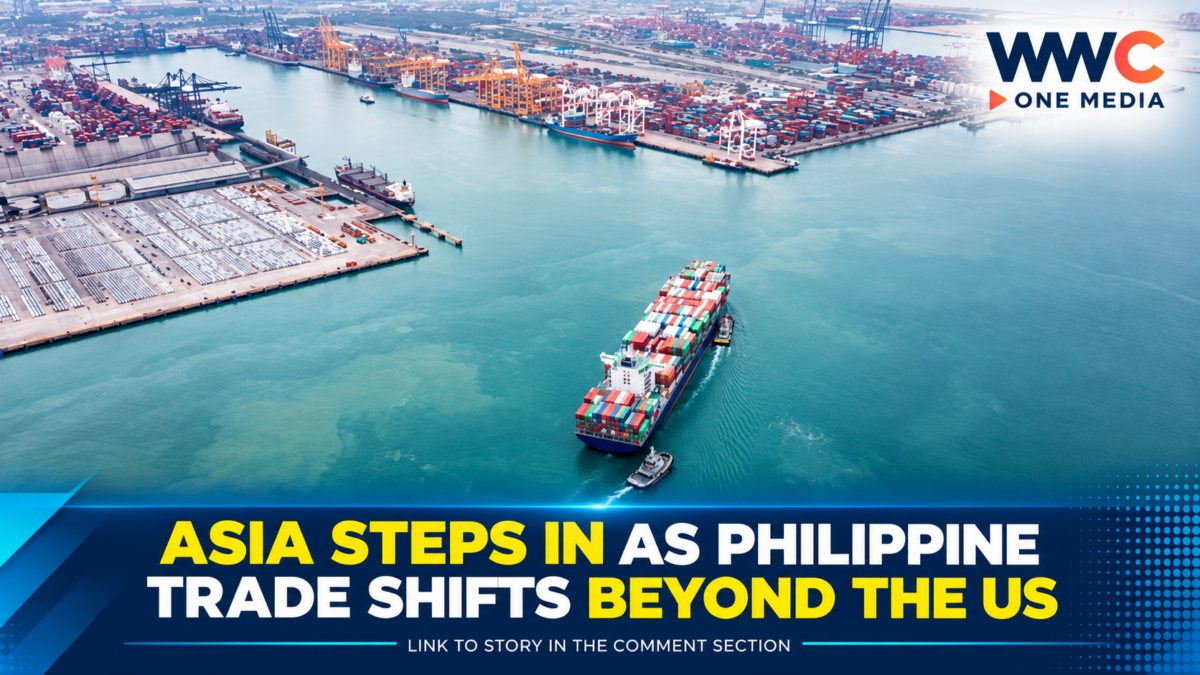
MANILA — Asia is increasingly helping fill the gap as Philippine businesses reduce their reliance on the United States, with trade within the Asia-Pacific region accelerating amid geopolitical uncertainty and global supply-chain disruptions.
The shift reflects a broader push by companies to diversify their markets, suppliers and production networks rather than depend heavily on a single country.
Intra-Asia Trade Accelerates
The United States remains the Philippines’ largest trading partner, but shipments to the American market have been declining, while trade within Asia-Pacific has been gaining momentum.
Businesses are increasingly looking toward neighboring Asian economies as they seek greater resilience against geopolitical tensions, disruptions and sudden changes in trade conditions.
This shift is also being reinforced by the “China Plus One” strategy, in which companies maintain operations in China while adding production or sourcing bases elsewhere to reduce concentration risks.
For the Philippines, the strategy could create opportunities to attract more investment, expand exports and become more deeply integrated into regional supply chains.
Philippines Positioned to Benefit
The Philippines has been identified among 22 emerging markets expected to grow faster than the global average, with several of those economies located in Asia-Pacific and ASEAN.
Industries linked to artificial intelligence, data centers, new energy, healthcare and life sciences are helping generate additional cross-border trade as companies move equipment, components and other higher-value goods across the region.
The country’s geographic position and expanding connections with major Asian economies could give Philippine businesses more opportunities as supply chains become increasingly regional.
Trade Data Show Asia’s Growing Importance
Official data reinforce the importance of Asia to Philippine trade.
In the first eight months of 2026, the country’s total imports reached $105.6 billion, up 19.1% from the same period a year earlier. In August alone, imports rose 16.6% year-on-year to $12.96 billion.
Asia remains a dominant source of those imports. During the first half of 2026, East Asia accounted for 53.6% of Philippine imports, while Southeast Asia represented another 24.9%. China was the country’s largest source among APEC economies, with $23.23 billion in imports during the period.
Exports are also heavily connected to the region. In August, East Asia accounted for 44.7% of Philippine exports, while Southeast Asia represented 14.4%.
MSMEs Could Become the Next Growth Engine
The regional shift could be particularly important for Philippine micro, small and medium enterprises.
Many smaller businesses remain focused primarily on domestic customers, but e-commerce and international logistics are lowering some of the barriers to reaching overseas buyers.
Nearly 200 Philippine MSMEs have received international trade training this year, with programs aimed at helping businesses address gaps in trade knowledge, logistics, technology and access to financing.
With MSMEs accounting for the overwhelming majority of Philippine businesses, even a modest increase in the number of companies entering international markets could have a significant impact on exports.
Europe Offers Another Alternative
The Philippines is also looking beyond Asia.
Exports to Europe have been registering strong growth, while negotiations toward a potential Philippines-European Union free trade agreement could eventually provide another avenue for market diversification.
A wider network of trading partners would reduce the country’s exposure to downturns or disruptions in any single market while giving Philippine companies more options for sourcing, manufacturing and selling their products.
A Major Shift in Global Supply Chains
The changing trade patterns reflect a broader transformation in global commerce.
Geopolitical tensions, tariffs, transportation disruptions and supply-chain vulnerabilities are encouraging companies to build networks that span multiple countries and regions.
For the Philippines, the growing flow of trade within Asia could therefore represent more than a temporary replacement for weaker US-bound shipments. It could become part of a longer-term restructuring of how Philippine companies connect with the global economy.
As businesses continue to diversify, the country’s ability to capitalize on its regional connections, improve logistics and help smaller firms export could determine how much of Asia’s expanding trade flows the Philippines can capture.