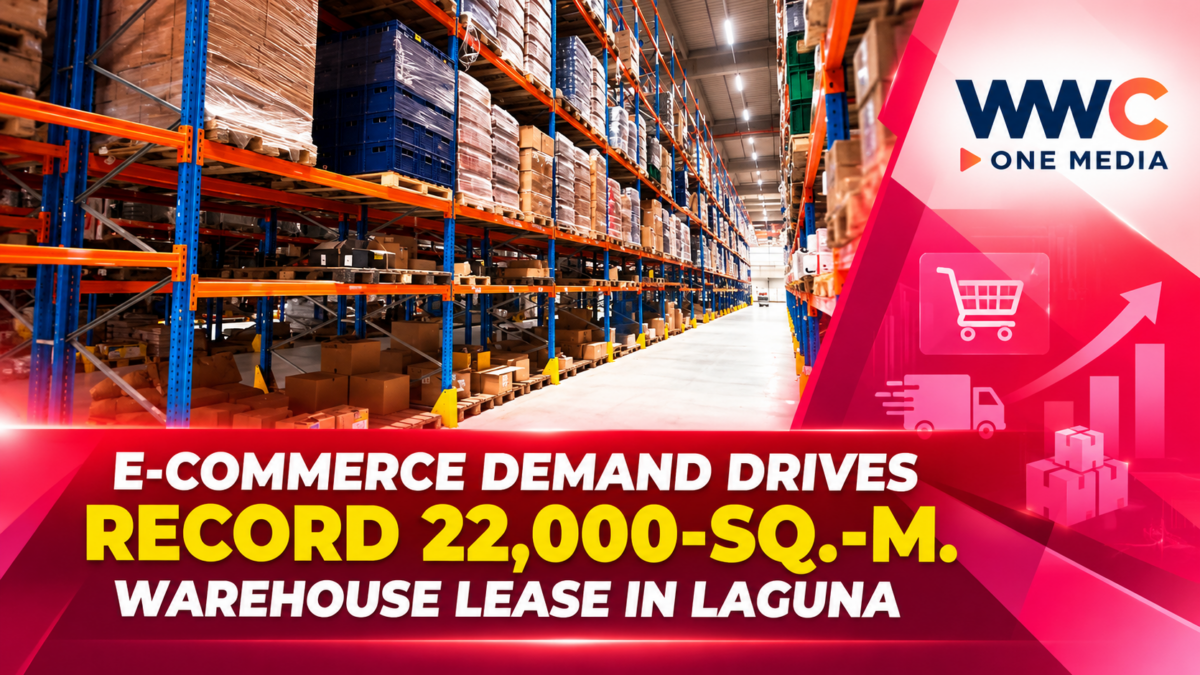
MANILA, Philippines — Rising e-commerce activity and the growing need for faster delivery have driven one of the Philippines’ largest industrial property deals this year, with a 22,000-square-meter warehouse lease in Laguna emerging as the biggest single industrial leasing transaction recorded by Savills Philippines during the first half of 2026.
The transaction underscores Laguna’s growing importance as a fulfillment and distribution hub for South Luzon, where logistics operators are increasingly seeking larger facilities that can support not only storage but also sorting, dispatch and last-mile delivery.
According to Savills Philippines, Laguna recorded about 54,000 square meters of notable industrial leasing transactions in the first half of 2026. The 22,000-square-meter deal was the largest individual warehouse commitment tracked across the South Luzon industrial corridor during the period.
The surge comes even as developers are scaling back new industrial supply, creating a market in which demand for strategically located warehouse space remains strong while the pipeline of additional facilities becomes more limited.
Laguna emerges as South Luzon logistics hub
Laguna, together with Batangas and Cavite, accounted for 80% of industrial leasing transactions in South Luzon during the first half of 2026, according to Savills.
But logistics and e-commerce-related activity was concentrated almost entirely in Laguna, reinforcing the province’s role as a major fulfillment and distribution base serving Metro Manila and surrounding markets.
Savills said the 22,000-square-meter transaction reflects the scale of fulfillment-driven demand currently emerging in Laguna.
The location has become attractive to logistics operators because businesses increasingly need facilities that allow them to move products quickly from warehouses to consumers.
For e-commerce companies, the warehouse is no longer simply a place to store inventory. It can also serve as a center for sorting orders, preparing shipments and coordinating last-mile deliveries.
Savills Executive Director for Investment Services Ninoy Teo said occupiers are prioritizing locations that combine scale with proximity to major consumer markets.
Companies are looking beyond storage
The changing requirements of logistics operators are also influencing the type of industrial properties being sought.
Savills Director Early Orolfo said companies are increasingly looking beyond warehouse capacity alone, with sorting efficiency, dispatch speed and inventory turnover becoming important considerations when choosing sites.
This reflects the evolution of e-commerce supply chains, where delivery speed can directly affect the customer experience.
Larger and strategically positioned facilities can allow operators to consolidate inventory, process greater volumes and shorten the distance between distribution centers and consumers.
The trend is particularly relevant in Laguna because of its connection to Metro Manila and the wider South Luzon industrial corridor.
Warehouse demand remains strong despite slower supply growth
The strength of demand is emerging against a backdrop of significantly lower new industrial supply.
Savills expects the Philippines’ industrial construction pipeline to deliver only about 152,000 square meters of new warehouse space in 2026, down sharply from approximately 450,000 square meters completed in 2025.
Higher construction costs and broader economic headwinds have contributed to the slowdown in new development.
Despite this, established industrial locations continue to attract occupiers.
Laguna is expected to receive around 25,000 square meters of additional industrial space in 2026, according to Savills. The province already has the largest existing warehouse base in the South Luzon corridor.
The combination of strong demand and restrained new supply could keep competition for well-located modern warehouses elevated.
Vacancy remains tight in Laguna
The demand picture is also reflected in vacancy levels.
Savills reported that Laguna had the lowest industrial-park vacancy rate in South Luzon at 3.5% during the first half of 2026.
The relatively tight vacancy suggests that available warehouse space in established locations is being absorbed without a major buildup of excess inventory.
For logistics and e-commerce companies, this can make securing suitable facilities more challenging, particularly when businesses require large spaces capable of supporting modern fulfillment operations.
The 22,000-square-meter transaction is notable in this context because it represents a much larger commitment than the typical industrial lease in Laguna.
Savills said the province’s average industrial deal size was about 2,102 square meters during the period, meaning the 22,000-square-meter transaction was more than 10 times the average deal size.
CBRE data also points to strong logistics demand
Other property-market data supports the broader trend.
CBRE recorded 130,000 square meters of industrial transactions nationwide in the second quarter of 2026, representing a 31% increase from the previous quarter and a 155% increase from a year earlier.
Distribution and logistics accounted for 68% of Q2 demand, equivalent to about 88,000 square meters.
CBRE also identified Laguna as the strongest-performing subdistrict in the CALABA industrial corridor during the quarter, with 79,000 square meters of transactions. This included a 22,000-square-meter transaction by a third-party logistics provider — consistent with the scale identified by Savills.
The figures from the two property consultancies point to the same underlying trend: logistics operators are taking up increasingly large amounts of industrial space as supply chains adapt to rising delivery volumes.
E-commerce is reshaping warehouse requirements
The growth of online shopping has changed the way companies think about their physical distribution networks.
Retailers and e-commerce platforms need inventory positioned closer to consumers, while logistics companies need facilities capable of processing large numbers of individual orders.
That has increased demand for warehouses with efficient layouts, strong road connectivity and enough space for sorting and dispatch operations.
The trend is already visible among major logistics players.
In March, SM Prime said its Silangan Warehouse complex in Laguna had been fully leased, with about 86,000 square meters recently committed under a multiyear agreement. The company cited increased e-commerce activity and manufacturing growth as among the factors supporting demand.
In August, SM Prime also said its logistics footprint had expanded through a new 40,000-square-meter facility in Pasig for SPX Express and Scommerce, while noting that SPX had previously committed to about 86,000 square meters at the Laguna warehouse complex.
These deals demonstrate how logistics providers are building larger networks to handle growing volumes.
Developers face a more difficult supply environment
While demand remains resilient, the industrial-property market is not without challenges.
Savills said developers are responding to higher construction costs and broader macroeconomic pressures by slowing the pace of new supply.
The Philippines’ economic growth also moderated, with second-quarter 2026 GDP growth reported at 2.3% year on year, according to the Savills market report.
This creates a mixed environment for industrial real estate.
On one hand, weaker economic conditions can encourage companies to delay expansion. On the other, structural demand from logistics, e-commerce and manufacturing can continue to support warehouse absorption in established locations.
Laguna appears to be benefiting from the latter trend.
Power and connectivity becoming more important
The next phase of industrial development may also depend increasingly on infrastructure beyond roads and warehouse buildings.
Savills identified electricity supply and grid reliability as emerging considerations in industrial site selection.
As warehouses become more automated and logistics operations rely increasingly on digital systems, reliable power becomes critical to maintaining continuous operations.
For large fulfillment centers, disruptions can affect sorting systems, inventory management, refrigeration where applicable and other automated processes.
This means industrial developers may increasingly compete not only on location and building size but also on infrastructure reliability.
Laguna positioned for continued logistics growth
The 22,000-square-meter lease highlights the growing scale of logistics demand in one of the Philippines’ most established industrial corridors.
With e-commerce continuing to generate demand for faster fulfillment and delivery, logistics operators are looking for facilities that combine large floor areas, accessibility and proximity to consumers.
At the same time, the slowdown in new industrial construction means the supply of modern warehouse space may not expand as quickly as it has in previous years.
For Laguna, that combination could reinforce its position as a key South Luzon fulfillment and distribution center.
The latest transaction therefore represents more than a single large warehouse lease. It is a sign of how e-commerce is reshaping the Philippine industrial-property market, pushing logistics companies toward larger, better-connected facilities while developers contend with rising construction costs and a more constrained supply pipeline.
As online commerce and modern supply chains continue to expand, Laguna is increasingly becoming one of the country’s most important locations for the warehouses behind the Philippines’ growing delivery economy.