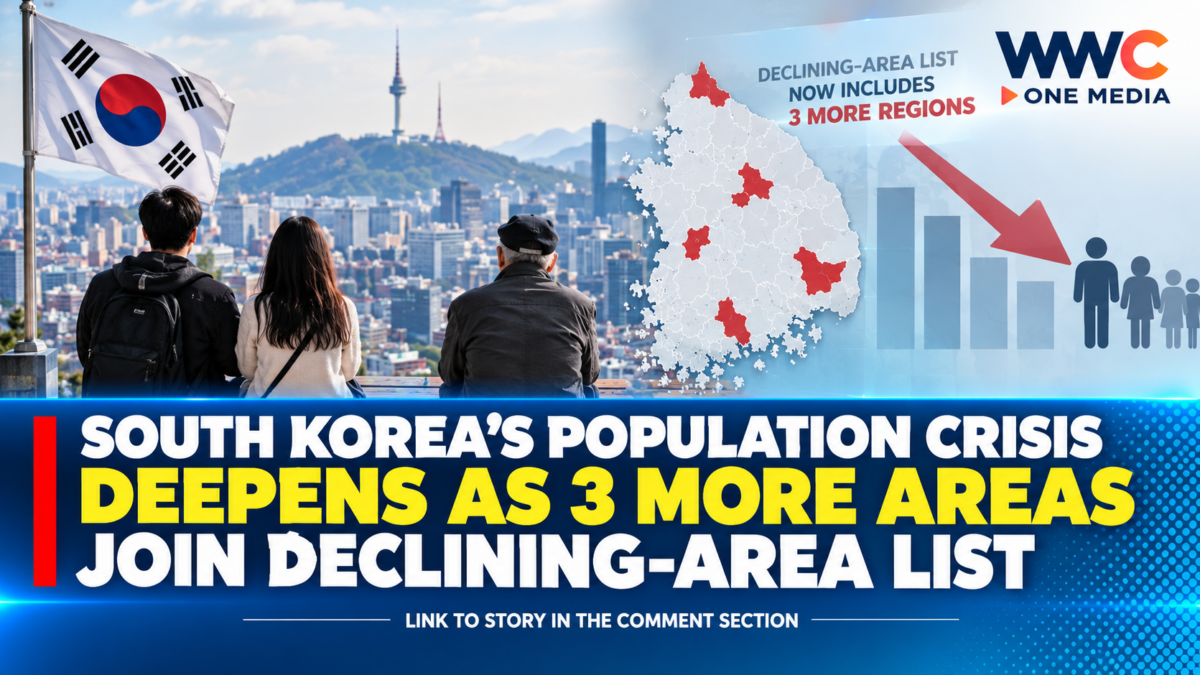
South Korea has officially expanded its list of population-declining areas to 92, as the government responds to continued demographic pressure and growing regional imbalances.
The Ministry of the Interior and Safety announced Wednesday that Busan’s Geumjeong District, Gyeonggi Province’s Dongducheon and South Gyeongsang Province’s Tongyeong have been newly designated as population-declining areas.
The three locations had previously been classified as areas of concern rather than full population-declining areas. Their elevation brings the national total from 89 to 92, five years after the government first created the designation in 2021.
The government also maintained a separate watchlist of 18 population-decline concern areas. Busan’s Buk District and North Gyeongsang Province’s Yecheon and Chilgok counties were newly placed on that list.
The latest redesignation reflects a broader assessment of demographic conditions. Rather than looking only at whether a region’s population is shrinking, the government said it considered population size, demographic structure and regional vitality.
The revised assessment uses nine indicators, including population change, aging, the share of young people, birth rates, youth migration, employment and other measures of local economic and social activity.
But the government is also highlighting areas where conditions have improved.
Yeonggwang County in South Jeolla Province, Busan’s Dong District and Daegu’s Seo District have moved out of the population-declining designation after showing improvements in demographic conditions. Rather than immediately ending support, the government will classify them as “population vitality plus” areas and maintain existing assistance for another five years.
That transition is designed to prevent regions from losing momentum just as demographic conditions begin to improve.
South Korea’s wider population challenge remains significant. The country’s population peaked at about 51.84 million in 2020 before entering a declining trend, while population concentration in the capital region has continued to increase.
The government plans to connect the designated areas to a range of financial and administrative measures, including the regional extinction response fund, which is worth roughly 1 trillion won annually.
Officials say future funding will increasingly focus on projects that can improve residents’ everyday lives and encourage people to remain or settle in shrinking regions, rather than simply concentrating on physical infrastructure.
The government also operates special administrative and tax measures for population-declining areas, including incentives related to housing, employment and settlement.
The latest designation therefore sends a message that South Korea’s demographic challenge is not confined to small rural counties. Major urban districts such as Busan’s Geumjeong are now being drawn deeper into the government’s population-decline response.
With the official list expanding to 92 areas, the next challenge will be whether billions of won in regional support can translate into something harder to measure: more young residents, stronger local economies and communities capable of reversing population decline.
WWC ONE MEDIA G,A