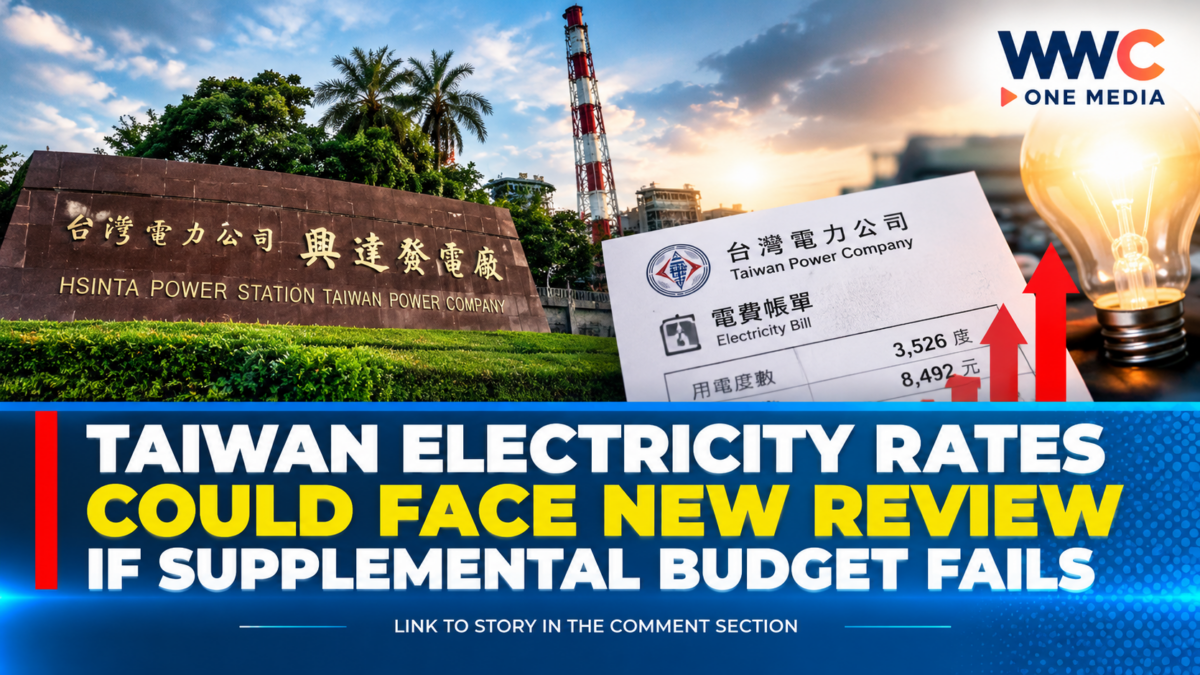
Taiwan’s electricity prices could be back in the spotlight if lawmakers reject a proposed supplemental budget designed to provide additional financial support to state-run Taiwan Power Co. (Taipower).
Economics Minister Kung Ming-hsin said Tuesday that Taipower currently has no plan to raise electricity rates. However, the government’s rate review panel could reconsider its decision if the legislature fails to approve the additional funding.
The warning came during legislative questioning, when TPP Legislator Hung Yu-hsiang asked whether electricity rates would remain unchanged through the end of the year.
Kung said the rate review panel would determine whether another review is necessary if the supplemental budget is rejected, stressing that the final decision would not be his alone.
The proposed supplemental spending plan has become a broader political issue because a large share of the funding is intended to stabilize energy and living costs.
According to figures cited during the legislative session, 69.3% of the supplemental budget is earmarked for measures aimed at keeping energy and living expenses stable, including support for Taipower and state-run fuel supplier CPC Corp. Defense spending accounts for 24%, while additional social welfare funding represents 3.5%.
Hung questioned whether the allocation reflects the government’s spending priorities, while Premier Cho Jung-tai defended the plan, arguing that stable energy prices are essential to households and the wider economy.
Cho said sudden increases in electricity and other living costs could affect the public broadly, making government support for state-run energy companies necessary to maintain price stability.
CPC Corp. has already absorbed around NT$20 billion (US$630 million) in fuel costs while keeping prices unchanged, according to Cho. He said the company is relying on the supplemental budget to help maintain normal operations.
The debate puts Taiwan’s electricity pricing policy at a potentially sensitive crossroads. Keeping rates stable can help shield households and businesses from sudden increases, but continued government support also places pressure on public finances and state-run energy companies.
For consumers, the immediate message is that there is no announced electricity-rate increase at present. But the government’s ability to maintain that position could depend heavily on what happens to the supplemental budget in the legislature.
The next legislative decision could therefore determine whether Taiwan’s current electricity-price freeze continues — or whether another rate review suddenly moves back onto the agenda.
WWC ONE MEDIA G,A