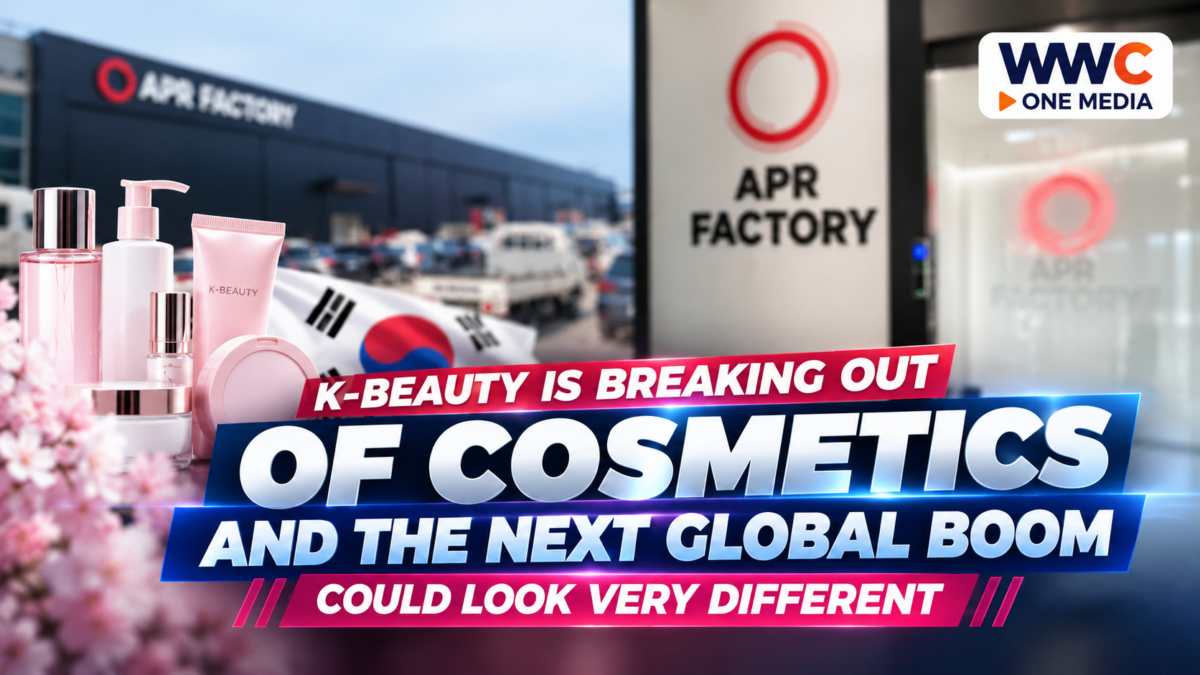
SEOUL — South Korea’s beauty industry is entering a new phase as leading companies move beyond traditional cosmetics and into beauty devices, medical aesthetics and technology-driven solutions.
Companies including APR, Amorepacific and PharmaResearch are expanding their businesses as global demand for Korean beauty products and aesthetic services continues to grow.
APR, the company behind Medicube and its AGE-R home beauty devices, is preparing to enter the medical-device market with products including a focused-ultrasound device and a polynucleotide-based skin booster.
Its skin booster has already received Class II medical-device clearance and export approval in Korea. The company began overseas shipments in the second quarter and expanded into Japan and the Middle East during the third quarter. A Korean launch is planned for 2028, subject to additional regulatory approval.
APR is also reorganizing its manufacturing facilities to accommodate the expansion, with its Gasan plant in Seoul focusing on energy-based devices and two facilities in Pyeongtaek specializing in home beauty devices and skin boosters.
Amorepacific Moves Into Beauty Tech
Amorepacific is also broadening its reach.
The company, which operates 15 cosmetic brands, acquired a 49.5 percent stake in skin-care device developer Viol Medical for 80 billion won ($60 million) after initially partnering with the company on device development.
It has also partnered with Higher Corp. to combine Amorepacific’s skin-care analysis technology with device-development capabilities.
PharmaResearch, known for its Rejuran skin-booster brand, is taking a similar approach. The company plans to introduce a new device and expand its medical-aesthetic offerings, while its CEO has indicated plans to pursue mergers or acquisitions to build a broader medical-aesthetics business.
Meanwhile, energy-based device makers such as Wontech and Classys are moving in the opposite direction by entering the home beauty device market, further blurring the line between professional aesthetic treatments and consumer beauty technology.
Why the Industry Is Changing
The expansion is being driven by several trends, including rising incomes, longer life expectancy and growing international demand for Korean aesthetic services.
South Korea’s government is also positioning K-beauty as a higher-value technology industry. The Finance Ministry said K-beauty exports reached a record $3.1 billion in the first quarter of 2026, while emphasizing the industry’s transition toward AI, data and devices.
The country’s cosmetics exports reached $11.4 billion in 2025, according to Seoul Economic Daily, with products shipped to 205 countries.
But becoming a global beauty-tech powerhouse will not be easy.
Companies entering medical devices face strict regulatory requirements in major markets, including the United States and Europe. They also need local distributors with established medical-clinic networks and the ability to provide after-sales support, increasing the cost and complexity of overseas expansion.
The industry is therefore evolving from a business centered primarily on creams, serums and makeup into one combining cosmetics, devices, data and medical aesthetics.
K-beauty has already conquered global shelves. Now, the bigger question is whether Korean companies can turn that global popularity into a much broader beauty-technology empire.
WWC ONE MEDIA G,A