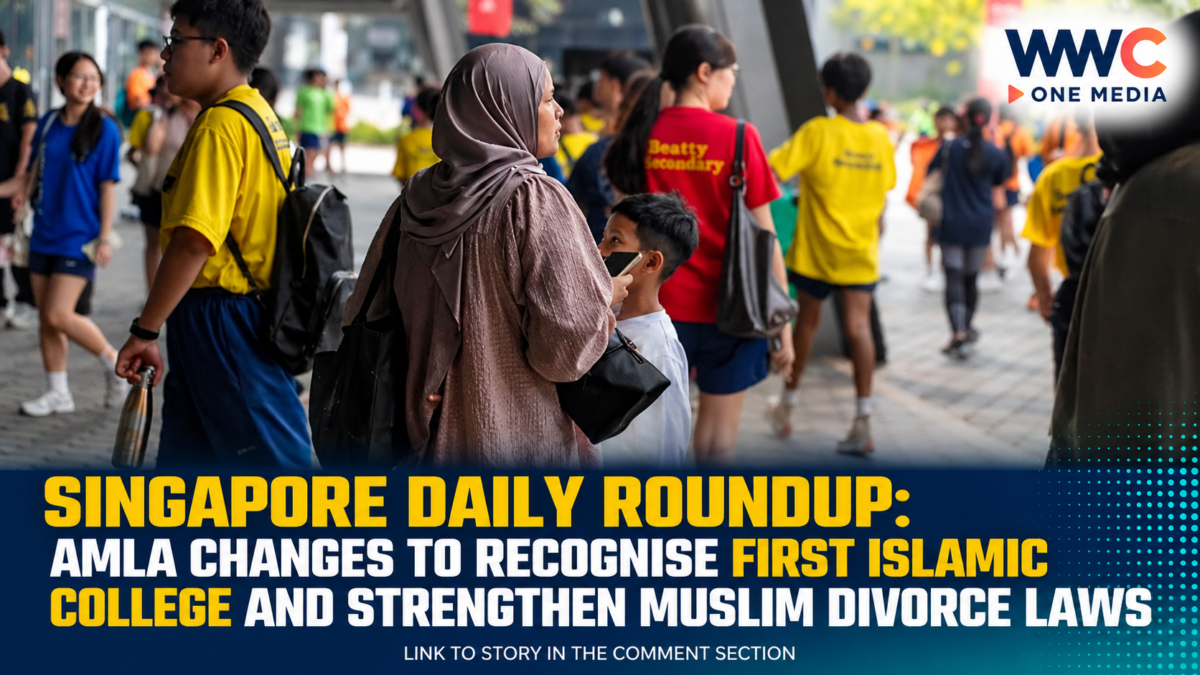
Singapore has proposed changes to the Administration of Muslim Law Act (AMLA) that would formally recognise the country’s first Islamic college, allow it to award degrees and streamline selected Muslim divorce procedures.
The proposed amendments were introduced in Parliament on Tuesday (Oct. 6) by Acting Minister-in-charge of Muslim Affairs Zaqy Mohamad.
The Ministry of Culture, Community and Youth (MCCY) said the changes are intended to strengthen Singapore’s Muslim institutions while ensuring that marriage and divorce processes remain responsive to the community’s changing needs.
1. AMLA amendments to recognise Singapore’s first Islamic college
The proposed amendments would give the upcoming Singapore College of Islamic Studies (SCIS) legal recognition and the authority to award degrees, diplomas and certificates in tertiary religious education.
The college, which is scheduled to open in 2028, will offer an undergraduate degree in Islamic Studies and is intended to nurture the next generation of asatizah, or Islamic religious teachers.
The Majlis Ugama Islam Singapura (MUIS) would formally oversee SCIS as part of its statutory functions and could provide funding from community funds it administers, including zakat, wakaf and the Mosque Building and MENDAKI Fund.
The proposed framework is intended to provide accountability while preserving the college’s academic independence and scholarly standards.
The Minister-in-charge of Muslim Affairs would also have oversight of selected administrative and financial matters, including access to financial records, appointments to the Board of Governors and approval of key decisions such as changes to the college’s constitution.
SCIS was announced in 2024 as Singapore’s first Islamic college dedicated to developing religious leaders who can provide Islamic guidance suited to the country’s multiracial and multi-religious society.
2. Muslim divorce procedures could become simpler
The proposed AMLA changes would also reduce some administrative requirements for Muslim couples going through divorce at the Syariah Court.
For couples who mutually agree to end their marriage through talak tafwidh — where the husband delegates the pronouncement of divorce to the wife — there would no longer be a requirement to first appoint hakam, or marital conciliators.
MCCY said this could save couples six months or more, as well as about S$172 per party in Hakam appointment and court-order fees, when they have already agreed on the divorce and all related matters.
The proposed changes would also allow the court, in suitable fasakh applications, to waive the requirement for sworn testimony from two witnesses when the grounds for divorce can be established through other evidence, such as documentary records.
The aim is to reduce unnecessary delays and conflict while ensuring that the court can continue to properly assess each case.
3. Child welfare to become a stronger focus in divorce cases
Another major proposal is to explicitly state that the welfare of the child is the Syariah Court’s paramount consideration in matters involving children.
The court would also gain powers to allow or prevent a child from being relocated overseas.
MCCY said the change responds in part to the growing number of transnational marriages and situations where one parent may relocate overseas for work or other reasons.
The amendments would also allow Muslim couples who obtained a divorce overseas to apply to the Syariah Court for financial and child-related orders, provided certain conditions are met.
One of the requirements would be that either party is domiciled in Singapore or had lived in Singapore for at least three years before making the application.
4. New proposed rule for some Muslim marriages
The Bill also proposes a new requirement for certain Muslim marriage applications.
Where at least one party is neither a Singapore citizen nor a permanent resident, the couple would have to meet a minimum period of physical presence in Singapore before applying to marry.
MCCY said the intended minimum period is 31 days, aligning with the requirement for civil marriages under the Women’s Charter.
The ministry said the change would help ensure that foreigners marrying in Singapore have an established presence or meaningful connection to the country.
5. Eight public officers referred to police over property purchases
Separately, eight public officers have been referred to the police following a review of property purchases made by civil servants who worked in agencies involved in rail planning.
Coordinating Minister for Public Services Chan Chun Sing told Parliament on Tuesday that the Public Service Division had referred the cases to the police for independent investigation.
The purchases were made between 2007 and 2014 and involved properties located near future MRT stations.
Chan stressed that a referral to the police does not mean wrongdoing has been established, with the facts to be assessed independently and due process followed.
The review was prompted by questions surrounding a working paper examining whether civil servants involved in transport planning may have benefited from information about future infrastructure projects.
The government has also expanded its review beyond the period examined in the research paper.
6. Former Lions goalkeeper Hassan Sunny’s nasi padang stall closes
Singapore football fans will no longer be able to visit Dapur Hassan, the nasi padang stall associated with former Lions goalkeeper Hassan Sunny, at Tampines.
The stall announced its closure on social media on Sunday (Oct. 4), marking the end of six years of operations.
The eatery had become another chapter in Hassan’s life after his football career, giving fans a chance to see the former national goalkeeper in a different setting.
The closure means diners will no longer be able to get the stall’s nasi padang offerings at its Tampines location.
7. OldTown White Coffee to close its last Singapore outlet
Fans of Malaysian coffee and cuisine in Singapore also have only a few days left to visit OldTown White Coffee’s final Singapore outlet.
The outlet at Kallang Wave Mall is scheduled to close on Oct. 11.
The cafe announced the closure in a Facebook post on Oct. 2, bringing the brand’s physical presence in Singapore to an end after its outlets served Malaysian-style dishes and its signature white coffee to local customers.
With the Kallang Wave Mall branch closing, customers looking for OldTown White Coffee in Singapore will no longer have a local outlet to visit.
More changes ahead for Singapore’s Muslim community
The proposed AMLA amendments represent a broad update covering religious education, marriage, divorce and child welfare.
For SCIS, the changes would establish a formal legal and governance framework ahead of its planned 2028 opening, including its ability to award recognised tertiary qualifications.
For families, the proposed divorce-related changes are aimed at reducing unnecessary administrative burdens while putting greater emphasis on children’s welfare.
The Bill will be debated at a subsequent Second Reading in Parliament before the proposed changes can become law.