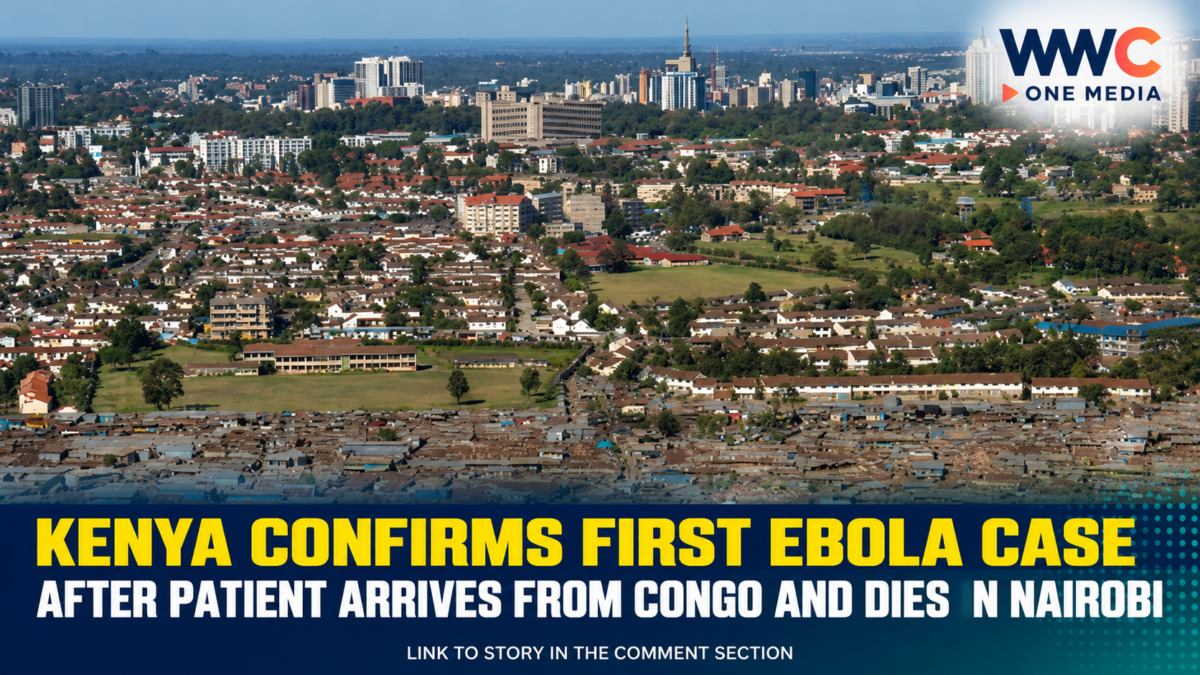
Kenya has confirmed its first imported case of Ebola after a Kenyan citizen who had been living in the Democratic Republic of Congo (DRC) died while receiving treatment in Nairobi.
Health authorities confirmed the case on Tuesday, Oct. 6, after laboratory tests showed that the patient was infected with the Bundibugyo strain of Ebola virus. The man had travelled from the DRC through Uganda before arriving in Kenya on Saturday.
The case has prompted an immediate contact-tracing operation, with Kenyan health authorities identifying 28 people who had contact with the patient, including relatives and healthcare workers. Officials are also tracing passengers and crew members who were on the same flight to Nairobi.
Patient Had Been Living in Congo for Seven Years
According to Kenya’s Health Ministry, the patient had lived in the DRC for about seven years and became ill roughly a month before returning to Kenya.
He had sought treatment at several health facilities in the DRC before travelling by road to Kampala, Uganda.
From Kampala, he boarded a Jambojet flight to Nairobi. The aircraft, identified by Kenyan authorities as Jambojet flight 8523, landed at Jomo Kenyatta International Airport at about 1.10pm on Saturday, Oct. 3.
The patient underwent routine public-health screening at the airport before proceeding through immigration.
Health ministry officials said he was subsequently taken directly from the airport to Nairobi Hospital by relatives and a friend.
Symptoms Emerged as He Was Hospitalised
The patient was admitted to Nairobi Hospital after developing symptoms consistent with a serious viral illness.
Kenyan authorities said he had fever, chills, intense fatigue and weakness, muscle pain, painful swallowing, a sore throat and bleeding beneath the skin at injection sites.
He was quickly isolated after arriving at the hospital.
Samples were tested at both Kenya’s National Virology Reference Laboratory and the Kenya Medical Research Institute (KEMRI), with both laboratories confirming infection with the Bundibugyo strain.
The patient was placed on supportive treatment but died late Monday.
Authorities said arrangements were being made for a safe and dignified burial under protocols designed to reduce the risk of further transmission.
28 Contacts Identified
Kenyan health officials have so far identified 28 contacts of the deceased, including family members and healthcare workers.
The government is also tracing 23 passengers and four crew members who travelled on the same flight from Uganda to Nairobi.
Officials said people considered at risk will be monitored and placed under appropriate quarantine or isolation measures.
The response is focused on identifying anyone who may have had direct contact with the patient before he was isolated, particularly people who accompanied him from the airport and healthcare workers who may have treated him.
Kenya has maintained heightened surveillance since the Ebola outbreak began in the DRC earlier this year.
The country’s Health Ministry said it had screened more than 650,000 travellers as of Oct. 6 and tested 267 samples in five laboratories. The newly confirmed patient was the first positive result detected in Kenya.
Why the Airport Screening Did Not Detect Him
Kenyan health officials said the patient passed through routine screening at Nairobi’s airport despite already being infected.
Patrick Amoth, the Health Ministry’s director general, said medication may have temporarily masked his symptoms, potentially allowing him to pass the screening process without being flagged.
The development highlights the difficulty of detecting infectious diseases among travellers who may have mild or suppressed symptoms when they cross borders.
The patient had already travelled through several locations — from the DRC to Uganda and then to Kenya — before being isolated in hospital.
Kenya Becomes Another Country Linked to Outbreak
Kenya is the latest country to report an imported case connected to the ongoing Ebola outbreak in eastern Congo.
Uganda previously reported 20 confirmed cases and two deaths, most of them linked to imported infections from the DRC. The World Health Organization declared Uganda free of the disease in August after the country completed the required monitoring period without new cases.
The current outbreak is being driven by the Bundibugyo virus, a relatively rare Ebola species.
WHO has warned that the continuing outbreak in the DRC presents a significant regional risk because of cross-border travel, trade and population movement. In an earlier assessment, WHO described the risk to countries sharing land borders with areas reporting Bundibugyo virus as high, while assessing the global risk as low.
WHO’s current outbreak information also says there is no vaccine or specific treatment approved for Bundibugyo virus disease, although candidate vaccines and treatments are being studied.
Congo Outbreak Has Become a Major Regional Health Emergency
The case in Kenya comes as the DRC continues to battle a rapidly expanding Ebola outbreak.
The outbreak was declared in May 2026 and has spread across several provinces in eastern Congo. By early October, reports indicated that the outbreak had surpassed 8,000 cases and 4,000 deaths, making it one of the most serious Ebola outbreaks ever recorded.
The response has been complicated by insecurity, population displacement, difficult access to affected communities and shortages affecting some healthcare workers.
WHO has been supporting national authorities with surveillance, contact tracing, laboratory testing, clinical preparedness and cross-border response measures.
The organisation has also stressed the importance of community engagement in controlling the outbreak, particularly in areas where mistrust or insecurity can make it difficult for health teams to identify cases and contacts.
Officials Urge Public Not to Panic
Kenyan authorities have sought to reassure the public that preparations were already in place to respond to imported Ebola cases.
Health Cabinet Secretary Aden Duale said Kenya had maintained a high level of alert since the outbreak began in May.
The government has trained thousands of healthcare workers in Ebola prevention and management and strengthened laboratory capacity and surveillance at airports and border crossings.
Authorities have urged members of the public to maintain good hand hygiene, avoid close contact with people who are sick and seek medical attention at recognised health facilities if they develop concerning symptoms.
Healthcare workers have also been instructed to maintain strict infection-prevention and control measures regardless of the illness being treated.
The immediate priority remains tracing the patient’s contacts and monitoring them through the incubation period.
For Kenya, the confirmation of its first imported Ebola case represents a significant test of its preparedness — but officials say the early isolation of the patient and the rapid launch of contact tracing are intended to prevent the infection from spreading further.