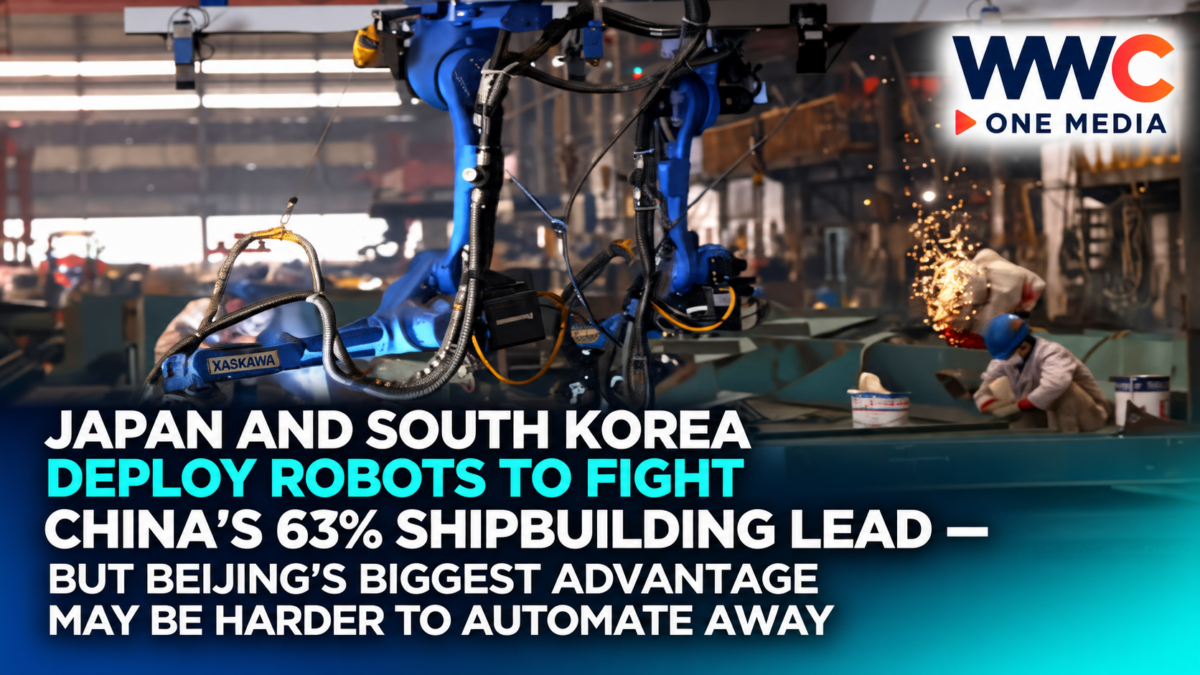
TOKYO/SEOUL — Japan and South Korea are turning shipyards into giant robotics laboratories as they try to stop China from pulling even further ahead in one of the world’s most strategically important industries.
China captured roughly 63% of global new shipbuilding orders by compensated gross tonnage in 2025, compared with about 21% for South Korea, according to industry data cited in recent reporting.
Japan and South Korea still retain major strengths in technologically demanding vessels, including liquefied natural gas carriers and sophisticated naval platforms.
Together, the two countries continue to build a substantial share of the world’s commercial fleet.
But Chinese yards have scale, lower costs, strong state backing and enormous order books.
That combination has alarmed not only Tokyo and Seoul—
but Washington.
The response is increasingly built around AI, robotics and highly automated “smart shipyards.”
Hanwha says AI already supports 67% of indoor welding
At Hanwha Ocean’s massive Geoje shipyard in South Korea, artificial intelligence is already being used to help automate one of shipbuilding’s most labor-intensive jobs.
Hanwha says AI now assists with around 67% of indoor welding, with the company targeting full automation of indoor welding by 2030.
The company is also targeting about 50% AI adoption in surface preparation and painting by the end of the decade.
Those tasks matter because welding, blasting and painting require large numbers of skilled workers and are often performed in difficult, dangerous environments.
Automating them can improve consistency while reducing exposure to fumes, heat, confined spaces and heavy equipment.
Hanwha wants robots that can work like skilled shipyard employees
The long-term ambition goes beyond conventional industrial robots.
Hanwha signed an agreement with the Korea Institute of Robot Convergence in September to develop:
autonomous work robots;
industrial humanoid robots;
and AI-based robotic systems specifically designed for shipbuilding.
The challenge is unusually difficult.
Car factories can build thousands of nearly identical vehicles along highly standardized production lines.
Ships are different.
A single vessel can be hundreds of meters long.
Its interior changes constantly during construction.
Steel blocks are enormous.
Different ships require different layouts.
And much of the work happens outdoors or inside irregular spaces.
That makes shipbuilding one of the hardest major manufacturing industries to automate.
HD Hyundai wants an autonomous shipyard by 2030
South Korean rival HD Hyundai is pursuing an equally aggressive strategy.
Its Future of Shipyard, or FOS, program aims to create increasingly autonomous shipyards using AI, robotics and digital production systems.
The company is targeting around a 30% improvement in productivity and a 30% reduction in production lead times.
HD Hyundai Robotics and HD Hyundai Samho formalized a partnership earlier this year to develop shipbuilding-specific automation and smart-factory systems.
Their work includes robotic solutions designed to operate in real shipyard environments rather than controlled factory floors.
The company has also been developing humanoid welding robots with HD Hyundai Robotics, U.S. humanoid robotics specialist Persona AI and Korean engineering company VAZIL.
A prototype has been targeted for 2026, followed by demonstrations and potential commercialization beginning in 2027.
“Dark factories” are entering shipbuilding vocabulary
The Financial Times reports that Korean shipbuilders increasingly talk about developing small “dark factories”—production areas that could eventually operate with minimal or no direct human presence.
That idea already exists in industries such as electronics and automotive manufacturing.
Applying it to ships would be much harder.
But even partial implementation could be transformative.
Automated welding, cutting, painting and material movement could allow shipyards to produce more vessels with fewer workers.
That matters because South Korea’s biggest structural problem is becoming demographic.
Korea has lost tens of thousands of shipyard workers
Employment at South Korean shipyards has fallen to about 125,000, down from around 200,000 at its 2014 peak.
The industry faces:
an aging workforce;
difficulty recruiting younger workers;
physically demanding jobs;
and competition from other manufacturing sectors.
At the same time, Korean shipbuilders have enormous order backlogs.
That creates a strange problem.
Demand exists.
Orders exist.
But companies may not have enough skilled people to build ships quickly enough.
Robotics therefore is not merely a cost-cutting strategy.
It is increasingly becoming necessary to maintain production capacity.
Japan faces an even more severe demographic challenge
Japan’s shipbuilding sector has the same problem, arguably on a larger demographic scale.
The country’s working-age population continues shrinking.
Shipyards compete for skilled workers with manufacturers across the economy.
The Japanese government says severe labor shortages have made productivity improvements and the transfer of veteran skills an urgent national priority.
Tokyo is responding by financing development of:
AI welding robots;
automated plate-bending systems;
digital shipyard simulations;
and other technologies designed to allow fewer workers to produce more ships.
Japan wants to double shipbuilding output by 2035
Japan’s ambition is not simply to preserve its current position.
It wants to expand.
Industry and government plans aim to roughly double annual shipbuilding volume by 2035, supported initially by automation and labor-saving technology.
That is an aggressive target for an industry constrained by both workers and physical yard capacity.
It explains why robotics is becoming central to Japan’s maritime industrial policy.
If shipyards cannot substantially increase productivity per worker, doubling output may be impossible.
Japan and the U.S. are developing AI shipbuilding technology together
The strategic dimension is becoming increasingly explicit.
Japan’s Ministry of Land, Infrastructure, Transport and Tourism launched a joint research program with the United States this year focused on AI shipbuilding technologies.
The collaboration follows a shipbuilding memorandum signed between the Japanese and U.S. governments.
The work includes AI-driven automation for processes such as:
plate bending;
welding;
and simulation systems that coordinate robotic production.
Japan selected 14 research projects earlier this year as part of its next-generation AI shipyard program.
That turns shipbuilding automation into more than a corporate efficiency project.
It has become part of an allied industrial-security strategy.
Why Washington cares so much about ships
The United States has allowed its commercial shipbuilding industry to shrink dramatically over decades.
China moved in the opposite direction.
Beijing supported enormous yard expansion and built an ecosystem connecting:
commercial shipbuilding;
naval construction;
steel;
ports;
shipping finance;
and state-owned industrial groups.
Washington increasingly worries that commercial shipbuilding strength can translate into military advantage.
A country capable of mass-producing tankers and container ships also develops:
skilled workers;
dry docks;
steel fabrication;
engines;
marine electronics;
and supply chains
that can support naval construction.
That makes shipbuilding part of the wider U.S.-China strategic competition.
South Korean shipbuilders are already expanding into America
South Korea is becoming increasingly important to Washington’s response.
Hanwha Ocean’s parent acquired Philly Shipyard in the United States and is transferring smart-yard technology from Korea into its U.S. operations.
That gives the U.S. access to Korean shipbuilding knowledge without having to rebuild every capability from scratch.
The strategic logic is obvious:
America needs more shipbuilding capacity.
South Korea has some of the world’s most advanced yards.
China is the competitor both governments increasingly want to counter.
China’s advantage is scale
Robotics may help Japan and Korea.
But the hardest part of China’s lead may have little to do with robots.
China has enormous physical shipbuilding capacity.
Its yards can accept huge volumes of new orders.
Its steel industry is massive.
Domestic shipping companies provide a large customer base.
State-owned banks can support financing.
And Beijing has treated shipbuilding as a strategic sector for years.
In 2025, Chinese yards secured 1,421 vessels totaling around 35.37 million compensated gross tonnes, according to industry figures cited by Switzerland Global Enterprise.
That scale creates efficiencies that automation alone may not immediately overcome.
Chinese shipyards are not technologically stagnant either
There is another critical caveat.
Japan and South Korea are not racing against a stationary competitor.
Chinese shipyards are also automating.
They are deploying:
robotic welding;
digital twins;
smart logistics;
automated cutting;
AI production planning;
and increasingly sophisticated yard-management software.
This is why claims that Japanese and Korean shipyards are automatically “years ahead” technologically should be treated cautiously.
Some experts cited by the FT believe Korean and Japanese yards may hold roughly a five-year lead in selected automation technologies.
Others argue China has already closed much of the gap.
The real competition therefore is not robots versus human workers.
It is smart shipyards versus increasingly smart Chinese shipyards operating at much larger scale.
Korea still has a major edge in LNG carriers
There are areas where South Korea remains exceptionally strong.
LNG carriers are among the most technically demanding commercial vessels.
They require:
complex containment systems;
cryogenic engineering;
advanced propulsion;
strict safety standards;
and extremely precise construction.
Korean companies such as HD Hyundai, Hanwha Ocean and Samsung Heavy Industries have dominated this market for years.
That gives Seoul a valuable defensive position.
China can win a greater number of ordinary ship orders while Korea retains stronger margins and technology in high-value categories.
The challenge is that Chinese competitors are steadily improving in those areas too.
Naval shipbuilding could become even more valuable
Defense work may ultimately become one of the biggest opportunities for Japanese and South Korean yards.
Western governments are increasing military spending.
Navies need:
destroyers;
frigates;
submarines;
support ships;
and maintenance capacity.
U.S. naval shipyards themselves face serious backlogs.
Japan and South Korea possess advanced maritime engineering capabilities that could become increasingly valuable to Washington.
That means maintaining shipyard capacity is not simply about commercial profits.
It is becoming a national-security objective.
Automation can also preserve veteran knowledge
One underappreciated advantage of AI is knowledge transfer.
When experienced welders retire, decades of tacit knowledge can disappear.
Hanwha says it is capturing the techniques of veteran workers and using those data to train AI systems that assist younger employees and robots.
That could allow shipyards to preserve expertise that is difficult to document in conventional manuals.
AI can potentially learn:
welding angles;
movement patterns;
material behavior;
inspection techniques;
and production decisions
from experts who have spent decades on the job.
In aging economies, that may prove just as valuable as replacing manual labor.
Robots could also make shipbuilding safer
Shipyard work can be dangerous.
Workers operate around:
heavy steel;
extreme heat;
high platforms;
confined spaces;
paint fumes;
sparks;
and industrial equipment.
Welding and painting automation can remove people from some of the most hazardous environments.
That makes robotics easier to justify even when the financial return is uncertain.
A machine that reduces injuries can provide value beyond simple labor savings.
But robots are expensive
The biggest obstacle is cost.
Shipbuilding robots cannot simply be purchased off the shelf and placed anywhere.
They often require:
specialized sensors;
custom software;
machine vision;
large industrial arms;
mobile platforms;
and integration into existing workflows.
Older shipyards may need substantial redesign before robots can operate efficiently.
That means smart-yard modernization can require billions of dollars before productivity benefits appear.
If demand weakens, companies could be left carrying expensive automation investments during an industry downturn.
Shipbuilding has always been cyclical
This risk matters because shipbuilding is not a steady business.
Order cycles can swing dramatically based on:
global trade;
freight rates;
energy demand;
ship prices;
interest rates;
and fleet replacement cycles.
A yard that looks overwhelmed with orders today may face excess capacity several years later.
Automation therefore creates a capital-allocation dilemma.
Companies need to invest heavily while demand is strong.
But those investments must remain economically viable when the cycle turns.
China’s state support gives it more room to absorb that risk
This may be Beijing’s most difficult advantage to counter.
Chinese shipbuilding receives substantial government backing through:
policy banks;
industrial planning;
local governments;
state-owned customers;
and infrastructure investment.
That support can allow yards to expand capacity even when private-sector returns are uncertain.
Japanese and Korean companies face stronger pressure from shareholders and commercial lenders.
Their automation programs therefore have to make financial sense.
China may be able to pursue industrial scale for strategic reasons even when margins are thinner.
Korea and Japan are trying to compete on productivity, not wages
Neither Japan nor South Korea can realistically beat China simply by making labor cheaper.
Their wages are higher.
Their populations are aging.
Their workforces are smaller.
So the competitive strategy must be different.
Build fewer ships per worker.
Automate the repetitive work.
Keep humans focused on difficult engineering.
Improve quality.
Shorten construction times.
And concentrate on vessels where technology commands higher margins.
That is what smart shipyards are designed to achieve.
The 2030 deadline is becoming important
Many of the major automation programs converge around the end of this decade.
Hanwha wants indoor welding fully automated by 2030.
HD Hyundai is targeting increasingly autonomous shipyard operations by the same period.
Japan is accelerating deployment of AI shipbuilding robots and has begun joint development with the United States.
That gives the industry only a few years to prove the concept.
By 2030, investors should have much clearer evidence of whether robots can materially change shipbuilding economics.
The real competition is about who can build more ships with fewer people
China’s lead is currently measured in orders.
The next phase may increasingly be measured in productivity.
How many labor hours are required per ship?
How quickly can a vessel move through a yard?
How many defects require rework?
How much welding can machines perform?
How much of production can be simulated before steel is cut?
Those metrics could decide whether Japan and South Korea can preserve their shipbuilding industries despite shrinking workforces.
Washington needs its allies to succeed
For the United States, this battle has another layer.
America cannot quickly recreate decades of shipbuilding experience.
It therefore has a strong interest in keeping Japanese and South Korean yards competitive.
If those countries lose too much market share and industrial capacity, Washington becomes even more dependent on a global maritime industry dominated by China.
That gives robotics programs in Busan, Geoje, Ulsan and Japanese shipyards strategic significance far beyond Asia.
They have become part of the industrial base of the wider U.S.-aligned security system.
China still holds the strongest hand—for now
Japan and South Korea have world-class engineering.
They have advanced robotics.
They have strong positions in LNG carriers and naval technology.
And they are accelerating faster than they have in years.
But China currently has something much harder to recreate:
scale.
It has more capacity.
More new orders.
Huge domestic industrial demand.
And extensive government support.
Smart shipyards can narrow that gap.
They may allow Japan and Korea to build ships faster with fewer people.
But automation alone cannot instantly recreate the enormous ecosystem China has built around shipbuilding.
That is why the robotics race matters so much.
Japan and South Korea are no longer simply trying to make their shipyards more efficient.
They are trying to prove that advanced automation can compensate for smaller workforces and smaller industrial scale.
And with China already controlling nearly two-thirds of global new ship orders, the window to prove that strategy may be closing quickly.