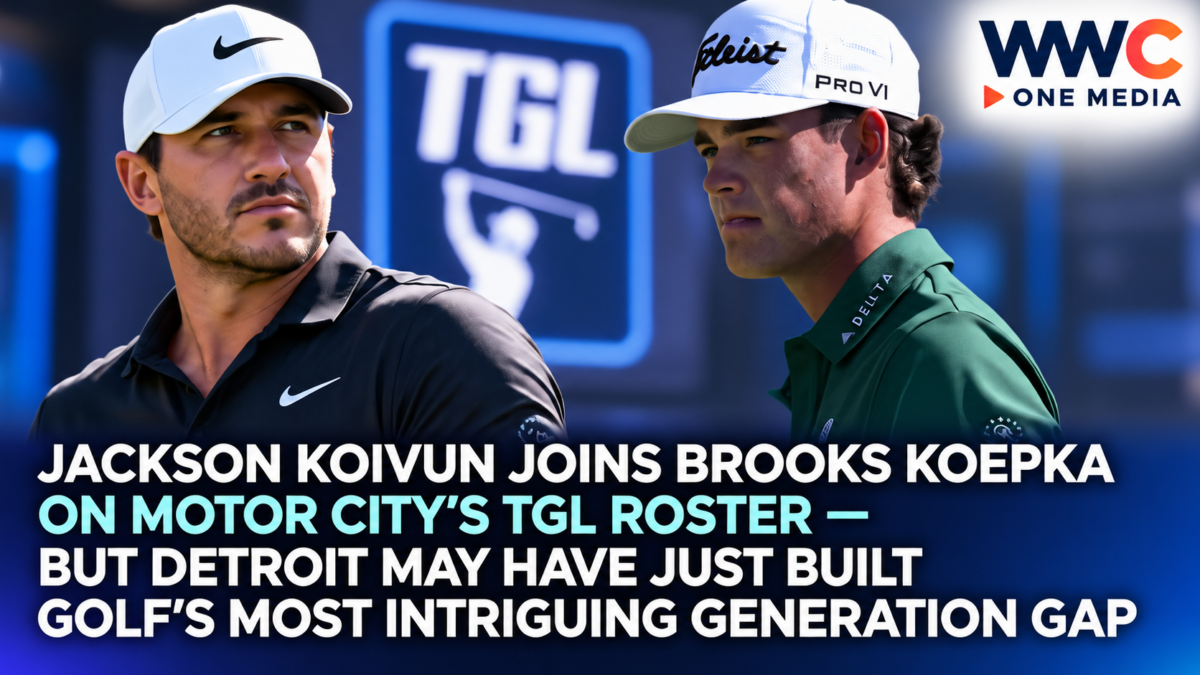
DETROIT — Motor City Golf Club has added 21-year-old PGA Tour winner Jackson Koivun to its inaugural TGL roster, pairing one of golf’s hottest young stars with five-time major champion Brooks Koepka as Detroit prepares to enter the technology-driven team league in 2027.
The move gives TGL’s newest franchise an immediate identity.
Koepka brings major-championship pedigree, experience and one of golf’s biggest names.
Koivun brings youth, momentum and a rapidly growing reputation as one of the sport’s next elite players.
Motor City Golf Club announced Koivun as its second confirmed player on October 5, after signing Koepka in August. The Detroit-based expansion team will begin competition during TGL’s 2027 season.
The rest of Motor City’s four-player roster has not yet been announced.
But with Koepka and Koivun already secured, Detroit may have created one of TGL’s most interesting combinations before its first match is even played.
Koivun’s rise has been remarkably fast
Koivun turned professional only in June 2026 after a record-setting career at Auburn University.
He did not need long to prove he belonged on the PGA Tour.
In only his third start as a professional, Koivun won the 3M Open, shooting 25-under par and defeating world No. 1 Scottie Scheffler by three shots.
The performance also set the tournament’s 72-hole scoring record.
The victory came only 35 days after Koivun completed his final round as an amateur at the U.S. Open.
At 21 years, two months and three days old, he became one of the youngest PGA Tour winners of the modern era.
That kind of immediate success is unusual even for highly rated college players.
It is one of the main reasons Motor City moved quickly to add him.
Then came an unbeaten Presidents Cup debut
Koivun’s rookie season became even more impressive at the Presidents Cup.
U.S. captain Brandt Snedeker selected Koivun as his final captain’s pick, a bold decision considering how little professional experience he had.
Koivun rewarded that confidence.
He finished the competition 2-0-1, helping the United States erase a Sunday deficit and beat the International team 17-13 at Medinah.
He also defeated Si Woo Kim 2 up in singles after trailing early in the match.
That performance strengthened the argument that Koivun is unusually comfortable in team golf.
And TGL is built around exactly that environment.
Team golf is already part of Koivun’s identity
Before becoming a professional, Koivun built much of his reputation in team competition.
At Auburn, he helped the Tigers win NCAA team championships in 2024 and 2026.
He was also part of the victorious U.S. team at the 2025 Walker Cup.
Koivun became the first player in college golf history to win all three major national player-of-the-year awards — the Haskins Award, Hogan Award and Nicklaus Award — more than once.
He finished his Auburn career with 11 individual victories and school records in multiple scoring categories.
That combination of individual success and team experience makes him unusually well suited to TGL’s format.
Koepka gives Motor City immediate star power
Koivun joins a player at the opposite end of the experience spectrum.
Brooks Koepka is a five-time major champion, former world No. 1 and nine-time PGA Tour winner.
His major résumé includes back-to-back U.S. Opens in 2017 and 2018 and PGA Championship victories in 2018, 2019 and 2023.
Koepka was Motor City’s first roster signing.
When TGL announced him in August, the league described him as the foundation of the expansion team.
The logic was obvious.
A new sports franchise needs a recognizable star.
Koepka gives Detroit one immediately.
Koivun now gives the team something different:
a player who could become one of the defining names of the next generation.
Motor City is betting on a veteran-and-prodigy formula
The pairing creates a compelling contrast.
Koepka is 36 and has spent more than a decade competing in the biggest events in professional golf.
Koivun is 21 and has been a professional for only a few months.
One has already built a Hall-of-Fame-level major résumé.
The other may only be beginning one.
That makes Motor City’s early roster construction unusually interesting.
Instead of building entirely around established stars or entirely around young players, Detroit is combining both.
If the chemistry works, the franchise could gain both competitive balance and marketing appeal.
Koivun says the TGL atmosphere attracted him
Koivun had already visited TGL’s SoFi Center before signing.
He described the arena setup as unlike anything he had experienced in golf and said the team environment appealed to him because some of his best memories in the sport came from competing alongside teammates.
That matters because TGL is deliberately different from traditional professional golf.
Matches are played indoors at SoFi Center in Palm Beach Gardens, Florida.
Players hit full shots into a giant simulator screen before moving to a rotating physical green for short-game play.
The format is faster, louder and more interactive than a normal PGA Tour tournament.
Teams represent cities rather than individual sponsors.
And matches are designed for prime-time television.
For a player such as Koivun, who grew up in a more digital and entertainment-driven sports environment, that format may feel more natural than it does for older professionals.
TGL itself is still expanding
Motor City Golf Club will become the seventh TGL team when it debuts in 2027.
It joins:
Atlanta Drive GC;
Boston Common Golf;
Jupiter Links Golf Club;
Los Angeles Golf Club;
New York Golf Club;
and The Bay Golf Club.
Atlanta won the inaugural SoFi Cup in 2025.
Los Angeles Golf Club followed by winning the 2026 championship.
Motor City is the league’s first expansion franchise.
That gives its roster construction broader significance.
The team will help determine whether TGL can successfully expand beyond its original six franchises.
Detroit ownership has major sports connections
Motor City’s ownership group is led by Middle West Partners.
Its investors include members of the Hamp family, who are closely connected to the NFL’s Detroit Lions.
TGL described the ownership group as deeply tied to Detroit and interested in building a franchise reflecting the city’s sports culture.
That local connection is important.
TGL teams do not play home matches in their respective cities.
All competition currently takes place at SoFi Center in Florida.
So teams must build geographic identity through branding, ownership, players and fan engagement rather than traditional home arenas.
Motor City’s challenge will be convincing Detroit sports fans to treat a golf team competing hundreds of miles away as one of their own.
Koivun could help solve that problem
Young stars can be particularly valuable for a new franchise.
Koivun has already generated significant attention because of his rapid PGA Tour success.
He entered professional golf as one of the most accomplished amateurs in the world.
Then he immediately won.
Then he delivered in the Presidents Cup.
That trajectory gives Motor City a player fans can potentially follow for years.
Koepka gives the team recognition today.
Koivun could give it continuity tomorrow.
That is a smart combination for an expansion team.
Koivun has already earned more than $2 million
Despite playing only a limited schedule since turning professional, Koivun has already made a significant financial impact on the PGA Tour.
PGA Tour records show he had earned more than $2.14 million during the 2026 season while making seven cuts in eight official starts.
He also recorded three top-10 finishes and one victory.
His performance statistics are also strong.
Koivun has averaged roughly 307 yards off the tee, hit around 74% of greens in regulation and posted a scoring average below 68 in his measured PGA Tour rounds.
Those numbers help explain why expectations have risen so quickly.
Koivun is not being marketed as a future prospect simply because he dominated college golf.
He has already shown he can compete against the best professionals.
His 3M Open victory changed everything
Before July, Koivun was one of several highly touted young players entering professional golf.
After the 3M Open, that changed.
Koivun did not simply win.
He beat Scheffler, the world No. 1, by three strokes.
He closed with a bogey-free 66.
And he broke the event’s scoring record.
For a player in only his third professional start, the performance immediately raised expectations.
It also showed why TGL wanted him.
The league benefits from players who can bring both elite performance and a compelling storyline.
Koivun provides both.
TGL needs younger stars
This is also strategically important for the league.
TGL was launched by Tiger Woods and Rory McIlroy’s TMRW Sports with a roster filled with established PGA Tour names.
That gave the competition immediate credibility.
But long-term growth requires younger players too.
Fans need reasons to keep watching as veteran stars age.
Players such as Koivun can connect TGL with the next generation of professional golf.
The league has already highlighted younger names including Ludvig Åberg and Min Woo Lee.
Koivun fits naturally into that strategy.
Koepka brings something different: major-championship credibility
TGL also cannot rely only on youth.
Koepka’s five majors give Motor City legitimacy.
He has repeatedly performed under the highest pressure in traditional golf.
That matters because one criticism of technology-driven or indoor golf formats is that they can feel disconnected from the sport’s biggest championships.
Koepka counters that immediately.
He has won U.S. Opens.
He has won PGA Championships.
He has been world No. 1.
His presence tells fans this is not simply exhibition golf.
Elite championship players are willing to compete.
Koepka also knows how to handle pressure
Motor City team governor Michael Hamp emphasized Koepka’s ability to perform when stakes are highest when the team announced him.
The same language is now being used around Koivun.
After the Presidents Cup, Hamp said Koivun showed he was “built for the big moments.”
That appears to be Motor City’s emerging identity.
Not simply famous players.
Players known for competing well under pressure.
Whether that translates inside SoFi Center remains to be seen.
But as an expansion-team philosophy, it is easy for fans to understand.
Two roster spots are still open
Motor City still needs to complete its four-player lineup.
That means the next two signings could dramatically shape the team.
The franchise could pursue more veteran stars.
It could add another young player.
Or it could select players specifically suited to TGL’s short-match format.
The current roster already gives Motor City considerable flexibility.
Koepka provides experience.
Koivun provides youth.
The remaining two players can be chosen around chemistry and format.
TGL golf rewards different skills
TGL does not reproduce traditional 72-hole tournament golf.
The compressed team format places greater importance on:
aggressive shotmaking;
match-play decision making;
communication;
short bursts of putting pressure;
and comfort performing in front of a noisy indoor crowd.
That may benefit Koivun.
He has already demonstrated success in match play and team competition.
His undefeated Presidents Cup debut is particularly relevant.
A player who performs well when every hole has immediate consequences can be extremely valuable in TGL.
Koivun may also benefit from Koepka
The relationship could work both ways.
Koepka has played in major championships, Ryder Cups, Presidents Cups and high-pressure professional events around the world.
Koivun is still learning what life looks like as a full-time touring professional.
Being around a player with Koepka’s experience could accelerate that transition.
At the same time, Koivun’s energy and recent success could help keep Motor City from becoming overly dependent on one established superstar.
That is often the challenge with expansion teams.
A recognizable veteran attracts attention.
A young player creates long-term upside.
Detroit now has both.
TGL is also competing for attention in a crowded golf market
The league’s growth cannot be separated from the broader battle for golf audiences.
Professional golf has spent years dealing with:
PGA Tour-LIV Golf tensions;
changing media habits;
declining attention spans;
streaming competition;
and efforts to attract younger fans.
TGL was created partly as a response.
Its matches are shorter.
Technology is visible.
Players wear microphones.
Teams create local identities.
And the league can fit into prime-time television windows more easily than a four-day traditional tournament.
Koivun’s signing reinforces that positioning.
He represents the type of player TGL wants fans to associate with its future.
Koepka’s presence is significant given his complicated golf history
Koepka’s participation also remains notable because of his previous connection with LIV Golf.
His career has been closely associated with golf’s period of division between the PGA Tour and Saudi-backed LIV.
TGL, by contrast, was developed through TMRW Sports in partnership with the PGA Tour.
Koepka joining Motor City therefore underscores how much professional golf’s competitive landscape continues to evolve.
For TGL, adding a player with his résumé expands the league’s reach beyond the original group of PGA Tour-aligned stars.
Motor City is trying to create instant credibility
Expansion franchises normally need years to establish identity.
Motor City is attempting to accelerate that process.
Koepka gives the team an internationally recognizable champion.
Koivun gives it one of professional golf’s hottest young names.
Detroit ownership gives it local sports credibility.
And TGL gives it a format designed to create quick fan attachment.
That does not guarantee success.
Chemistry matters.
Performance matters.
The final two roster spots matter.
And other TGL teams already have established cores and two seasons of experience.
Motor City will be starting from zero.
The 2027 season could become Koivun’s biggest visibility test yet
Koivun is already known among serious golf fans.
TGL could introduce him to a broader television audience.
The league places players in a much more personality-driven environment than normal PGA Tour broadcasts.
Fans hear conversations.
Players react immediately.
Matches move quickly.
Individual personalities become central to the show.
For a 21-year-old still establishing his professional identity, that exposure could be enormously valuable.
It could also bring new pressure.
Detroit may have found the ideal expansion-team storyline
The early Motor City roster almost writes its own narrative.
Brooks Koepka represents what Koivun may someday become: a multiple-major champion and global golf star.
Koivun represents what Koepka once was: a young player still discovering how high his ceiling can go.
Putting those two players together gives TGL a compelling generational story.
It also gives Detroit something every new sports franchise needs:
a reason for neutral fans to pay attention.
Motor City still has half of its roster left to build.
But the foundation is already unusually strong.
A five-time major winner.
A 21-year-old PGA Tour champion.
And a young player who just went undefeated in his Presidents Cup debut.
The biggest question now is no longer whether Detroit can attract star talent.
It is who Motor City adds next — and whether Koepka and Koivun can turn one of TGL’s newest teams into one of its first immediate contenders.