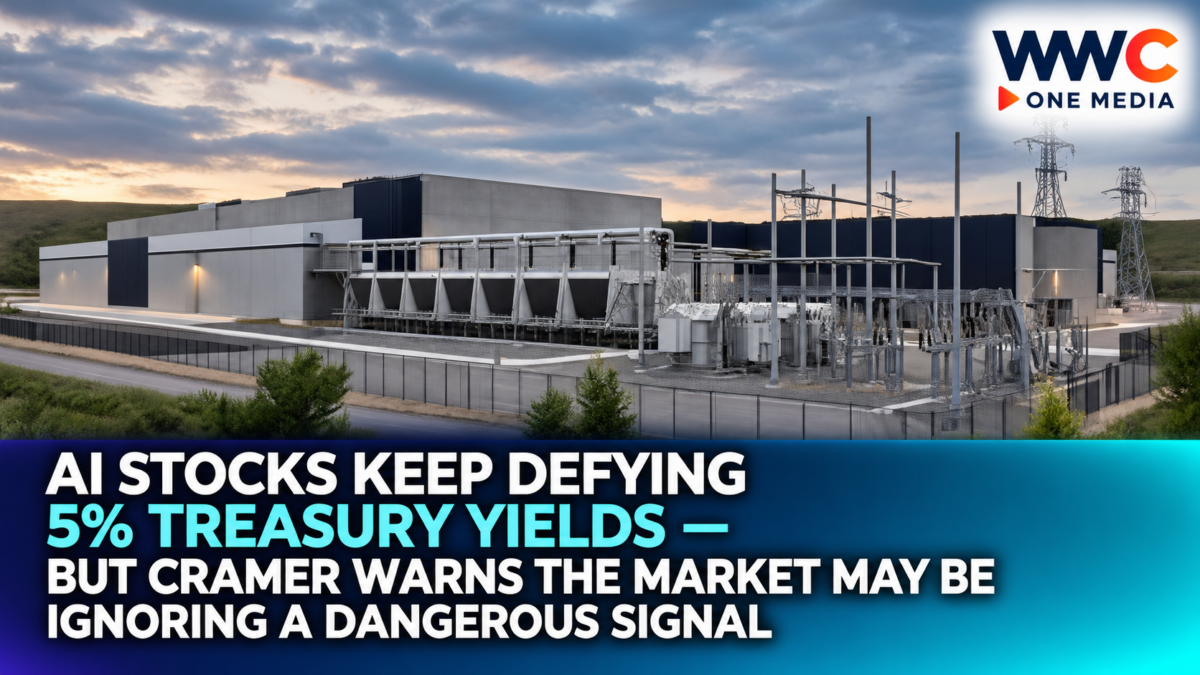
NEW YORK — Artificial-intelligence stocks are doing something Wall Street normally hates: rallying even as long-term U.S. Treasury yields hover above 5%, a level that historically puts serious pressure on expensive growth companies.
That disconnect is at the center of Jim Cramer’s latest market warning.
Cramer argues that investors have become so enthusiastic about artificial intelligence that they are increasingly willing to overlook one of the most important forces in financial markets:
the cost of money.
The benchmark 10-year U.S. Treasury yield was recently around 5.31%, while the 30-year yield has traded above 5.6%, levels not seen consistently in decades.
Yet the Nasdaq just closed at another record high.
Nvidia rose 2.1%.
Microsoft, Meta Platforms and other megacap technology names also gained.
The Nasdaq advanced about 1%, while the S&P 500 climbed 0.7%.
That is the contradiction.
Bond yields are screaming caution.
AI stocks are screaming growth.
Why 5% Treasury yields normally hurt technology stocks
The relationship between interest rates and growth stocks is fundamental.
A large part of a high-growth technology company’s valuation comes from earnings investors expect it to generate years into the future.
When interest rates rise, those future profits become less valuable in today’s dollars.
At the same time, investors can earn more from relatively safe government bonds.
If a Treasury bond yields 5% or more, investors do not need to take as much equity risk to earn a meaningful return.
That normally makes richly valued technology stocks less attractive.
It also raises borrowing costs for companies financing enormous capital projects.
That is why the current market behavior is so unusual.
Investors are effectively saying:
AI growth is powerful enough to justify owning expensive stocks even when the risk-free alternative pays more than 5%.
Cramer’s argument is that investors may be underestimating the danger
Cramer’s warning is not that AI is fake.
It is that enthusiasm can make investors temporarily ignore traditional valuation discipline.
The AI trade has become so dominant that stocks tied to the theme are often rewarded despite conditions that would normally pressure them.
That includes:
high Treasury yields;
expensive valuations;
large capital spending requirements;
and growing questions about returns on AI investment.
The issue is not whether companies such as Nvidia, Microsoft or Meta are strong businesses.
They clearly are.
The issue is whether their share prices already assume too much future success.
Nvidia has become the clearest example
Nvidia reached a market capitalization of roughly $5.76 trillion after Monday’s rally.
Its extraordinary rise reflects explosive demand for GPUs used in AI training and inference.
Cloud companies, AI laboratories, governments and corporations continue ordering enormous quantities of accelerated computing equipment.
But Nvidia’s valuation also means expectations are enormous.
The company must continue delivering rapid revenue and profit growth simply to justify the price investors are already paying.
If AI infrastructure spending slows even modestly, the stock could react sharply because so much future growth is already embedded in the valuation.
That is one reason Treasury yields matter.
At 5.3%, investors have a much more attractive alternative than they did when yields were near zero.
AI is actually helping push yields higher
There is another irony.
The AI boom itself may be contributing to the bond-market problem.
Bank of Japan Deputy Governor Shinichi Uchida said this week that massive AI investment is boosting demand, capital spending and economic activity, potentially lifting the economy’s natural interest rate.
He also noted that heavy borrowing by AI-related companies can put upward pressure on long-term yields.
In other words:
AI is helping stocks rise.
But AI investment may also be helping interest rates stay high.
That creates a built-in tension.
The stronger the investment boom becomes, the more financing is required.
And the more financing required, the more upward pressure may emerge in credit and bond markets.
Data centers are becoming a capital-intensive arms race
The scale of AI infrastructure spending is difficult to overstate.
Companies are building:
data centers;
power plants;
transmission systems;
semiconductor fabs;
networking systems;
and specialized cooling infrastructure.
Singapore-based DayOne Data Centers filed for a U.S. IPO after reporting first-half revenue of $512 million, up dramatically from $151.5 million a year earlier.
But its net loss also widened to $77.2 million.
That encapsulates the broader AI infrastructure story.
Revenue is exploding.
So are costs.
The question eventually becomes whether returns justify the capital deployed.
Power is already becoming a constraint
Morgan Stanley says power shortages are beginning to disrupt parts of the AI hardware supply chain.
Nvidia and Broadcom appear relatively insulated, but delays in data-center energization could affect suppliers of:
memory;
optical components;
and other supporting technologies.
That matters because AI growth is no longer limited by chips alone.
Companies increasingly need:
electricity;
grid connections;
transformers;
land;
water;
and transmission capacity.
If projects are delayed because they cannot secure power, revenue expectations for the companies supplying those projects may need to be revised.
That is exactly the kind of real-world constraint that could suddenly matter more than AI enthusiasm.
Bond investors are already asking tougher questions
The bond market has been signaling concern for weeks.
Government borrowing costs in the U.S., Germany and Japan have reached multi-decade highs amid worries over:
inflation;
large fiscal deficits;
heavy government borrowing;
and continued capital demand from AI investment.
The U.S. 10-year yield has moved above the 5% level that once was considered a psychological danger zone.
Now investors are debating whether 6% could become the new pain threshold.
That would materially change the valuation equation for equities.
A move toward 6% would increase mortgage rates.
Raise corporate borrowing costs.
Put pressure on leveraged businesses.
And make Treasury securities even more competitive with stocks.
Yet investors are still pouring money into equities
Despite those concerns, U.S. equity funds recorded a second consecutive week of inflows through September 30.
Reuters reported that continued AI optimism helped offset fears about rising yields.
That shows how powerful the AI narrative remains.
Investors are not merely tolerating high interest rates.
They are actively adding money to stocks despite them.
That is a major vote of confidence.
It is also precisely what worries skeptics.
Markets are often most vulnerable when investors collectively decide that an old rule no longer matters.
Wall Street is even talking about S&P 10,000
Investor optimism has become strong enough that strategists are openly discussing an S&P 500 at 10,000.
Reuters noted that some analysts now believe the milestone could be reached before the end of the decade, or even earlier under particularly bullish assumptions.
The argument rests heavily on:
AI productivity;
exceptional corporate profit growth;
large fiscal spending;
and sustained investor confidence.
But even bullish strategists acknowledge the risks.
If bond yields continue rising, expensive stocks become harder to justify.
And if AI earnings fail to meet expectations, today’s market leaders could fall quickly.
Corporate profits are doing a lot of the heavy lifting
One reason stocks have resisted higher yields is that earnings have remained unusually strong.
Reuters noted that U.S. corporate profits surged more than 50% in the second quarter, while analysts expect another increase of more than 35% in Q3.
Strong profits can offset high valuation pressure.
If a company is growing earnings rapidly enough, investors may still accept a premium stock multiple even when bond yields are high.
That is the current bull case.
The problem is that extraordinarily strong earnings expectations create an extraordinarily high bar.
A company may beat estimates and still fall if investors expected an even bigger beat.
AI stocks now have to prove the spending is working
The market is increasingly moving from the “AI adoption” phase to the “AI return on investment” phase.
Investors want evidence that hundreds of billions of dollars in capital spending are producing:
new revenue;
higher margins;
lower labor costs;
greater productivity;
or defensible competitive advantages.
That means earnings reports are becoming more important.
It is no longer enough for a CEO to say the company is investing in AI.
The market increasingly wants to know what those investments are earning.
If companies can answer that convincingly, current valuations may remain supportable.
If they cannot, high Treasury yields become much more dangerous.
The weak jobs report temporarily helped tech
The market did receive one important piece of relief.
September U.S. payroll growth came in much weaker than expected.
That dramatically reduced expectations of another Federal Reserve rate hike in October.
Reuters said market-implied odds of a hike fell from roughly 70% to around 24%.
That gave technology stocks another boost.
Lower odds of additional tightening reduce the threat that short-term rates rise further.
But the long end of the Treasury market remains stubbornly high.
That is an important distinction.
The Fed can control overnight interest rates directly.
It has much less control over long-term yields determined by inflation expectations, fiscal deficits and investor demand.
Washington’s debt problem is feeding the bond selloff
The U.S. government now carries more than $40 trillion in debt, according to Reuters.
Annual interest costs are approximately $1 trillion, consuming around one-fifth of federal tax revenue.
That is one reason long-term bond yields remain elevated.
Investors demand higher returns when governments issue enormous amounts of debt.
If Washington continues borrowing heavily, yields may stay high even if the Federal Reserve stops raising rates.
That creates a structural challenge for growth stocks.
The rate pressure may not disappear simply because monetary policy pauses.
AI spending itself could keep financial conditions tighter
This creates one of the strangest macroeconomic loops of the current market cycle.
AI investment boosts productivity expectations.
That pushes stocks higher.
The investment also increases corporate borrowing and capital demand.
That can push bond yields higher.
Higher yields should hurt growth stocks.
But stronger AI optimism keeps supporting those same stocks.
Eventually, one force has to dominate.
So far, AI has won.
Cramer’s warning is essentially that investors should not assume it always will.
The Nasdaq record hides the valuation risk
The Nasdaq’s record close sends a powerful message.
Investors remain willing to pay for growth.
But a record index level does not mean the underlying risk has disappeared.
Treasury yields remain near multiyear highs.
Oil is still expensive.
The global bond market remains volatile.
European fiscal concerns are growing.
And geopolitical tensions remain elevated.
The market is overcoming all of these concerns because investors expect corporate earnings and AI growth to remain exceptional.
That makes earnings disappointment arguably more dangerous than before.
Even central bankers are warning about an AI correction
The Bank of Japan’s Uchida explicitly warned that financial markets could correct if expected AI profits fail to materialize.
That is a significant point.
Central bankers normally focus on inflation, employment and monetary policy.
The fact that AI valuation risk is now appearing in central-bank commentary shows how large the investment boom has become.
AI is no longer simply a technology-sector story.
It is affecting:
capital spending;
interest rates;
electricity demand;
credit markets;
and global financial conditions.
That makes any correction potentially broader than a traditional tech selloff.
Cramer is not saying investors should abandon AI
The important nuance is that Cramer remains broadly constructive on many AI-related companies.
His concern is about ignoring macroeconomic risk.
A strong company can still become an expensive stock.
A revolutionary technology can still produce a bubble.
And a long-term winner can still suffer a deep short-term correction.
The same was true during the internet boom.
The internet transformed the world.
Many internet stocks still collapsed.
The technology being real did not make every valuation rational.
That is the lesson investors are increasingly being forced to consider with AI.
The key level may no longer be 5%
For years, investors treated a 5% 10-year Treasury yield as potentially catastrophic for equities.
The market has now absorbed that level surprisingly well.
Reuters notes investors are increasingly debating whether 6% is the new 5% — the level that could finally cause much greater financial stress.
That psychological shift matters.
Markets adapt.
What once looked shocking becomes normal.
But normalization does not remove the economic effects.
Companies still pay more to borrow.
Homebuyers still face higher mortgage rates.
Governments still pay more interest.
And equity valuations still face a higher discount rate.
The pain may simply take longer to appear.
The next earnings season could settle the argument
The coming Q3 earnings reports may become the clearest test of whether AI stocks deserve to keep ignoring yields.
Investors will want answers to several questions:
Are AI revenues growing fast enough?
Are cloud companies monetizing their investment?
Are data-center utilization rates strong?
Are margins improving?
Are companies borrowing more heavily to maintain spending?
And are customers actually willing to pay enough for AI products to justify the infrastructure being built?
Strong answers could keep the rally alive.
Weak answers could force investors to look again at a 5.3% Treasury yield and ask why they are paying extreme multiples for future earnings.
The market is effectively making one enormous bet
The current market structure rests on a simple proposition:
AI-driven growth will be strong enough to overcome historically expensive money.
So far, that bet is working.
The Nasdaq is at a record.
Nvidia is worth nearly $5.8 trillion.
Equity funds are attracting money.
And Wall Street strategists are discussing an S&P 500 at 10,000.
But the bond market is sending a very different message.
Long-term yields remain near levels not seen consistently in decades.
Government debt continues expanding.
And borrowing costs are becoming increasingly painful across the economy.
Cramer’s warning is therefore not that AI stocks must collapse because yields are high.
It is that investors may be acting as though high yields no longer matter at all.
And if that assumption proves wrong, the same AI stocks lifting Wall Street to records could become the ones that pull it down fastest.