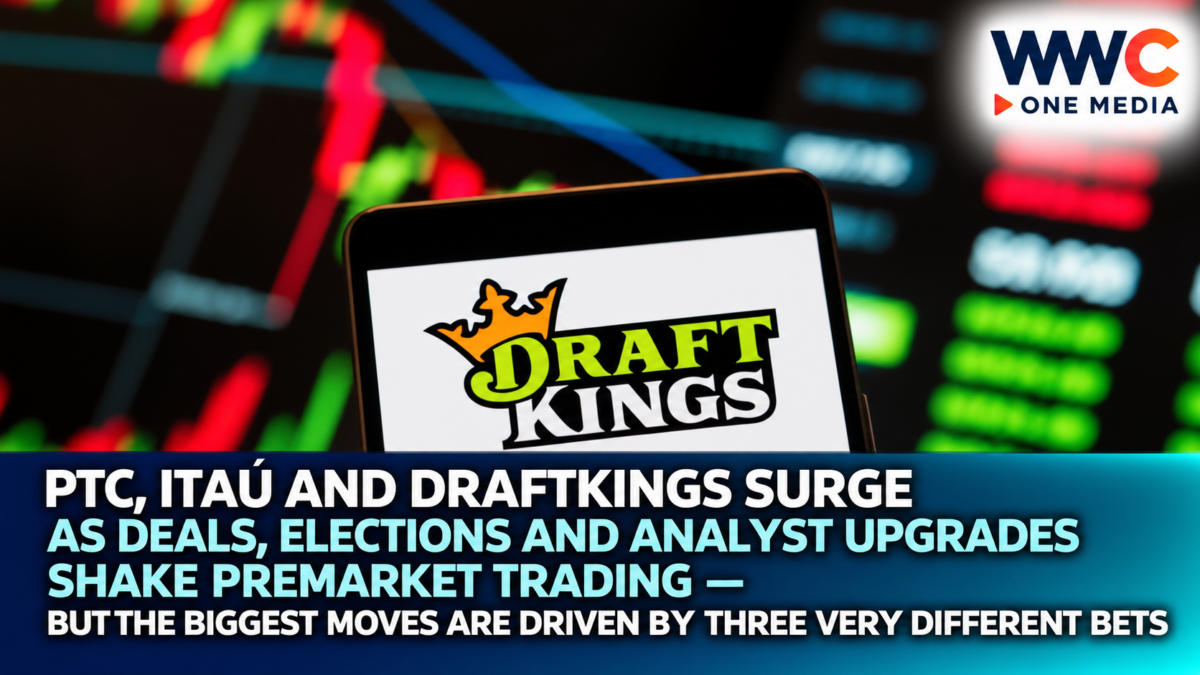
NEW YORK — Wall Street opened the week with some of the biggest premarket moves coming from three completely different corners of the market: industrial software, Brazilian banking and online gambling.
PTC exploded higher after Schneider Electric agreed to buy the software company for roughly $22.6 billion.
Brazilian financial stocks, including Itaú Unibanco, surged after right-wing presidential candidate Flávio Bolsonaro unexpectedly led Brazil’s first-round election.
And DraftKings jumped after Bank of America upgraded the online betting company to Buy following a brutal share-price decline.
The common thread was not one economic story.
It was repricing.
Investors were suddenly forced to recalculate what each company might be worth after receiving new information they had not fully expected.
PTC jumps more than 30% after Schneider Electric’s $22.6 billion takeover
The biggest high-profile premarket move came from PTC, the Boston-based industrial software company.
Shares jumped more than 30% before the opening bell after French industrial giant Schneider Electric agreed to acquire PTC in an all-cash transaction.
Schneider will pay $205 per PTC share, valuing the company’s equity at approximately $22.6 billion and the enterprise at about $23.7 billion. The price represents a premium of roughly 42% to PTC’s previous closing price.
The deal is expected to close in the third quarter of 2027, subject to shareholder and regulatory approvals.
PTC sells software used by manufacturers to design products, manage engineering data and operate industrial systems.
Its products include Creo, Windchill and ThingWorx.
For Schneider, the attraction is straightforward.
The French company has become one of the largest beneficiaries of global spending on electrification, data centers and automation.
Buying PTC gives it a much larger position in industrial software.
Schneider wants to connect hardware and software
Schneider’s strategy is to combine its electrical equipment, automation systems and industrial infrastructure with PTC’s software.
That would allow the company to offer more integrated systems spanning:
product design;
factory operations;
digital twins;
industrial data;
automation;
and AI-enabled manufacturing.
Schneider expects the transaction to generate around $730 million in annual revenue and cost benefits over time.
The logic fits a broader industrial trend.
Manufacturing companies increasingly want hardware and software to work as one system.
Factories are becoming more automated.
Machine data is becoming more valuable.
Artificial intelligence is being integrated into product design and manufacturing.
Schneider is betting PTC can give it a much stronger software layer across that ecosystem.
But Schneider shareholders hated the price
What looked like great news for PTC shareholders looked much less attractive to Schneider investors.
Schneider Electric shares fell roughly 10% in Paris, erasing around $18 billion in market value.
That reaction shows investors are worried Schneider may have paid too much.
The 42% takeover premium is substantial.
The deal also requires new debt and capital.
And much of the expected value depends on future revenue synergies rather than immediate cost savings.
Reuters Breakingviews estimated the projected returns could remain close to Schneider’s cost of capital, raising questions about whether the acquisition creates enough economic value to justify its price.
So while PTC shareholders received an immediate windfall, Schneider shareholders were being asked to wait years for the strategy to prove itself.
PTC also highlights how AI is reshaping software valuations
The deal comes at an unusual moment for software companies.
Traditional software stocks have faced investor concern that generative AI could disrupt established applications.
At the same time, industrial software is increasingly viewed as strategically valuable because AI systems need structured engineering and manufacturing data.
PTC sits directly inside that tension.
Its software stores highly specialized product and factory information that cannot easily be replaced by a generic AI chatbot.
That may partly explain why Schneider was willing to pay such a large premium.
The acquisition could also fuel speculation that other industrial-software companies become takeover targets.
Autodesk and Procore traded higher after the deal, according to market coverage.
Itaú jumps as Brazil’s election shocks investors
Another major group of premarket movers came from Brazil.
U.S.-listed shares of Itaú Unibanco and other Brazilian companies surged after right-wing Senator Flávio Bolsonaro unexpectedly finished ahead of President Luiz Inácio Lula da Silva in the first round of Brazil’s presidential election.
Bolsonaro received roughly 47% of the vote, compared with about 45% for Lula.
The two will now face each other in an October 25 runoff.
The result surprised investors.
Brazilian markets had not fully priced in such a strong Bolsonaro performance.
That triggered an immediate rally in banks, retailers and other companies exposed to the domestic economy.
Why banks such as Itaú rallied
Investors believe a Bolsonaro victory could produce a more market-friendly fiscal agenda.
He has campaigned on themes including:
tighter government spending;
greater fiscal discipline;
smaller government;
and lower taxes.
Markets are betting that better fiscal control could eventually reduce inflation and allow Brazil’s central bank to cut interest rates more aggressively.
Lower rates can be especially helpful for banks.
They can stimulate borrowing.
Improve credit demand.
Reduce stress on consumers.
And support economic growth.
Itaú, Banco do Brasil, Bradesco and Santander Brasil all rallied strongly as investors repositioned for that possibility.
Brazil’s entire market exploded higher
The reaction went far beyond Itaú.
Brazil’s Ibovespa jumped 7.7% to a record 206,911.89, its biggest one-day gain since 2020.
The Brazilian real strengthened by more than 4%.
The iShares MSCI Brazil ETF jumped roughly 12%.
XP Inc. surged more than 30%.
Nu Holdings also jumped sharply.
J.P. Morgan upgraded Brazilian equities to Overweight after the election result, citing the more favorable political and fiscal backdrop.
That makes Brazil one of the biggest global market stories of the week.
But Brazilian investors may be getting ahead of themselves
The rally assumes Bolsonaro can win the runoff.
That has not happened yet.
Lula still received more than 45% of the first-round vote.
The difference between the candidates was narrow.
And the runoff could change once voters supporting defeated candidates choose between the final two.
Even if Bolsonaro wins, he would still need to turn campaign promises into legislation.
That means the rally is largely based on expectations.
Not completed reforms.
Brazilian stocks could therefore remain extremely volatile until October 25.
DraftKings rallies after Bank of America upgrades the stock
The third major story came from DraftKings.
Shares jumped around 6% to 7% after Bank of America upgraded the stock from Neutral to Buy, while keeping a $27 price target.
The upgrade came after a brutal period for investors.
DraftKings shares had fallen roughly 47% over the previous year, leaving the stock much cheaper than it had been during earlier optimism about the U.S. online betting market.
Bank of America analyst Shaun Kelley argued that the risk-reward had improved enough to justify turning bullish.
Prediction markets are part of the new DraftKings bull case
The most interesting part of Bank of America’s upgrade was its view of prediction markets.
The bank estimates DraftKings could generate roughly $400 million in prediction-market fees by 2027, plus another $200 million to $400 million from market-making operations.
That creates an entirely new potential growth engine.
DraftKings built its business around:
sports betting;
online casino gaming;
fantasy sports;
and related gambling products.
Prediction markets could expand its addressable market beyond traditional sportsbook customers.
Users can trade contracts based on outcomes involving:
politics;
economic indicators;
entertainment;
sports;
and other events.
If DraftKings successfully enters that market at scale, it could reduce the company’s dependence on sportsbook margins alone.
But prediction markets also create regulatory risk
That opportunity comes with a major caveat.
Prediction markets remain politically and legally controversial.
Federal regulators and state gambling authorities continue debating whether many event contracts should be treated as derivatives, gambling products or something in between.
That creates uncertainty.
DraftKings could spend heavily building the business only to face regulatory restrictions.
Bank of America argues that the current stock price already reflects much of that risk.
That is why the brokerage sees the recent selloff as an opportunity rather than a warning.
DraftKings still faces a difficult core business environment
The company is also dealing with challenges unrelated to prediction markets.
Sports betting can produce volatile quarterly results because operator margins depend partly on game outcomes.
When heavily favored teams win and popular bets hit, sportsbooks can have unusually bad weeks.
Customer-acquisition spending can also remain expensive.
Competition is fierce.
FanDuel remains a major rival.
And investors increasingly want DraftKings to demonstrate durable profitability rather than simply expand betting volume.
Those concerns helped push the stock down before Monday’s upgrade.
Bank of America sees estimates nearing a bottom
One reason the firm became more constructive is that analyst earnings forecasts may finally have stopped falling.
Bank of America said Wall Street expectations appear closer to a bottom after a period of repeated estimate cuts.
That is important.
Stocks often begin recovering before earnings actually improve.
What matters is whether expectations stop getting worse.
If DraftKings can show that earnings estimates are stabilizing while new revenue sources emerge, investors may become willing to pay a higher valuation again.
The $27 target represents substantial upside from the stock’s recent levels.
Vaxcyte became another huge mover
Outside the three names highlighted in CNBC’s headline, Vaxcyte produced one of the most dramatic moves in the entire market.
Shares surged after the biotechnology company reported strong late-stage results for VAX-31, its experimental pneumococcal vaccine.
The vaccine targets 31 bacterial strains associated with diseases including:
pneumonia;
meningitis;
and bloodstream infections.
VAX-31 produced immune responses that were comparable or superior to Pfizer’s Prevnar 20 and Merck’s Capvaxive across most shared strains.
That sent Vaxcyte shares sharply higher while Pfizer and Merck traded lower.
Vaxcyte may be attacking a multibillion-dollar market
Analysts estimate the adult pneumococcal vaccine market could eventually reach roughly $3 billion to $6 billion or more.
Vaxcyte’s advantage is breadth.
Its vaccine targets more strains than current competing products.
The company expects additional late-stage trial data in 2027 and is targeting a U.S. marketing application in the first half of 2028.
That makes Vaxcyte one of the day’s clearest examples of how a single clinical trial can completely change a biotech company’s valuation.
Pfizer and Merck moved in the opposite direction
The Vaxcyte results created immediate pressure on incumbent vaccine leaders.
Pfizer fell roughly 1.6%.
Merck dropped about 3%.
That is the opposite side of every breakthrough biotech rally.
If one company introduces a potentially superior product, somebody else’s existing franchise may lose value.
Investors are already attempting to estimate whether VAX-31 could eventually take market share from Prevnar and Capvaxive.
Commercial launch is still years away.
But markets price future competition long before it arrives.
Harley-Davidson also benefited from an analyst call
Harley-Davidson was another notable winner.
Shares climbed after Citi upgraded the motorcycle maker, citing improving demand, product launches and cost reductions.
The stock ultimately rose close to 10% during Monday trading.
That shows how powerful analyst upgrades can become when a stock has already suffered through low expectations.
If investors are deeply bearish, even modest evidence of stabilization can produce an outsized rally.
DraftKings showed the same effect.
Intel moved lower as its competitive picture became more complicated
Not every technology stock participated.
Intel fell after reports that Taiwan Semiconductor Manufacturing Co. was in discussions related to Elon Musk’s Terafab project in Texas.
Investors interpreted the development as another sign that TSMC could strengthen its U.S. manufacturing role at a time when Intel is trying to rebuild its foundry business.
Intel remains one of 2026’s largest turnaround winners.
But competition for advanced semiconductor manufacturing is becoming increasingly intense.
Every major customer decision matters.
Why Monday’s movers matter beyond one trading session
PTC, Itaú and DraftKings could hardly be more different.
One makes industrial software.
One is Brazil’s biggest private bank.
One operates online gambling and betting platforms.
Yet each illustrates the same market principle.
Stocks move when expectations change faster than prices can adjust.
PTC investors woke up owning a company suddenly worth $205 per share to an acquirer.
Brazilian investors woke up facing a presidential election outcome that looked very different from what polls had suggested.
DraftKings investors woke up to a major Wall Street bank arguing that the stock’s 47% collapse had finally gone too far.
Those are the kinds of surprises that produce dramatic premarket moves.
The takeover trade is the most concrete
Among the three, PTC’s catalyst is the simplest.
There is an agreed takeover price.
If the transaction closes as planned, shareholders receive cash.
The biggest risks are regulatory approval, shareholder approval and deal completion.
That means PTC’s price should increasingly trade around the probability that Schneider’s offer closes.
It is no longer primarily trading on quarterly earnings expectations.
Brazil remains the most politically sensitive
Itaú’s rally is much less certain.
The entire thesis depends partly on the presidential runoff.
Markets may continue rising if Bolsonaro strengthens his lead.
They could reverse if Lula regains momentum.
Even after Election Day, economic policy will determine whether investors were right.
That makes Brazilian stocks potentially much more volatile than PTC.
DraftKings is the most speculative fundamental bet
DraftKings sits somewhere in between.
There is no election that determines its value.
There is no signed buyout agreement.
Instead, investors must decide whether Bank of America’s thesis is right.
Can prediction markets become a large new revenue source?
Can sportsbook margins improve?
Can earnings estimates stabilize?
And has the stock already fallen enough?
That makes the DraftKings rally fundamentally different from PTC’s.
It is based on a new opinion about future value—not a transaction fixing that value.
Premarket rallies also come with a warning
Large premarket moves can be dramatic.
They are not always durable.
Low trading volume before the opening bell can exaggerate price changes.
Once the full market opens, institutional investors may take profits or reassess the news.
Some stocks continue higher.
Others give back much of the initial move.
That is why investors should focus less on the percentage move itself and more on what actually caused it.
Monday delivered three very different reasons to buy
PTC surged because another company agreed to buy it.
Itaú jumped because investors suddenly saw a higher probability of political and fiscal change in Brazil.
DraftKings rallied because Wall Street decided its selloff had created an attractive risk-reward opportunity.
Vaxcyte soared because a clinical trial changed expectations for a multibillion-dollar vaccine market.
And each move carried a different level of certainty.
That is the real lesson from Monday’s premarket trading.
The percentage gain tells you how excited investors are.
The catalyst tells you whether that excitement has a chance of lasting.