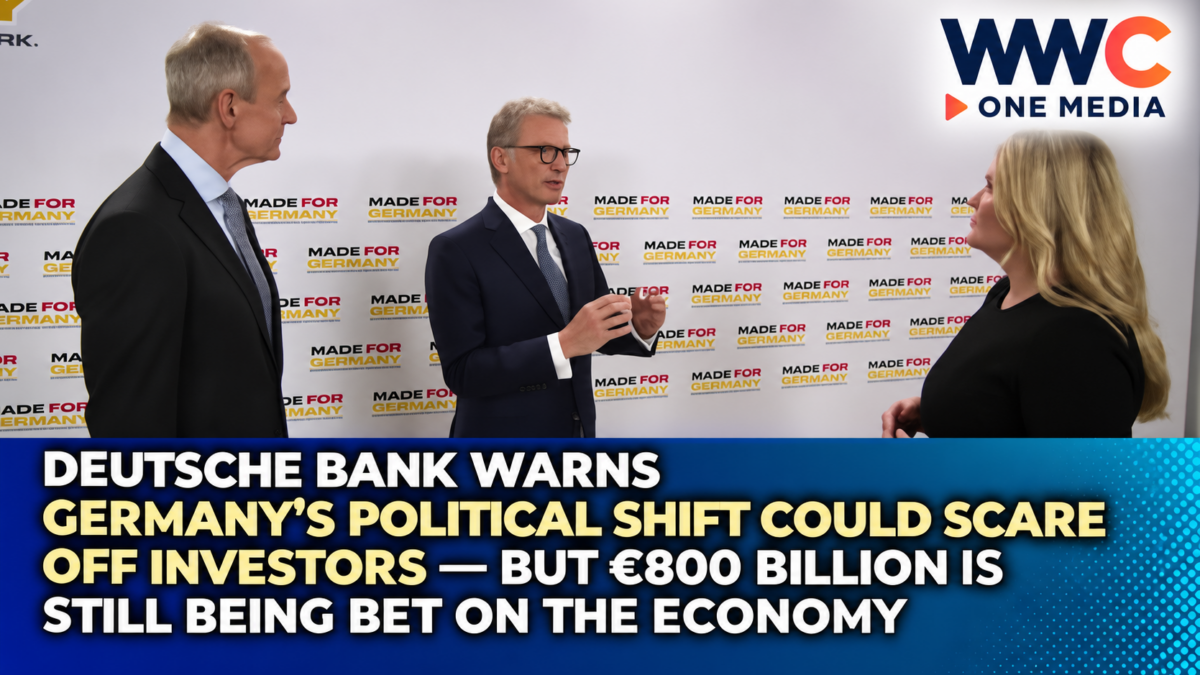
FRANKFURT — Germany may be attracting hundreds of billions of euros in corporate investment, but Deutsche Bank CEO Christian Sewing says the country’s latest election results risk undermining one of its most valuable assets: political stability.
Sewing warned that the recent rise of both the far-right Alternative for Germany, or AfD, and the far-left Die Linke could make international investors more cautious about committing capital to Europe’s largest economy. Speaking alongside Siemens CEO Roland Busch, Sewing said the latest election results were “not positive for Germany” and argued that investors want political stability, rule of law and a country firmly anchored in the European Union.
The warning comes after a remarkable series of state-election results.
The AfD scored a historic victory in Saxony-Anhalt, taking nearly 44% of the vote and becoming the largest party in the state parliament. The party later finished first again in Mecklenburg-Western Pomerania, while Die Linke won Berlin with roughly a quarter of the vote.
For German business leaders, the concern is not simply ideological.
It is financial.
If investors begin to doubt Germany’s commitment to the European Union, fiscal stability or market-oriented economic reform, companies could become less willing to build factories, headquarters and research facilities there.
And that is exactly what Sewing says Germany cannot afford.
Deutsche Bank Says Investors Want Stability
Sewing’s warning is particularly significant because Deutsche Bank sits at the center of German and European capital markets.
International investors often evaluate Germany as a relatively safe place to put money because of its legal system, institutional stability, industrial base and central position within the EU.
Sewing said that advantage becomes weaker if political parties hostile to European integration continue gaining ground.
His concern is especially directed at the AfD, which has advocated significantly tighter immigration rules and has questioned Germany’s current European and foreign-policy direction.
Reuters has reported that the AfD also favors restoring closer energy ties with Russia and has challenged Germany’s support for Ukraine.
For multinational corporations, those positions introduce uncertainty.
Businesses making 10-, 20- or 30-year investments care enormously about whether Germany remains integrated into the EU single market, maintains predictable trade rules and stays aligned with Western institutions.
That is why political fragmentation can quickly become an investment issue.
The AfD’s Rise Is No Longer a Fringe Story
The political shift has happened quickly.
In Saxony-Anhalt, the AfD won nearly 44% of the vote in September, falling short of an outright majority but delivering one of the strongest performances by a far-right party in postwar German history.
In Mecklenburg-Western Pomerania, the AfD again finished first, while Chancellor Friedrich Merz’s Christian Democrats suffered a disastrous result and failed to enter the state parliament.
The AfD has transformed itself in just over a decade from a fringe eurosceptic movement into one of Germany’s most powerful political forces. Reuters noted that the party had risen to the top of national polling even as the traditional parties continue refusing coalition agreements with it.
That “firewall” has kept the AfD out of many governments.
But each new victory makes the arrangement harder to sustain politically.
Berlin Sent a Warning From the Opposite Direction
Germany’s political shift is not occurring only on the right.
In Berlin, Die Linke won the September 20 election with around 25% of the vote, overtaking the Christian Democrats and campaigning heavily on housing affordability and public ownership.
Its lead candidate, Elif Eralp, backed plans to bring housing owned by large corporate landlords into public ownership.
A 2021 referendum had shown majority support for some form of socialization, but more recent polling indicated substantially less enthusiasm for an expensive large-scale expropriation program.
The Kiel Institute for the World Economy has also warned that expropriating more than 200,000 privately owned housing units would do little to increase actual housing supply.
That matters to investors because large real-estate owners may become more cautious about putting money into Berlin if they believe assets could face greater political intervention.
So from Sewing’s perspective, Germany is being pulled simultaneously by forces on both the left and right that challenge the centrist economic consensus investors have traditionally relied on.
Merz Is Under Growing Pressure
The election results have placed Chancellor Friedrich Merz in a difficult position.
Reuters reported that his approval rating had fallen to roughly 11%, while dissatisfaction inside his own Christian Democratic Union has intensified.
The CDU’s poor performance in Mecklenburg-Western Pomerania was especially damaging.
Merz came to office promising faster growth, lower bureaucracy and major structural reforms.
But voters remain frustrated over living costs, industrial weakness, immigration and what many perceive as slow implementation.
That creates a political trap.
The more Merz struggles to pass reforms, the more voters turn toward protest parties.
And the stronger those protest parties become, the harder major reforms can become politically.
German President Issues a Much Darker Warning
The concerns intensified further on October 3.
German President Frank-Walter Steinmeier warned that Germany risks political divisions reminiscent of the Weimar era if extremist rhetoric, disinformation and rejection of democratic norms continue spreading.
Steinmeier said roughly one-third of voters are now backing forces that reject important elements of Germany’s democratic consensus, while also warning about misinformation linked to foreign actors and domestic extremist networks.
The comparison to Weimar Germany is politically explosive because of what followed that era.
Steinmeier was not saying modern Germany is about to repeat history.
But his speech underscored how seriously parts of the German establishment now view the erosion of centrist politics.
Yet Germany Is Still Attracting Huge Investment
That is what makes the story more complicated.
Political risk is rising.
But corporate investment has not collapsed.
The Made for Germany initiative, backed by major companies including Deutsche Bank and Siemens, says its members have committed more than €800 billion in investment through 2028.
The initiative began in 2025 with 61 companies pledging about €631 billion.
By July 2026, membership had increased to 139 companies and the total pledged investment had risen above €800 billion.
The program is designed to restore confidence in Germany as an investment destination after years of weak growth, high energy costs and concern over industrial competitiveness.
Both Sewing and Siemens CEO Roland Busch are among the initiative’s most prominent corporate supporters.
But Not All €800 Billion Is New Money
The headline figure requires an important caveat.
Reuters noted that it is not clear how much of the €800 billion represents investment plans that companies would have made anyway and how much represents genuinely new spending triggered by the initiative.
That means investors should not read the number as €800 billion of entirely fresh capital suddenly flowing into Germany.
Still, the scale matters.
Large companies are publicly signaling that they remain willing to invest heavily in Europe’s biggest industrial economy—provided the political and regulatory environment remains competitive.
That is exactly why Sewing believes instability could be so damaging.
Germany has capital ready to be deployed.
The question is whether politics makes that capital stay.
Merz Says Germany Is Becoming a Better Investment Destination
Merz struck a much more optimistic tone at the annual Made for Germany meeting on September 30.
He said corporate investment commitments had climbed from roughly €600 billion to more than €800 billion and argued that Germany is improving the conditions needed to attract both domestic and international capital.
He pointed to reforms aimed at limiting labor costs, improving social-insurance sustainability and strengthening the country’s competitiveness.
Merz also cited Deutsche Bank research suggesting international investors increasingly see Europe—and Germany in particular—as an attractive alternative to other global markets.
That creates a striking contrast.
On the same day Merz was arguing Germany could become one of the world’s best investment destinations, Deutsche Bank’s CEO was warning that election results were putting that opportunity at risk.
Germany’s Economy Is Actually Improving
The political anxiety is also arriving just as Germany’s economy shows signs of recovery.
The German government has raised its 2026 growth forecast to 1.3%, up sharply from a previous estimate of 0.5%.
It also expects growth of about 1.1% in 2027.
Germany’s economy grew 0.3% in the second quarter, supported by infrastructure spending, defense investment and stronger exports.
The government expects exports to rise around 3.7% in 2026.
The Ifo economic institute is similarly optimistic, forecasting roughly 1.4% GDP growth in 2026 and 1.2% in 2027.
After years of stagnation, those numbers suggest the economy may finally be gaining momentum.
Government Spending Is Helping Drive the Recovery
Part of the improvement comes from fiscal stimulus.
Germany is spending heavily on:
infrastructure,
defense,
climate investment,
and industrial modernization.
Ifo estimates roughly €40 billion in additional fiscal spending is supporting growth this year.
That spending can create construction work, business investment and stronger domestic demand.
It also supports industries closely connected to Germany’s traditional strengths in engineering and manufacturing.
But government stimulus cannot solve every structural problem.
Germany still faces:
high labor costs,
expensive energy,
an aging population,
bureaucracy,
weak productivity growth,
and increasing competition from China.
Political fragmentation makes addressing those issues harder.
Energy Prices Remain a Major Vulnerability
Germany remains particularly exposed to high global energy costs.
The ongoing Middle East conflict has pushed European gas prices higher, with benchmark prices rising above €80 per megawatt hour, the highest since 2022.
That hurts German manufacturers because industries such as chemicals, steel, glass and machinery use enormous amounts of energy.
The government now expects inflation to reach approximately 2.7% in 2026 and around 3% in 2027, partly because of higher energy prices.
Merz’s government is responding with temporary tax cuts on gasoline and diesel.
But energy remains one of the biggest competitive disadvantages facing German industry.
Investor Confidence Has Improved — Cautiously
The mood among professional investors is better than it was earlier this year.
Germany’s ZEW investor sentiment index rose to 34.7 in September, while the assessment of current economic conditions improved sharply to minus 47.1 from minus 61.1.
ZEW President Achim Wambach said experts remain cautiously optimistic that the economy is recovering.
But he also warned that high energy prices and geopolitical uncertainty continue to create significant risks.
That combination captures Germany’s current position almost perfectly.
The economy may be improving.
The politics may be worsening.
Europe Itself Is Part of Sewing’s Investment Case
Sewing’s comments also reveal how corporate leaders increasingly think about Europe.
He argued that Germany cannot compete globally by operating as an isolated national economy.
Europe must function more like a true home market.
That means deeper integration of:
capital markets,
banking,
energy,
digital services,
and industrial policy.
For international investors, a genuinely integrated European market would be far more attractive than 27 fragmented national systems.
The problem is that political parties hostile to deeper European integration could move Germany in the opposite direction.
That is why Sewing described recent election results as damaging to investor confidence.
Germany Needs Foreign Capital More Than Ever
Germany’s industrial transformation will be expensive.
The country must invest heavily in:
renewable power,
electric grids,
semiconductors,
artificial intelligence,
defense,
rail,
housing,
and digital infrastructure.
German companies alone cannot fund everything.
Foreign investors are therefore critical.
A U.S. pension fund deciding where to invest €5 billion can choose Germany.
Or France.
Or the United States.
Or Asia.
Those decisions depend not only on tax rates and labor costs.
They depend on confidence that policies will remain reasonably stable.
That is where politics enters the investment calculation.
The AfD’s Economic Agenda Could Become the Bigger Question
The AfD’s success creates a specific long-term concern for investors.
If the party eventually enters state or federal government, businesses will examine not only its immigration policies but also its stance toward:
the euro,
the EU,
Russia,
trade,
energy policy,
and international institutions.
Reuters reported that the AfD has advocated restoring energy ties with Russia and quitting the euro, positions that would represent major departures from Germany’s current economic architecture.
Such policies could create considerable uncertainty for multinational companies.
Even before the AfD enters government, the possibility alone can affect long-term planning.
The Political Center Is Being Squeezed
Germany’s traditional political system was built around strong centrist parties.
For decades, the CDU/CSU and Social Democrats dominated federal politics.
That system is fragmenting.
Voters are increasingly moving toward:
the AfD on the right,
Die Linke on the left,
and other smaller movements dissatisfied with mainstream parties.
The result is more complex coalition politics and less certainty about long-term policy.
For investors, coalition fragmentation means reforms can become slower and compromises more unpredictable.
That is one reason Sewing’s warning matters even though state elections do not immediately determine federal economic policy.
Germany Still Has Powerful Advantages
None of this means Germany has suddenly become an unattractive place to invest.
The country retains major strengths:
a highly skilled workforce,
world-class engineering,
strong research institutions,
large industrial clusters,
political institutions that remain robust,
and direct access to the EU single market.
The €800 billion Made for Germany commitment shows companies still see substantial opportunity.
Germany is also benefiting from increased defense and infrastructure investment.
The government’s improved GDP forecasts suggest those policies are beginning to have an effect.
That is why Sewing’s message is better understood as a warning than a prediction of capital flight.
The Real Risk Is Losing Momentum
Germany spent years struggling with stagnation.
Now growth is finally returning.
Companies are preparing large investment programs.
The government is increasing infrastructure and defense spending.
Exports are improving.
Investor sentiment is stabilizing.
And international companies are again looking seriously at Germany.
That makes political instability especially dangerous.
Germany could be approaching the beginning of an economic revival at exactly the moment voters are becoming more skeptical of the mainstream parties trying to deliver it.
Deutsche Bank’s Warning Is Really About Confidence
Investors can tolerate weak quarters.
They can tolerate recessions.
They can even tolerate temporarily high taxes.
What they dislike most is uncertainty about the basic rules.
Will Germany stay firmly integrated in Europe?
Will contracts remain secure?
Will market-oriented reforms continue?
Will coalition governments remain stable?
Will property rights stay predictable?
Will energy and industrial policy change after every election?
Those are the questions Sewing is effectively asking.
The Next Elections Will Matter More Than Markets May Realize
Germany’s recent state elections do not immediately rewrite federal policy.
But they are revealing where voters are moving.
The AfD has already shown it can dominate large parts of eastern Germany.
Die Linke has shown it can win the capital.
Merz’s CDU is struggling.
And Germany’s president is now openly warning about deepening political fragmentation.
That means international investors may increasingly start treating German elections the way they already treat elections in other politically volatile markets:
as events capable of changing investment risk.
€800 Billion Says Germany Still Has a Chance
For now, the economic picture is not one of abandonment.
It is one of contradiction.
German businesses and foreign companies are promising more than €800 billion in investment.
Economic growth forecasts are improving.
Government spending is supporting a recovery.
But at the same time, political support for the traditional center is eroding.
That is why Sewing’s warning carries weight.
Germany’s biggest challenge may not be convincing businesses that the country has valuable industries.
They already know that.
The bigger challenge is convincing investors that the political environment around those industries will remain stable enough for their money to stay for decades.
And that is where the latest elections have introduced a new risk.
Germany may finally be rebuilding its economic momentum — just as its political center begins to fracture.