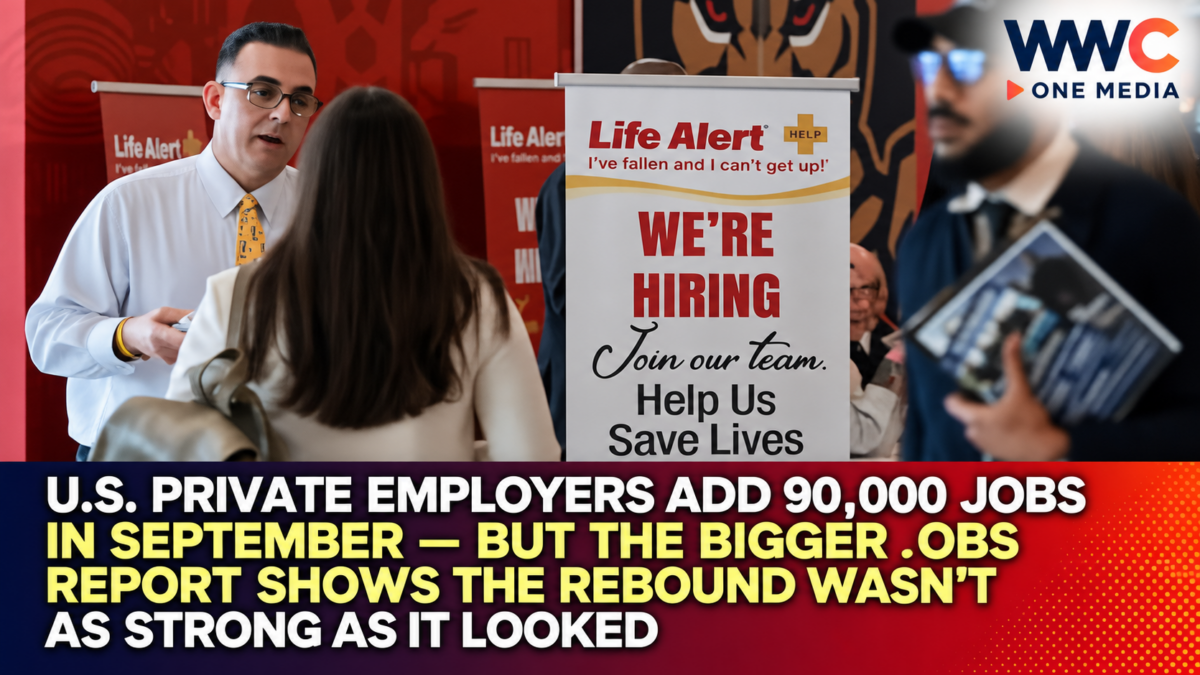
WASHINGTON — U.S. private-sector hiring appeared to rebound sharply in September, with employers adding 90,000 jobs according to ADP, beating expectations and snapping three months of weakening job growth. But official government data released days later painted a far less encouraging picture.
The ADP National Employment Report showed private employers added 90,000 jobs in September 2026, more than double the revised 36,000 gain in August and above economists’ expectations of around 70,000.
ADP Chief Economist Nela Richardson called it a strong report, saying hiring accelerated after three months of slowing employment growth while wage gains remained solid.
At first glance, the figures appeared to suggest the U.S. labor market was stabilizing.
But that optimism came with a major warning.
Two days later, the U.S. Bureau of Labor Statistics reported that the economy added only 29,000 total nonfarm jobs in September, while private payroll employment increased by about 46,000.
Unemployment also edged higher to 4.2%.
The difference shows why ADP’s report is best viewed as one labor-market indicator rather than a direct prediction of the official jobs number.
ADP Beat Expectations
Economists surveyed by Reuters had expected ADP to show about 70,000 new private-sector jobs.
Instead, employers added 90,000.
That made September ADP’s strongest hiring month since May and appeared to offer some reassurance after a prolonged hiring slowdown.
August’s initial estimate of 38,000 jobs was revised slightly lower to 36,000.
The September increase therefore represented a meaningful acceleration.
But the details reveal that hiring was concentrated in a relatively small number of industries.
Education and Health Care Did Most of the Heavy Lifting
The strongest sector was education and health services, which added 55,000 jobs.
Leisure and hospitality followed with 22,000 new positions.
Manufacturing added 17,000 jobs, while construction increased employment by 15,000.
Those gains helped offset weakness elsewhere.
Financial activities lost 16,000 jobs, while professional and business services shed 11,000.
Natural resources and mining lost another 1,000 positions.
The sector breakdown matters because healthy labor-market expansion is generally stronger when hiring is broad-based.
September’s ADP report showed growth, but much of it was concentrated in health care, education, leisure and hospitality.
Manufacturing Posted a Rare Gain
Manufacturing was one of the more interesting bright spots.
The sector added 17,000 jobs, according to ADP.
That was notable because American manufacturers have been navigating high borrowing costs, tariffs, elevated energy prices and uncertainty over global supply chains.
Construction also added 15,000 positions.
Together, goods-producing industries generated 31,000 jobs, while service-sector companies added 59,000.
For policymakers, stronger goods-producing employment can be encouraging because manufacturing and construction often provide relatively high-paying positions without requiring advanced academic credentials.
But one month does not establish a durable trend.
Medium-Sized Companies Led Hiring
ADP’s data also showed a striking difference by company size.
Businesses with 50 to 499 workers added 54,000 jobs, making medium-sized companies the biggest source of employment growth.
Small establishments added 23,000 jobs.
Large companies with at least 500 employees added just 14,000.
Within the medium-sized category, firms employing 250 to 499 workers alone created 36,000 positions.
That suggests the September rebound was not primarily driven by America’s biggest corporations.
Mid-sized businesses played the largest role.
The Northeast Dominated Regional Growth
Geographically, hiring was unusually concentrated.
The Northeast added 56,000 jobs, including 47,000 in the Mid-Atlantic region.
The South added only 11,000.
The West gained 17,000.
The Midwest added just 5,000.
Some regions actually lost employment.
The South Atlantic lost 10,000 jobs, while the Pacific region lost 1,000.
That uneven geographic pattern is another reminder that the headline 90,000 figure did not represent uniformly strong hiring across the country.
Workers Who Changed Jobs Still Got a Bigger Pay Raise
ADP’s wage data provided another important signal.
Median base pay for private-sector workers increased 3.2% from a year earlier.
Workers who stayed in their jobs saw base pay rise 3.0%, while people who changed jobs received a much stronger 4.8% increase.
Gross pay showed an even wider gap.
Job-stayers saw gross pay rise 4.4%, while job-changers recorded a 7.3% increase.
That suggests switching employers can still produce a meaningful wage premium.
But workers may be increasingly reluctant to take that risk because overall job opportunities have been shrinking.
Job Openings Fell Before the ADP Report
Labor Department data released one day before ADP showed U.S. job openings fell by 256,000 to 7.079 million in August.
The ratio of job openings to unemployed workers slipped to roughly 1.01, down from 1.06 in July.
That is dramatically below the post-pandemic peak, when there were roughly two open jobs for every unemployed worker.
The decline shows employers have become more cautious about expanding staff.
Yet layoffs remained low.
Businesses dismissed about 1.64 million workers in August, while weekly unemployment claims later fell to around 197,000, near their lowest levels in decades.
That combination has produced one of the most unusual labor markets in recent years.
Companies are not aggressively firing workers.
But they are also not aggressively hiring.
The ‘Low-Hire, Low-Fire’ Economy Is Still Intact
Economists increasingly describe the U.S. labor market as a low-hire, low-fire economy.
Workers who already have jobs generally remain employed.
But unemployed Americans and recent graduates have fewer opportunities to choose from.
That helps explain why consumer confidence fell sharply in September even before the official payroll report confirmed the slowdown.
The Conference Board found Americans were becoming noticeably less positive about job availability.
And the subsequent BLS report reinforced that concern.
The Official Jobs Report Was Much Weaker
This is the most important development since CNBC’s September 30 article was published.
On October 2, the Bureau of Labor Statistics reported that total nonfarm employment increased by only 29,000 jobs in September.
The unemployment rate rose from 4.1% to 4.2%.
Private-sector employment increased by approximately 46,000, roughly half ADP’s 90,000 estimate.
There was more bad news in the revisions.
July employment was revised from a 21,000 gain to a 10,000 decline.
August was cut from 162,000 to 133,000.
Together, those revisions removed 60,000 previously reported jobs.
That makes the overall employment picture significantly weaker than it looked when ADP released its report.
Why ADP and BLS Can Be So Different
The gap between 90,000 and 46,000 does not necessarily mean one report is “wrong.”
They measure employment differently.
ADP analyzes anonymized payroll information covering more than 26 million private-sector workers and produces its estimates with the Stanford Digital Economy Lab.
The BLS uses its own large employer survey and applies separate sampling, seasonal adjustments and statistical methodology.
ADP itself does not claim its report predicts the BLS number.
Reuters noted before the government release that the two series historically have not always moved closely together from month to month.
That is exactly what happened in September.
ADP detected a solid private-sector rebound.
The BLS found much weaker hiring.
Economists therefore usually focus on the trend across multiple indicators rather than relying on either report alone.
Wage Growth Is Cooling Too
The government report also showed wage growth losing momentum.
Average hourly earnings rose just 0.1% in September, reaching $37.81.
Year over year, wages increased 3.0%.
That slower wage growth could help reduce inflation pressure.
But it can also hurt households if consumer prices continue rising faster than paychecks.
ADP’s data similarly showed moderate base-pay growth of 3.2%.
Both reports therefore suggest that the extreme wage increases seen during the post-pandemic worker shortage are fading.
The Fed Is Watching the Same Contradiction
The labor-market debate has major consequences for the Federal Reserve.
The Fed recently raised its benchmark interest rate to 3.75%-4.00% as policymakers continued fighting inflation.
Before the official September jobs report, markets were still considering another October rate increase.
The ADP report alone could have supported the argument that the labor market remained strong enough to handle higher borrowing costs.
But the official BLS report changed that calculation.
Reuters reported that the much weaker 29,000 payroll gain caused markets to reduce expectations for another near-term rate hike.
That leaves the Fed facing competing risks.
Inflation remains above target.
But hiring is slowing substantially.
Raise rates too aggressively and the Fed could push a fragile labor market into deeper weakness.
Stop tightening too soon and inflation could remain elevated.
Markets Originally Saw ADP as a Positive Signal
When the 90,000 ADP figure arrived, financial markets interpreted it as evidence that the economy had not fallen into a major employment downturn.
The Nasdaq rose on September 30 while the S&P 500 slipped only modestly, as investors simultaneously processed employment data and softer-than-expected inflation figures.
At the time, the labor-market story appeared relatively reassuring:
hiring was improving,
pay was still rising,
and layoffs were unusually low.
Two days later, the BLS report complicated that story considerably.
That sequence demonstrates why markets can swing rapidly when multiple employment indicators arrive within the same week.
AI Could Become Another Labor-Market Wild Card
There is another longer-term uncertainty.
Artificial intelligence is attracting massive investment and supporting economic growth.
But businesses are simultaneously experimenting with AI systems that can automate administrative, analytical and customer-service work.
Reuters has noted growing concern that AI adoption could eventually contribute to workforce reductions in some occupations, even as data-center and technology investment supports employment elsewhere.
So far, there is no evidence of an economy-wide AI-driven layoff wave.
But slower white-collar hiring in professional and business services may become an increasingly important area to watch.
ADP reported an 11,000-job decline in that category in September.
September’s 90,000 Gain Was Encouraging — But Not a Victory
Taken by itself, ADP’s September report looked surprisingly strong.
Private hiring more than doubled from August.
Education and health services expanded.
Manufacturing and construction added jobs.
Pay growth remained positive.
And layoffs stayed low.
But the broader evidence now available makes it difficult to call September a genuine labor-market rebound.
The official government report showed only 29,000 total new jobs.
Unemployment increased.
Previous months were revised lower.
Job openings continued falling.
And consumers said finding work was becoming more difficult.
The most accurate description of the U.S. labor market may therefore be neither boom nor collapse.
It is stalling.
Companies still want to retain workers they already have.
They are just becoming increasingly cautious about hiring anyone new.
And that makes the next phase of the economy unusually dependent on one question:
Can businesses regain confidence and start hiring again before today’s low-hire labor market turns into a high-layoff one?