
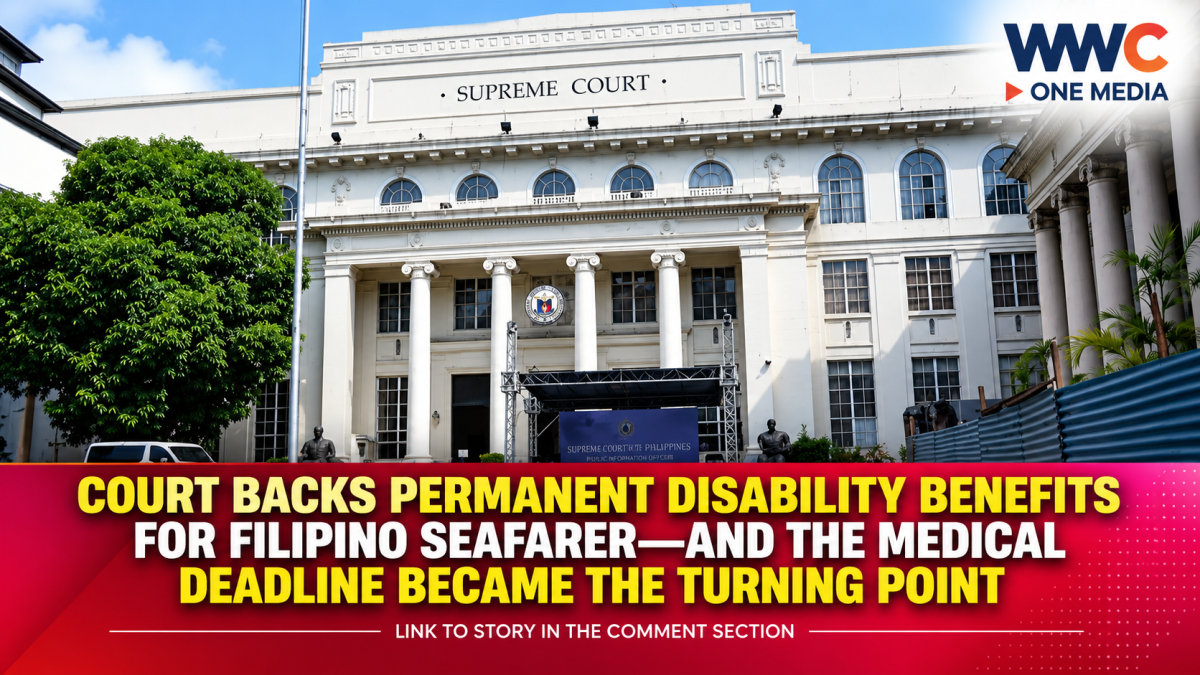
MANILA — The Court of Appeals has upheld an award of total and permanent disability benefits to a Filipino seafarer, emphasizing that employers cannot rely on an incomplete medical assessment when determining whether an injured or ill seafarer is fit to return to work.
The ruling adds to a growing body of Philippine jurisprudence stressing that medical evaluations in seafarer disability cases must be timely, final and definitive—a requirement that can have major financial consequences for maritime employers and manning agencies.
The Manila Standard reported the CA ruling, while decisions from the Supreme Court provide important context on how the rules governing these claims are applied.
The medical deadline can decide the case
Under established Supreme Court jurisprudence, a company-designated physician generally has 120 days from the seafarer’s reporting for medical treatment to issue a final assessment of the disability.
If additional treatment is genuinely necessary, the period may be extended to 240 days, but the employer must be able to justify that extension.
If no proper final assessment is issued within the applicable period, the disability may be considered total and permanent by operation of law.
That distinction is crucial.
A medical report that merely describes a patient’s condition or recommends continued treatment is not necessarily the same thing as a final and definite assessment determining whether the seafarer can return to work and, where applicable, the appropriate disability grading.
The Supreme Court has repeatedly stressed that the assessment must be complete enough to reflect the seafarer’s actual medical condition and capacity to resume employment.
Why the 120/240-day rule matters
The rule exists because a seafarer returning home injured or ill can be left in an uncertain position while medical treatment continues.
The Supreme Court has explained that:
- The company-designated physician should issue a final disability assessment within 120 days.
- If further treatment is medically justified, the period can be extended to 240 days.
- The employer bears the burden of showing why an extension was necessary.
- If a proper final assessment is still not issued within the extended period, the disability may become permanent and total by operation of law.
The rule therefore isn’t simply about counting days. The quality and finality of the medical assessment matter.
Employers cannot leave the seafarer in limbo
Recent Supreme Court cases reinforce that principle.
In Benhur Shipping Corp. v. Riego, the Supreme Court upheld total and permanent disability benefits after finding problems with the employer’s medical assessment. The Court emphasized that when the company-designated physician fails to provide a proper final assessment within the legally permitted period, the consequences can fall on the employer.
The Court also highlighted another important safeguard: when the seafarer’s own physician disagrees with the company-designated physician, the third-doctor procedure under the POEA-SEC becomes important in resolving the conflicting medical findings.
Once a seafarer properly requests referral to a third doctor, the employer cannot simply ignore that request. In Riego, the Supreme Court said the employer’s failure to act on valid requests for a third-doctor referral could be taken against it.
Disability is not judged solely by the injury itself
Another important point in Philippine labor jurisprudence is that “total disability” does not necessarily mean that a worker is completely helpless or physically incapacitated.
The courts have repeatedly examined whether the worker is actually capable of performing the occupation for which he or she was trained or accustomed to perform.
In an earlier Supreme Court ruling involving a seafarer, the Court explained that disability compensation is closely connected to loss of earning capacity, rather than simply the medical description of an injury. A worker may therefore qualify as totally disabled even without being completely paralyzed if the condition prevents the person from returning to the customary occupation.
A recent Supreme Court case shows how complicated these claims can become
The issue has continued to reach the Supreme Court.
In Ernesto D. Arriesgado v. Multinational Maritime Inc., decided on April 29, 2026, the Supreme Court partially reinstated an NLRC award involving a Filipino oiler whose injury occurred during a basketball game aboard a vessel.
The Court ultimately awarded US$60,000 in total and permanent disability benefits, along with a differential sickness allowance and nominal damages, while deleting attorney’s fees.
The Arriesgado case is particularly significant because it demonstrates that these disputes can involve several separate questions: whether an injury is work-related, whether the medical assessment was timely and definitive, which contractual provisions apply, and what level of compensation the seafarer is legally entitled to receive.
In that case, the Supreme Court also reiterated that sickness allowance, medical treatment and disability compensation are separate employer obligations under the applicable rules.
The benefit amount is not automatically the same in every case
It is important not to interpret a CA or Supreme Court ruling as establishing one universal payout for every Filipino seafarer.
The amount can depend on the applicable POEA-SEC, employment contract and collective bargaining agreement (CBA), as well as the nature and degree of disability.
For example, the Supreme Court’s 2026 Arriesgado ruling involved a claim for a higher amount under a CBA, but the Court ultimately awarded the US$60,000 benefit under the 2010 POEA-SEC rather than the larger CBA amount because the specific contractual requirements for the higher benefit were not established.
Other cases have produced different amounts. In a 2021 case, for example, the Court of Appeals affirmed a US$136,410 total and permanent disability award involving a Filipino seafarer, while removing one individual respondent from liability because he was merely an employee of the manning company.
That illustrates why each disability claim must be evaluated based on its own medical records, employment contract, CBA and applicable law.
What this means for Filipino seafarers
The latest CA ruling sends a potentially important message to Filipino maritime workers: medical paperwork and deadlines can be just as important as the underlying injury or illness.
A seafarer seeking disability benefits should carefully document:
- The date of repatriation and medical reporting;
- Medical examinations and treatment;
- Assessments issued by the company-designated physician;
- Any independent medical opinion;
- Requests for a third-doctor referral when medical opinions conflict; and
- The applicable employment contract and CBA.
At the same time, employers and manning agencies must comply with the medical-assessment procedures and cannot assume that an interim or incomplete report will automatically protect them from liability.
The Supreme Court has emphasized that the POEA-SEC, labor laws, employment contracts and applicable CBAs must be considered together when resolving these disputes.
The bigger issue for the maritime industry
The Philippines is one of the world’s major sources of maritime labor, making disability-benefit disputes especially significant for Filipino seafarers and the companies that employ them.
The continuing stream of cases reaching the courts shows that disagreements often arise not simply over whether a worker was injured or became ill, but over work-relatedness, medical assessment deadlines, disability grading and compliance with the procedures governing conflicting medical opinions.
For employers, the message is equally clear: medical assessments must be properly documented and completed within the applicable legal period.
For seafarers, the lesson is that a disability claim cannot safely be treated as a simple medical dispute. The legal and procedural requirements can determine whether a claim succeeds—and how much compensation is ultimately awarded.
WWC ONE MEDIA M.J.E




Leave a Reply