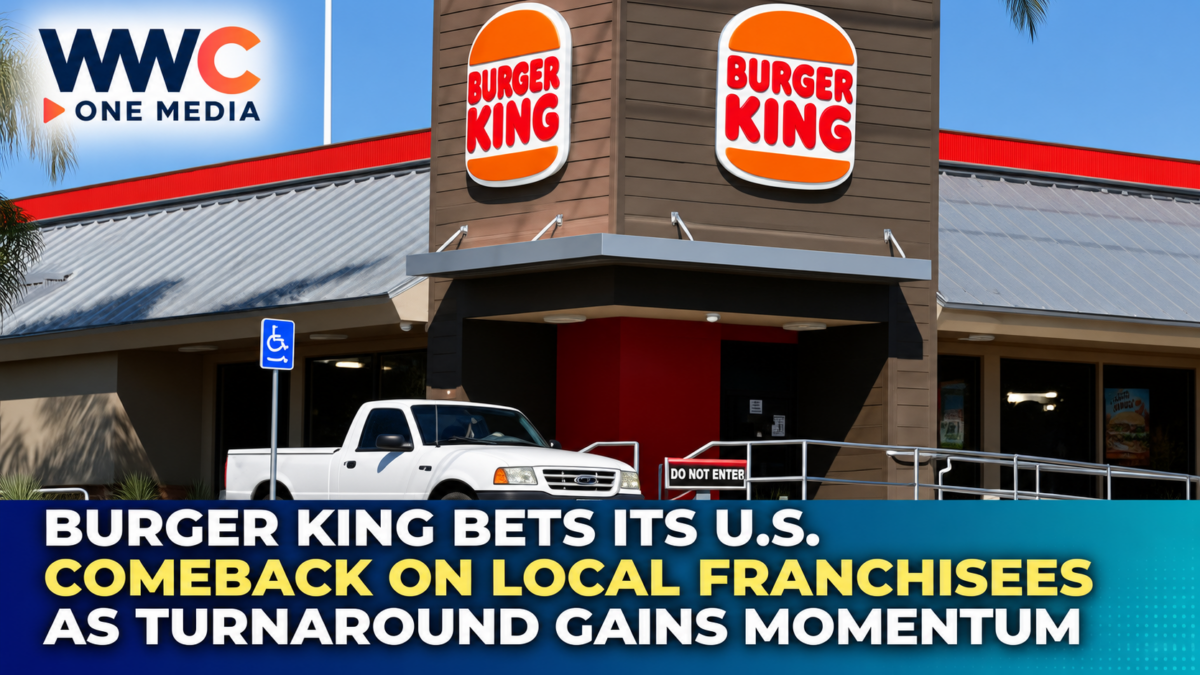
MIAMI — Burger King is betting that the next phase of its American comeback will not be driven from corporate headquarters, but by hundreds of local restaurant owners with their own money, reputations and communities tied to the business.
The fast-food chain is preparing to sell roughly 200 company-operated U.S. restaurants to franchisees by the end of 2026, accelerating a major restructuring that could leave parent company Restaurant Brands International directly operating only around 300 Burger King locations in the country.
Franchisees would operate virtually everything else across Burger King’s more than 6,000 U.S. restaurants.
But this is not simply an asset sale.
It is a strategic bet that smaller, locally involved operators can run individual Burger King restaurants more effectively than either a giant corporate owner or highly leveraged multi-state franchise groups.
And early evidence suggests the plan may be working.
Burger King’s U.S. same-store sales jumped 8.5% in the second quarter of 2026, one of its strongest performances in years, while new franchise operators are reporting significant increases in traffic and sales.
The broader turnaround has helped Burger King regain momentum against Wendy’s and begin narrowing the enormous gap separating it from McDonald’s.
BURGER KING PLANS TO SELL ABOUT 200 RESTAURANTS THIS YEAR
Burger King U.S. President Tom Curtis told CNBC that the company expects roughly 200 company-operated restaurants to be refranchised during 2026.
That is below an earlier target of around 300 restaurants.
But the direction has not changed.
Restaurant Brands International ultimately wants Burger King’s corporate-owned U.S. portfolio to shrink dramatically.
The company’s long-term steady-state target is approximately:
300 directly operated Burger King restaurants
located in a handful of strategically important markets.
The remaining thousands of locations would be owned and operated by franchisees.
That would return Burger King to the highly franchised, asset-light structure used by many of the world’s largest restaurant companies.
WHY DOES BURGER KING OWN SO MANY RESTAURANTS IN THE FIRST PLACE?
The answer goes back to one of the most important deals in Burger King’s turnaround.
Restaurant Brands International acquired Carrols Restaurant Group in 2024 for approximately $1 billion.
Carrols was Burger King’s largest U.S. franchisee.
The acquisition added 1,023 Burger King restaurants to Restaurant Brands’ corporate portfolio.
Before the acquisition, RBI already controlled roughly 175 company-operated Burger King locations, many acquired from troubled franchisees during restructurings and bankruptcies.
The result was unusual.
A company built around franchising suddenly found itself operating well over 1,000 Burger King restaurants directly.
But RBI never planned to keep most of them permanently.
BUY THEM, FIX THEM, THEN SELL THEM
The strategy was effectively:
Acquire restaurants
Improve operations
Modernize buildings
Strengthen economics
and then
Sell them back to stronger franchisees.
That makes the Carrols acquisition less like a permanent restaurant ownership strategy and more like a large-scale rehabilitation project.
Restaurant Brands believed many restaurants could perform better after receiving:
New equipment
Updated kitchens
Modern restaurant designs
Technology upgrades
and
Stronger operational support.
Once improved, those stores could be transferred to franchisees capable of running them for decades.
BURGER KING NOW WANTS LOCAL OWNERS
One of the most interesting parts of the strategy is who Burger King wants buying those restaurants.
For years, restaurant chains often favored massive franchise groups backed by private equity or other institutional investors.
Bigger operators had:
More capital
Larger management teams
and
Greater access to financing.
But Burger King is increasingly emphasizing something different.
Local involvement.
Curtis told CNBC the company wants franchisees who live and work in the communities they serve.
The theory is that someone personally invested in a local group of restaurants may pay closer attention to:
Food quality
Employee morale
Cleanliness
Customer complaints
and
Community reputation.
That can be harder when hundreds of restaurants are managed from a distant corporate office.
FRANCHISE AGREEMENTS CAN LAST 20 YEARS
Burger King views selecting franchisees as a long-term commitment.
Curtis noted that a typical Burger King franchise agreement lasts around 20 years.
That means choosing the wrong operator can create problems for decades.
An owner who underinvests in:
Maintenance
Staff
Equipment
or
restaurant remodeling
can damage the brand in an entire market.
For Burger King, refranchising is therefore not simply about finding whoever offers the highest purchase price.
The company wants operators with both capital and operational commitment.
ONE FORMER BURGER KING EXECUTIVE BECAME A FRANCHISEE HIMSELF
One example is Jeremy Kline.
Kline began working in restaurants as a teenager and eventually became Burger King North America’s director of franchising.
He later spent roughly two years trying to find buyers for a group of Burger King restaurants around Salt Lake City.
Eventually, he bought them himself.
In February, Kline acquired 16 Burger King locations in the Salt Lake City area.
His move illustrates exactly the type of operator Burger King increasingly wants:
someone with deep restaurant experience who understands both the corporate system and the local market.
THREE FORMER NEWK’S OPERATORS BOUGHT 20 FLORIDA RESTAURANTS
Another example comes from Florida.
Todd Jackson, Thomas Crowson and Colby Kaminer spent nearly two decades operating restaurants for fast-casual chain Newk’s Eatery.
Their company, CKJ Management, bought 20 Burger King restaurants in Florida in July 2025.
Their early results have been significant.
CKJ said sales in its market increased 21% year over year.
Traffic increased 16%.
Those figures represent one operator’s results rather than the entire Burger King system.
But they support RBI’s central theory:
better local operations can improve restaurant performance without relying solely on menu-price increases.
BURGER KING’S SAME-STORE SALES JUMPED 8.5%
The broader U.S. business is also showing momentum.
Burger King U.S. comparable sales increased 8.5% during the second quarter of 2026.
Comparable—or same-store—sales measure changes at restaurants open long enough to provide a meaningful year-over-year comparison.
That metric matters because growth can come from two sources:
opening new restaurants,
or
making existing restaurants perform better.
Burger King’s recent growth is increasingly coming from the second category.
Q1 WAS STRONG TOO
The second-quarter performance was not isolated.
Burger King U.S. comparable sales increased 5.8% during the first quarter of 2026.
That means the brand accelerated from an already solid start to the year.
Restaurant Brands CEO Josh Kobza described Burger King as a standout performer within the company’s portfolio.
That portfolio also includes:
Tim Hortons
Popeyes
and
Firehouse Subs.
For years, Burger King was often viewed as one of RBI’s biggest turnaround challenges.
It is increasingly becoming one of the stronger parts of the business.
IT STARTED WITH “RECLAIM THE FLAME”
The transformation began in earnest in 2022.
Burger King launched a strategy called:
Reclaim the Flame.
The original program committed $400 million to revitalize Burger King in the United States.
That included:
$150 million for advertising and digital investment
and
$250 million for restaurant technology, equipment, remodeling and physical improvements.
The objective was simple:
make consumers reconsider Burger King.
THE TURNAROUND EVENTUALLY BECAME MUCH BIGGER
The company later expanded its commitment.
Burger King announced another $300 million for its Royal Reset 2.0 restaurant modernization program.
RBI also planned roughly $500 million in improvements for hundreds of restaurants acquired through Carrols.
When the acquisition and related investments are considered together, the company has placed billions of dollars behind Burger King’s U.S. transformation.
This is no longer a short-term advertising campaign.
It is a multiyear restructuring of the entire system.
THE WHOPPER WAS PUT BACK AT THE CENTER
One of Burger King’s biggest strategic changes involved simplifying its identity.
The company returned attention to the Whopper.
Rather than continually attempting to compete through a flood of temporary products, Burger King began emphasizing the item most closely associated with the brand.
Its flame-grilled positioning provides a natural differentiator from competitors.
Burger King is continuing that strategy in 2026.
The company has announced planned Whopper improvements including:
New glazed buns
Creamier mayonnaise
and
upgraded packaging.
The goal is not to reinvent Burger King.
It is to make its signature product noticeably better.
REMODELING RESTAURANTS IS ANOTHER HUGE PART OF THE STRATEGY
Burger King has historically struggled with an aging U.S. restaurant base.
Many locations looked older than competing McDonald’s or newer fast-casual chains.
That matters more than it might seem.
Customers judge restaurants partly through:
Dining-room appearance
Bathrooms
Parking lots
Drive-thru speed
Digital ordering
and
overall cleanliness.
Burger King therefore made modernization a core pillar of its turnaround.
MODERN RESTAURANTS HAVE SHOWN STRONGER SALES
RBI’s investor materials have shown encouraging results from completed renovations.
Around 220 remodeled restaurants that had been reopened for at least six months were generating mid-teens percentage sales uplifts on average versus control locations.
That does not guarantee every renovation will produce the same result.
But it helps explain why Burger King and franchisees are willing to spend heavily updating stores.
A restaurant renovation becomes economically attractive if higher sales eventually repay the investment.
BURGER KING WANTS MOST U.S. STORES MODERNIZED
The long-term goal has been for roughly 85% to 90% of Burger King’s U.S. restaurants to meet modern image standards.
The modernization program includes Burger King’s newer Sizzle design.
That format places greater emphasis on:
Drive-thru traffic
Digital ordering
Pickup areas
and
more efficient restaurant operations.
That reflects how the fast-food business has changed.
Customers increasingly eat somewhere other than the restaurant dining room.
DIGITAL SALES NOW MATTER MUCH MORE
Burger King’s turnaround is also increasingly digital.
RBI reported that Burger King had surpassed a 20% digital sales mix in earlier turnaround disclosures.
Mobile ordering and loyalty programs allow restaurants to:
personalize offers
encourage repeat visits
collect customer data
and
reduce reliance on expensive third-party delivery platforms.
Digital loyalty has become increasingly important across the fast-food industry.
McDonald’s, Starbucks, Taco Bell and other large chains are all investing heavily in similar ecosystems.
BURGER KING IS ALSO INTRODUCING AI INTO RESTAURANTS
Restaurant Brands has introduced an AI-powered internal system called BK Assistant.
The tool is intended to help restaurant managers and employees quickly access information involving:
Operating procedures
Inventory
Compliance
and
restaurant guidelines.
Instead of searching through manuals or calling support teams, employees can potentially ask the AI tool questions directly.
The objective is to reduce administrative work and allow managers to focus more on customers and employees.
FRANCHISEE PROFITABILITY HAS IMPROVED
Restaurant Brands says average Burger King franchisee profitability has improved substantially since the turnaround began.
RBI previously said franchisee profitability fell to roughly $125,000 at one point.
It later recovered to around $205,000 in both 2023 and 2024.
The company says profitability continued improving in 2025 after adjusting for temporary beef inflation and advertising-fund transfers.
This metric matters enormously.
A franchisee making more money can afford to:
Remodel restaurants
Buy equipment
Pay employees
and
Open more locations.
A struggling franchisee does the opposite.
That is why Burger King treats restaurant economics as one of the most important indicators of whether its turnaround is sustainable.
TOP OPERATORS ARE MAKING EVEN MORE
RBI previously reported that its strongest “A-operators” generated average restaurant-level profitability above $275,000 in 2024.
That creates an important incentive.
Burger King can direct refranchising opportunities toward operators with stronger performance histories.
Those franchisees can then use profitable existing restaurants to finance additional locations.
It creates a potential cycle:
Better operators
lead to
better restaurants
which generate
better profits
which finance
more investment.
FRANCHISEES ARE PUTTING MORE MONEY INTO ADVERTISING
Another sign of confidence came from Burger King’s franchisees themselves.
Approximately 97% voted to continue contributing an elevated 4.5% of restaurant sales to the advertising fund through at least 2027.
That is meaningful because franchisees are voluntarily committing more of their revenue to marketing.
They would be unlikely to overwhelmingly support that investment if they believed Burger King’s strategy was failing.
The additional advertising gives the chain more ability to compete with significantly larger McDonald’s.
BURGER KING HAS RECLAIMED MOMENTUM AGAINST WENDY’S
One of the most symbolic signs of the turnaround came this summer.
CNBC reported that Burger King had moved back ahead of Wendy’s to become the second-largest burger chain in the United States by current system-sales momentum, trailing only McDonald’s.
The distinction needs context.
For full-year 2025, QSR industry data still ranked:
McDonald’s — $55.1 billion in U.S. system sales
Wendy’s — $11.9 billion
Burger King — $11.1 billion.
But their trajectories have since moved in opposite directions.
Burger King has reported accelerating same-store sales.
Wendy’s has struggled with declining traffic and has been closing underperforming restaurants.
That has allowed Burger King to reclaim the No. 2 position based on more recent performance.
MCDONALD’S IS STILL IN AN ENTIRELY DIFFERENT LEAGUE
Burger King’s comeback should not be confused with catching McDonald’s.
McDonald’s U.S. system sales remain several times larger than Burger King’s.
Its domestic restaurant network is also much larger.
So the realistic near-term competitive battle is not for first place.
It is about strengthening Burger King enough to become the unquestioned second major national burger platform.
Regaining that position would still be a major achievement given where the chain stood only a few years ago.
THE RESTAURANT INDUSTRY IS GETTING HARDER
The timing of Burger King’s refranchising effort creates another challenge.
Operating restaurants is becoming increasingly expensive.
Owners face:
Higher labor costs
Expensive beef
Insurance costs
Construction inflation
Interest rates
and
Consumers increasingly sensitive to menu prices.
Restaurant chains across the United States have responded by closing hundreds of weaker locations.
Wendy’s, Starbucks, Papa John’s, Pizza Hut, Jack in the Box and several other brands have all recently announced or executed significant closures.
That means Burger King is trying to recruit new operators at a difficult moment.
BEEF PRICES ARE A PARTICULAR PROBLEM
Burger chains are especially exposed to cattle prices.
Higher beef costs compress restaurant margins unless companies:
raise menu prices,
reduce portion sizes,
or
absorb the expense.
Burger King has said temporary beef inflation has pressured franchisee profitability.
That complicates its refranchising plans because potential buyers need confidence that restaurant economics will remain attractive after acquisition.
INTEREST RATES MATTER TOO
Most franchisees do not purchase restaurants entirely with cash.
They often borrow money.
Higher interest rates therefore raise the cost of:
Acquiring stores
Remodeling buildings
and
Purchasing equipment.
That can reduce how much buyers are willing to pay.
It is one reason Burger King’s refranchising program has moved somewhat slower than originally planned.
The company had targeted roughly 300 sales this year but now expects about 200.
WHY SELL THE RESTAURANTS AT ALL?
For Restaurant Brands International, refranchising has a major financial advantage.
A highly franchised business requires far less capital.
Instead of paying directly for:
Employees
Food
Utilities
Building maintenance
and
day-to-day operations,
RBI collects:
Royalties
Franchise fees
and other payments from operators.
That makes revenue smaller on paper because the franchisee records restaurant sales.
But the corporate business can become more predictable and less capital-intensive.
RBI WANTS TO BECOME EVEN MORE ASSET-LIGHT
Restaurant Brands has explicitly said it wants to simplify the company.
It plans to wind down its Restaurant Holdings reporting segment by the end of 2027.
That segment currently contains company-operated businesses created through acquisitions including the Carrols restaurants.
RBI expects refranchising and other restructuring to help reduce annual capital requirements.
The company forecasts free cash flow could rise from around $1.6 billion in 2025 to more than $2 billion annually by 2028.
That helps explain why the Burger King refranchising strategy matters to investors beyond restaurant sales.
THE COMPANY ALSO WANTS LOWER DEBT
Restaurant Brands is targeting corporate investment-grade leverage by 2028.
A more franchised Burger King system could help.
Selling restaurants provides cash.
Lower capital spending preserves cash.
Higher royalties from improving stores generate recurring cash.
That money can then be used for:
Debt reduction
Share repurchases
Dividends
or
future expansion.
Burger King’s turnaround is therefore connected directly to RBI’s broader financial strategy.
LOCAL OWNERSHIP COULD BECOME THE REAL TEST
Restaurant renovations and advertising are relatively easy to measure.
The hardest part of Burger King’s strategy may be selecting thousands of people who will operate the restaurants every day.
Corporate executives can design a perfect menu.
They can build an expensive advertising campaign.
They can remodel every building.
But the customer ultimately experiences Burger King through the person taking an order, preparing the food and running the restaurant.
That makes franchisee quality critical.
THE BIGGER STORY: BURGER KING’S COMEBACK NOW DEPENDS ON GIVING UP CONTROL
Burger King’s turnaround contains an interesting contradiction.
Restaurant Brands bought more than 1,000 restaurants so that it could gain greater control over the system.
Now it is deliberately giving most of that control back.
The difference is who receives it.
Burger King wants locally involved operators with stronger economics and a willingness to invest for the next 20 years.
Meanwhile, the company is upgrading restaurants, improving the Whopper, strengthening marketing and giving franchisees better technology.
The early numbers are encouraging:
8.5% U.S. comparable-sales growth
stronger franchisee profitability
double-digit sales gains at some refranchised markets
and
a renewed challenge to Wendy’s for the No. 2 position in American burgers.
But Burger King still operates in a brutally competitive industry where consumers are watching prices, restaurant costs are climbing and McDonald’s remains vastly larger.
That means the next phase of the comeback will not be determined in Burger King’s Miami headquarters.
It will be determined restaurant by restaurant.
Burger King spent billions taking control of struggling locations — now its comeback depends on whether handing them back to local owners can make them perform even better.