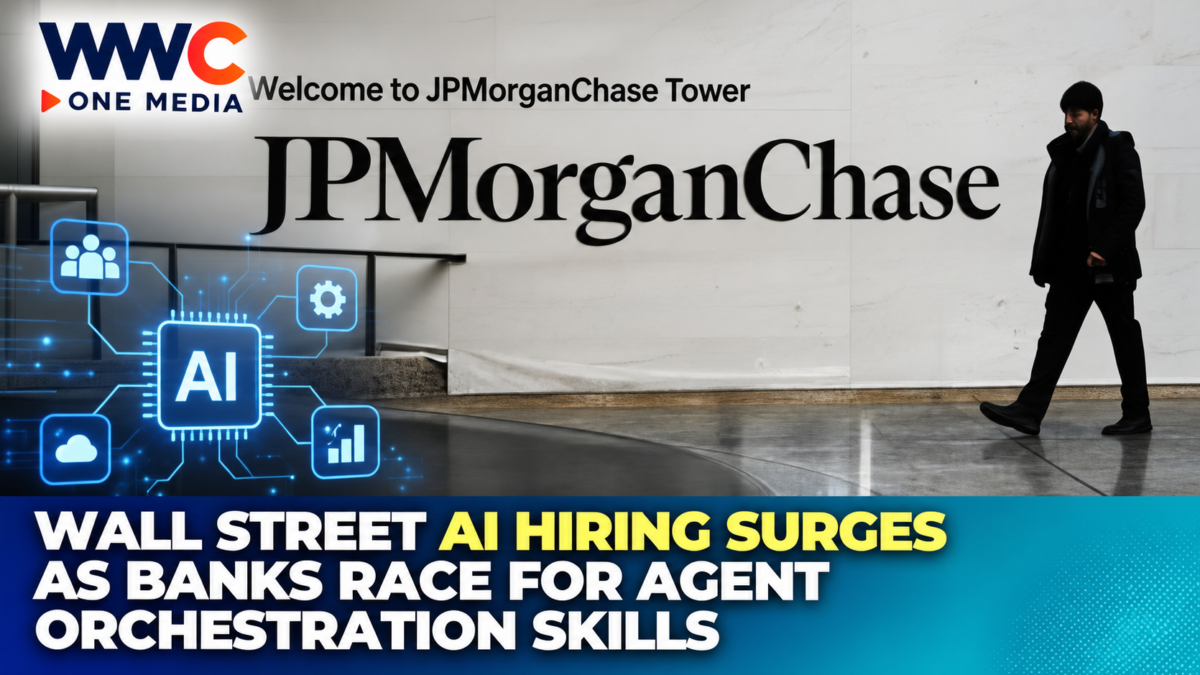
NEW YORK — Artificial intelligence is beginning to rewrite the Wall Street job description, but the first major effect may not be mass unemployment. Banks are hiring tens of thousands of AI-related workers, retraining existing employees and searching for a new class of technologists capable of coordinating teams of autonomous AI agents.
AI-related job postings across major financial institutions including JPMorgan Chase, Citigroup and Capital One rose 49% in 2026 to 139,819 listings, according to an analysis by enterprise workforce-data company Draup that was provided to CNBC.
But one skill is growing dramatically faster than the rest:
agent orchestration.
References to the skill in job listings jumped 1,721% this year, according to Draup.
Agent orchestration refers to designing and managing multiple specialized AI agents that work together on a larger task.
Instead of one chatbot answering a question, several AI systems might independently:
research data
analyze risk
prepare documents
check compliance
and
execute follow-up tasks.
One human employee may ultimately supervise the entire chain.
That is why Wall Street’s AI race is quickly becoming a workforce story as much as a technology story.
139,819 AI-RELATED FINANCE JOB POSTINGS
Draup’s analysis found nearly 140,000 AI-related job postings at major banks and financial companies in 2026.
That was up 49% from 2025.
The surge appears counterintuitive.
AI is frequently discussed as technology that could eliminate white-collar jobs.
But before it removes some positions, banks first need thousands of people capable of building, deploying, securing and monitoring the systems.
That is creating demand for:
AI engineers
machine-learning specialists
data scientists
AI governance experts
cybersecurity specialists
and
forward-deployed engineers.
The hiring wave shows that Wall Street is moving beyond simply experimenting with ChatGPT-style tools.
Banks increasingly want AI embedded directly into how they operate.
AGENT ORCHESTRATION DEMAND JUMPED 1,721%
The fastest-growing category identified by Draup was agent orchestration, with demand rising 1,721%.
Draup CEO Vijay Swaminathan described it as one of Wall Street’s hottest skills.
The reason is simple.
The banking industry increasingly expects future AI systems to operate as teams rather than standalone assistants.
For example, an investment-banking workflow could involve separate agents for:
company research
financial-model analysis
regulatory review
presentation creation
and
client preparation.
One orchestration layer would coordinate those agents and decide which system performs each task.
Humans would remain responsible for oversight and judgment.
But much of the preparation work could happen automatically.
WALL STREET IS MOVING FROM CHATBOTS TO AI AGENTS
Banks have spent the past several years rolling out internal chatbots.
The next phase is different.
AI agents can potentially take actions instead of simply producing answers.
JPMorgan Chase describes agentic AI as a structural change because agents can make decisions and interact with other systems rather than only generate information.
That creates enormous productivity potential.
It also creates new risks.
If an AI agent is allowed to access:
customer information
trading systems
payment infrastructure
or
internal databases,
banks need to know exactly what it is doing.
That means the demand for AI workers is expanding in two directions:
people who can build the systems,
and people who can control them.
CITI IS ALREADY BUILDING AN INTERNAL AI-AGENT PLATFORM
Citigroup provides one of the clearest examples.
In April, Citi introduced Arc, an internal platform that allows developers to create and scale AI agents throughout the bank.
Citi says the agents will handle tasks including:
research
information synthesis
preparation
and
execution.
The bank says more than 80% of its roughly 180,000 employees with access to Citi AI tools use them regularly.
That is a significant adoption level.
Citi gave one example involving wealth management.
Today, a banker might spend hours gathering:
portfolio data,
market information,
client records
and scenario analysis.
In the future, several AI agents could prepare most of that information automatically before the client meeting.
The human banker then spends more time advising the client.
Citi describes the evolving role as moving from coordinator to architect and advisor.
JPMORGAN IS ALSO DEPLOYING AI ACROSS ITS WORKFORCE
JPMorgan Chase is pursuing a similar strategy.
The bank has rolled out internal AI tools including its LLM Suite and an employee assistant designed to help staff search information and take actions across the company.
JPMorgan says AI is being used to remove repetitive work while allowing employees to spend more time on higher-value tasks.
In one internal technology program, the bank said an AI-enabled workflow had already been deployed to about 3,000 employees, with another 3,000 to 5,000 people potentially able to benefit from it.
Executives described the goal as removing “no-joy work” from employees’ daily routines.
That phrase captures much of Wall Street’s near-term AI strategy.
The earliest targets are not usually entire jobs.
They are repetitive pieces of jobs.
WHAT AI CAN REMOVE FROM A BANKER’S DAY
Many junior finance jobs involve extremely repetitive tasks.
An investment-banking analyst may spend hours:
formatting PowerPoint slides
updating financial models
reviewing filings
searching transactions
building comparable-company tables
and
summarizing documents.
AI can increasingly automate large portions of that work.
A system might scan hundreds of company filings in seconds.
It could extract financial data.
It could compare valuation multiples.
It could produce the first draft of a presentation.
A junior banker would then verify, adjust and interpret the results.
The result could dramatically increase how much work one employee can handle.
THAT COULD CHANGE THE WALL STREET CAREER LADDER
This raises a deeper question.
Wall Street has traditionally trained senior bankers through years of junior-level work.
Analysts learn by spending long nights building:
models
pitch books
company analyses
and
transaction materials.
Those tasks can be tedious.
But they also teach employees how deals and companies work.
If AI automates large parts of that apprenticeship, banks may need to rethink how young bankers acquire experience.
The analyst role may gradually shift from:
producing information
to
checking, interpreting and presenting information generated by machines.
That requires a different skill set.
BANKERS MAY NEED TO BECOME AI SUPERVISORS
The emerging Wall Street worker may not need to be a full-time software engineer.
But understanding how to direct AI systems could become essential.
Employees increasingly need to know:
which AI tool to use
how to ask the right question
how to verify the answer
how to coordinate several agents
and
when human judgment is still necessary.
That is why AI literacy is spreading beyond technology departments.
It is becoming a business skill.
FORWARD-DEPLOYED ENGINEERS ARE ANOTHER HOT ROLE
Another position gaining importance is the forward-deployed engineer.
These employees sit between pure technology teams and business departments.
They understand enough software engineering to build AI systems.
But they also understand specific business areas such as:
trading
investment banking
wealth management
risk
or
compliance.
Their job is to take AI technology and integrate it into actual workflows.
That is especially important in banking because the same AI system cannot simply be dropped into every department.
A trading desk has very different requirements from a mortgage business.
A compliance team has different risks from an investment banker.
Banks therefore need technologists who understand both software and finance.
AI GOVERNANCE DEMAND IS EXPLODING TOO
The AI hiring boom is not only about building systems.
Demand is also increasing rapidly for people who can govern them.
Job-posting references to:
responsible AI
AI governance
and related risk skills have risen sharply, according to Draup data cited in coverage of the CNBC report.
That makes sense.
Banks operate in one of the most heavily regulated industries in the world.
An AI mistake can potentially create:
financial losses
privacy violations
biased lending decisions
compliance breaches
or
cybersecurity problems.
An AI agent making autonomous decisions therefore requires strict monitoring.
BANKS CANNOT ALLOW AI TO BECOME A BLACK BOX
Financial regulators generally expect banks to understand how important systems make decisions.
That becomes more difficult with generative AI.
Large language models can produce unpredictable outputs.
Agents can also interact with multiple systems in ways developers did not explicitly script in advance.
JPMorgan argues that autonomous and semi-autonomous AI agents need runtime controls and detailed records showing:
what the agent did
what authority it had
and
why actions were taken.
That creates an entirely new category of financial technology governance.
CYBERSECURITY BECOMES EVEN MORE IMPORTANT
An AI agent connected to corporate systems can also create a new attack surface.
Hackers could attempt to manipulate the agent through:
malicious prompts
compromised data
stolen credentials
or
third-party software vulnerabilities.
The more authority an agent has, the greater the potential damage.
A read-only AI assistant is relatively limited.
An agent capable of initiating transactions or modifying systems is much more powerful.
That is why banks are simultaneously hiring AI builders and AI-security specialists.
GOLDMAN SACHS NOW HAS MORE THAN 12,000 ENGINEERS
Goldman Sachs is also expanding its technology workforce.
The bank recently opened a new engineering office in Bellevue, Washington, capable of housing more than 125 employees focused on AI and cloud technology.
Goldman says it now employs more than 12,000 engineers globally, representing about one-quarter of its workforce.
That statistic illustrates how dramatically Wall Street has changed.
A modern investment bank is increasingly also a giant software company.
Trading systems, risk engines, digital banking, data infrastructure and AI all require large engineering teams.
GOLDMAN’S OPERATING MODEL IS BEING REBUILT AROUND AI
Goldman launched an initiative known as One Goldman Sachs 3.0, aimed at redesigning operations around automation and artificial intelligence.
The bank says AI productivity gains could allow it to scale operations and redirect resources toward higher-value activities.
This is important because AI adoption is no longer being treated simply as another IT project.
Banks are beginning to reorganize workflows around the assumption that AI will become permanently embedded inside the company.
That could eventually influence:
staffing levels
management structures
office locations
and
compensation.
AI COULD REDUCE SOME FINANCE JOBS
The hiring boom does not mean every existing job is safe.
Goldman Sachs economists estimate that AI has already created a modest drag on U.S. employment.
Their research estimates AI reduced monthly payroll growth by roughly 16,000 jobs over the past year and increased the unemployment rate by around 0.1 percentage point.
Another Goldman analysis estimates roughly 300 million jobs globally have some exposure to AI automation over the longer term.
That does not mean all those jobs disappear.
Many will be partially automated instead.
But finance contains exactly the type of work AI handles increasingly well:
documents
numbers
research
analysis
and
structured workflows.
That makes Wall Street particularly exposed.
ENTRY-LEVEL JOBS MAY FEEL THE CHANGE FIRST
The most vulnerable tasks are often those performed by junior employees.
AI can already:
read financial statements,
summarize earnings calls,
generate spreadsheet formulas,
write basic computer code,
create presentation drafts
and compare large sets of financial data.
Those activities previously consumed much of an analyst’s time.
Banks may eventually need fewer analysts to produce the same amount of work.
But they could also use the productivity gains to handle more clients and transactions.
Which outcome dominates remains uncertain.
THERE IS NOT YET EVIDENCE OF A WALL STREET “AI JOB APOCALYPSE”
This distinction matters.
Despite dramatic predictions about AI eliminating white-collar jobs, broad evidence of mass displacement is still limited.
Reuters Breakingviews noted recently that while AI adoption has moved quickly, economy-wide productivity gains remain modest so far.
Goldman’s own labor research similarly suggests AI has produced a measurable but still relatively small impact on overall employment.
The immediate change is therefore more accurately described as:
job redesign
rather than
job extinction.
BANKS MAY HIRE FEWER PEOPLE FOR THE SAME OUTPUT
The bigger long-term effect could come through hiring.
A bank may not need to fire thousands of workers immediately.
Instead, it could simply replace fewer people who leave.
If a team of 20 employees becomes capable of doing the work previously handled by 30, management can reduce headcount gradually through:
attrition
retirement
and
slower hiring.
That is already occurring in some parts of global banking.
Reuters Breakingviews reported that several large Indian banks are beginning to reduce staff through attrition as automation expands in areas such as credit analysis, customer service and fraud monitoring.
Wall Street could follow a similar model.
AI COULD ALSO CREATE MORE REVENUE
There is another possibility.
Productivity improvements do not always eliminate workers.
Sometimes lower costs allow companies to expand.
If AI enables a wealth adviser to serve twice as many clients, the bank might use that capacity to grow the business instead of cutting staff.
Morgan Stanley recently argued that AI could significantly expand adviser capacity in wealth management.
That could increase the number of customers receiving personalized financial advice.
In that scenario, AI becomes a growth tool rather than simply a cost-cutting tool.
FINANCIAL ADVISERS COULD BECOME MORE PRODUCTIVE
Wealth management is one area where AI could dramatically change the economics.
Advisers spend substantial time on administrative work:
portfolio analysis
meeting preparation
research
documentation
and
follow-up communication.
AI can automate much of that.
The adviser can then spend more time speaking with clients.
That model is exactly what Citi describes with its Arc agent platform.
The human job becomes more focused on:
trust
relationships
judgment
and
complex advice.
Those are areas where humans still have significant advantages.
HUMAN JUDGMENT REMAINS CRITICAL IN HIGH-STAKES FINANCE
Banks operate in situations where small mistakes can have enormous consequences.
An AI-generated mistake in a casual email may be annoying.
An error in:
a billion-dollar acquisition model
a trading decision
a credit approval
or
a regulatory filing
can be far more serious.
That means humans will likely remain responsible for final decisions for the foreseeable future.
AI can prepare the analysis.
But accountability still sits with employees and executives.
WALL STREET’S BIGGEST SKILL MAY BECOME KNOWING WHEN NOT TO TRUST AI
That may ultimately be the most valuable capability.
AI can produce extremely confident answers that are wrong.
Financial professionals therefore need the ability to challenge outputs.
The strongest employees may be those who understand both:
finance deeply enough to recognize mistakes
and
AI well enough to know why the mistake happened.
That hybrid skill set is likely to become increasingly valuable.
SALARIES FOR AI TALENT REMAIN HIGH
Banks are also competing directly with technology companies for engineers.
Coverage based on Draup’s data shows generative-AI management roles can command median base compensation around $190,000, with specialized engineering roles potentially paying significantly more depending on experience.
That creates another challenge.
A bank hiring an elite AI researcher may be competing against:
OpenAI
Anthropic
Meta
and
Microsoft.
Technology companies can often offer enormous compensation packages.
Financial firms therefore have to convince engineers that banking offers unique problems, valuable data and the opportunity to deploy systems at massive scale.
WALL STREET IS BECOMING A TECHNOLOGY INDUSTRY
The transformation is broader than generative AI.
Modern banks already depend heavily on:
cloud computing
automated trading
cybersecurity
data engineering
quantitative modeling
and
software development.
AI accelerates that shift.
The traditional image of Wall Street as a business dominated entirely by traders and bankers is increasingly outdated.
Thousands of the most important employees now write code.
At Goldman, engineers already represent roughly one-quarter of the workforce.
That share could continue increasing.
THE BIGGER STORY: AI MAY NOT ELIMINATE WALL STREET JOBS — BUT IT COULD ELIMINATE THE OLD WALL STREET JOB DESCRIPTION
The most striking number in the CNBC report is not necessarily the 49% increase in AI-related hiring.
It is the 1,721% increase in demand for agent orchestration.
That statistic reveals where the industry believes work is heading.
Banks do not simply want employees who know how to use a chatbot.
They want people who can build teams of AI systems and integrate them into real financial operations.
That could fundamentally change who succeeds on Wall Street.
Tomorrow’s top investment banker may still need to understand companies, markets and clients.
But that banker may also supervise AI agents conducting research, building models and preparing transactions.
Tomorrow’s risk officer may monitor automated systems.
Tomorrow’s compliance employee may investigate decisions made partly by AI.
And tomorrow’s engineer may sit directly inside an investment-banking or trading team.
Artificial intelligence may eventually reduce the number of people needed for some tasks.
But right now, Wall Street is racing to hire the people who can make that transformation possible.
The bigger question is what happens once those systems are fully built:
Will AI simply make bankers dramatically more productive — or will banks eventually decide they need far fewer bankers at all?